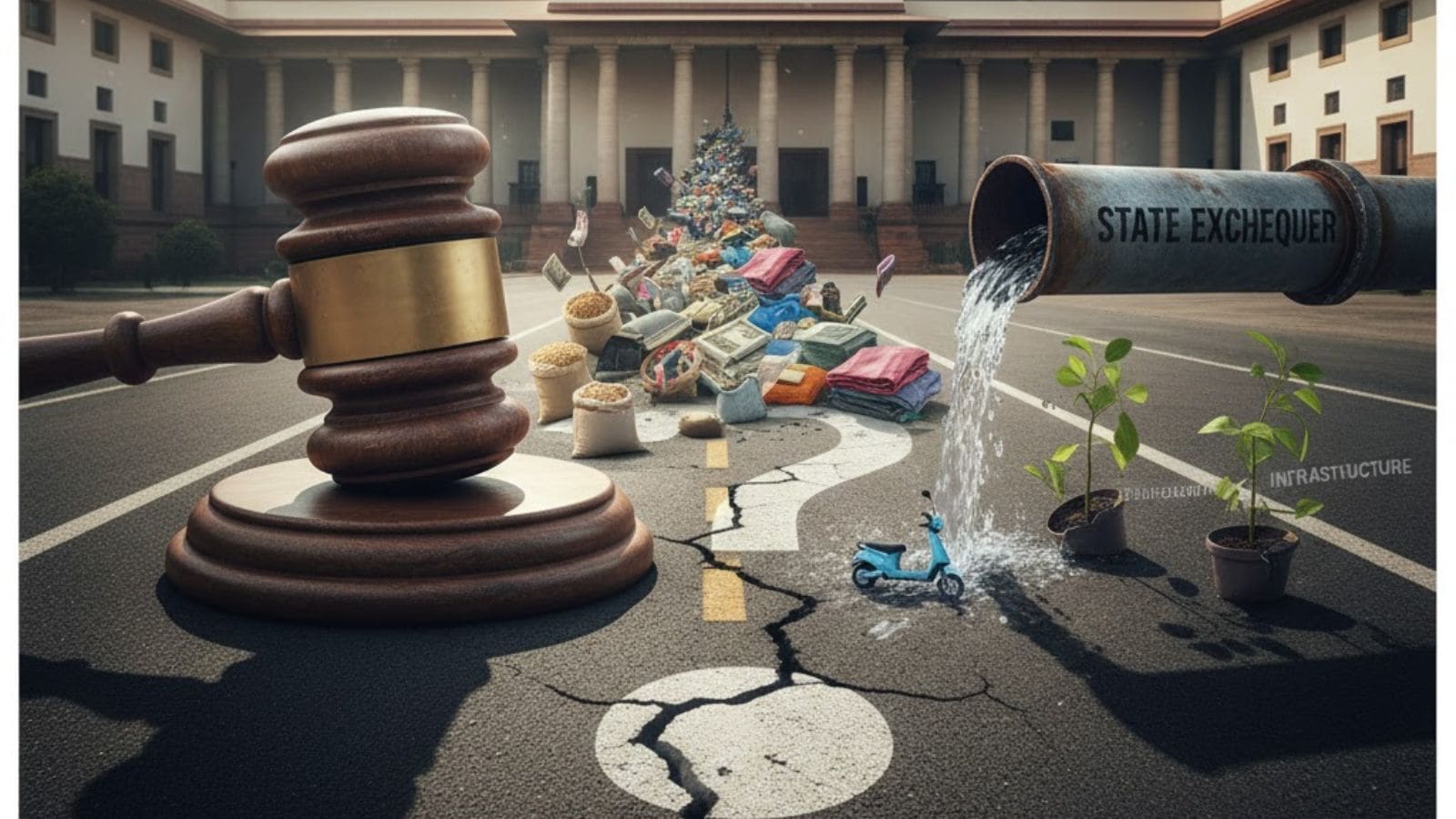
The Supreme Court Thursday slammed the practice of political parties and elected governments announcing freebies and direct cash transfers to woo voters ahead of elections, wondering if it would not amount to appeasement and asking how long the trend, which will only hamper the country’s development, can go on.
A three-judge bench presided over by Chief Justice of India Surya Kant suggested that governments seeking to provide subsidies should include them in their planned expenditure.
The bench, also comprising Justices Joymalya Bagchi and Vipul M Pancholi, was hearing a writ petition filed by the Tamil Nadu Power Distribution Corporation Ltd challenging Rule 23 of the Electricity Amendment Rules, 2024. The Rule provides that the tariff must be cost-reflective and that there should be no revenue gap between the approved annual revenue requirement and the estimated annual revenue from the approved tariff, except in situations of natural calamity.
The Corporation, a distribution licensee, wholly funded by the Government of Tamil Nadu, said it is “operating under explicit public welfare and socio-economic policy directives” issued by the government under Sections 65 and 108 of the Electricity Act, 2003. “The Impugned Rule, if implemented, would result in an exponential tariff shock, adversely affecting electricity consumers and placing an unsustainable burden on the public exchequer,” it said.
Issuing notice to the Centre, the CJI touched on the free power distribution by state governments without distinction between those who can afford and those who cannot and asked, “Is it in the public interest that…the state is absorbing all these?”
CJI Kant said he was not speaking only about Tamil Nadu, but about the whole of India. “What kind of culture are we developing? What is the distinction between persons who are capable of paying electricity charges and persons who are marginalised or below poverty line? It is understandable that as part of welfare scheme or your constitutional commitment as a welfare state, you want to provide them. But without drawing any distinction between those who can afford and those who cannot afford, if you start giving, will it not amount to a kind of a appeasing policy?”
Pointing out that it is happening across the country, the CJI said, “Sometimes we are really disturbed.”
Story continues below this ad
He added, “Even if you are a revenue surplus state, is it not your obligation to spend that amount for the development of the overall public, to develop infrastructure, hospitals, roads, schools, medical colleges? Instead of that, you keep on giving scooty, distribute food, distribute clothes, and people at the time of elections enjoy everything. What is happening in this country?”
The CJI said, “It is understandable that there are some people who cannot afford and they have to be provided. There are children who cannot afford education, they have to be provided…It is the state’s duty…The society should welcome it. But the persons who…are simply enjoying despite all means available, and are affluent and therefore any such kind of freebie first comes to their pocket, is it not the high time for the states to revisit these policy frameworks?”
‘There must be some profit element’
On the challenge, CJI Kant said, “If suppose it was directed that while generating or distributing power, there must be some profit element also, you could say we don’t require any profit because it will be coming mostly from the pockets of the poor, etc., and we will generate our revenue from those who can afford to pay. That’s understandable. This simply says please go by the cost-reflective consideration. Whatever you are incurring the expenditure in generating and supplying up to the doorstep, please ask them to take that much on them. So that people also have a sense of some savings, some discipline in their lives.”
The CJI said, “We know states where every power is free supplied, even if you have all the facility, you are getting free power supply. Therefore, you can leave your electrical instruments on all the time.”
Story continues below this ad
Senior Advocate Gopal Subramaniam, appearing for the Corporation, said, “The gap between revenue and expenditure has expanded over the years. In TN itself, it is touching about 50 odd thousand crores which the government is actually absorbing. Now…what happens is by implementing the new rule which has been inserted by the central government, the effect is you will have to pass on this tariff, this gap, in subsequent tariffs to the consumers. That is why this petition has been filed.”
The CJI said, “If someone wants to avail a faciltiy, the principle should be very clear, you pay for it. That’s the universal principle. If as a state you are asked to add element of profiteering, understandable, you will not do that. Because you are not doing business. You are only providing a basic amenity for the public at large.”
Show statesmanship, says Supreme Court
“But this is at whose cost? This money that you are saying you are spending, from where the state will get the money? The other tax payers’ money? Is it not their money? Are people not expecting you to construct some roads, hospitals and other facilities for them when they are paying for it? You are taking money from x,y,z and paying a,b,c, only because….we are not speaking of Tamil Nadu alone….there are matter pending before us”, said the CJI. The court was referring to petitions challenging freebies which are pending before it.
CJI Kant asked, “Why shouldn’t state governments have that much statesmanship?”
Story continues below this ad
The CJI said, “We know what is happening in the nearest places where the last elections happened. Why are schemes suddenly announced?”
He added, “High time that all political stalwarts, leaders, parties… social engineers, they need to revisit everything. We will be hampering the development of the nation if we keep on having this largess distribution. There has to be a balance. You can have long term plan. You know children of a certain area will not have good education unless we provide…give them scholarships, give them good schools.”
“Make sure their parents have some kind of vocational employment so that they don’t send children to work. Create that environment, that’s what needed the country. Give them good hospitals so that they don’t have to rely on private hospitals which charge exorbitant amounts….But how long this will continue?”
The court also pointed out that the state had not filed any affidavit stating where it is going to divert the funds from.
Story continues below this ad
The CJI said, “What should be the format of the welfare scheme, how it should be given, implemented, it is all for the political wisdom, for elected government to decide. Our worry is that states are running in deficit and still giving all these. From where all this money is coming?”
Justice Bagchi said, “If you see the scheme of the Electricity Act, it does not make a difference between a distribution or a generating company, which is a public utility company or a private company apart from certain subsidies or certain concessions given in advance. So if you wish as a state to give some subsidy, you ought to give an advance and that can be considered in the subsequent tariff regime. So the people who suffer because of the tuning up of the tariff will get rebate in the subsequent tariff fixed by the commission. This is the scheme.”
He added, “The Chief Justice is saying that if you had a planned financial outline, you should’ve given the subsidy in advance. That these are my public utility I am giving X subsidy. Then the (TN Electricity) Regulatory Commission…would be fully aware that this is a subsidy so that the generating company cannot claim a shortfall because their approved revenue requirement has gone down to that extent. But you don’t do it. After the time, if you suddenly give them a largess….”.
The CJI said, “Most of the states are revenue deficit. How many states are revenue surplus? But only because of these policies they are compelled to do that and then they don’t have a single penny for development. They keep collecting the tax for the whole month only for two things want to pay salaries and two for this kind of things.”
Story continues below this ad
Planned expenditure vs non-planned expenditure
Appearing for the Regulatory Commission, Senior Advocate P Wilson pointed out that Article 39 (b) dealing with directive principles of state police says that the ownership and control of the material resources of the community are so distributed as best to subserve the common good.
Justice Bagchi said, “If you take a welfare policy and as you say it is part of the directive principles, the courts have no headache on that. What we are really concerned and what this Article 32 petition really throws up this issue is planned expenditure versus non-planned expenditure. If you wish to have welfare schemes, put it as a part of your budgetary proposals and give justification as to this is my outlay on planned education. This is my outlay on unemployment people giving them advantage through any monetary schemes, but you don’t do it as in this case.”
The judge added that the desire to provide free electricity is “definitely not unwelcome. But the manner in which that desire is being enforced create a sense of arbitrariness in the fiscal administration. Laws which are within your domain, you can control but agencies which are regulated by the statute like electricity commission and the price of electricity, how can we interfere there? Just because the status suddenly decided to open its purse a bit more?”
The CJI said, “The state’s endeavour should be to create avenues for employment for the people so that they can earn and maintain the dignity and self-respect. If you start giving right from the morning free food, free gas, free cycle, free scooty…and it’s not one state we are speaking about, there are several states. And now we have reached a state where in the name of welfare schemes, you are directly transferring cash in their account. Why the people should work then? From where they are going to learn the work when they know everything I will get on a platter? Is this the nation-building we are doing?”