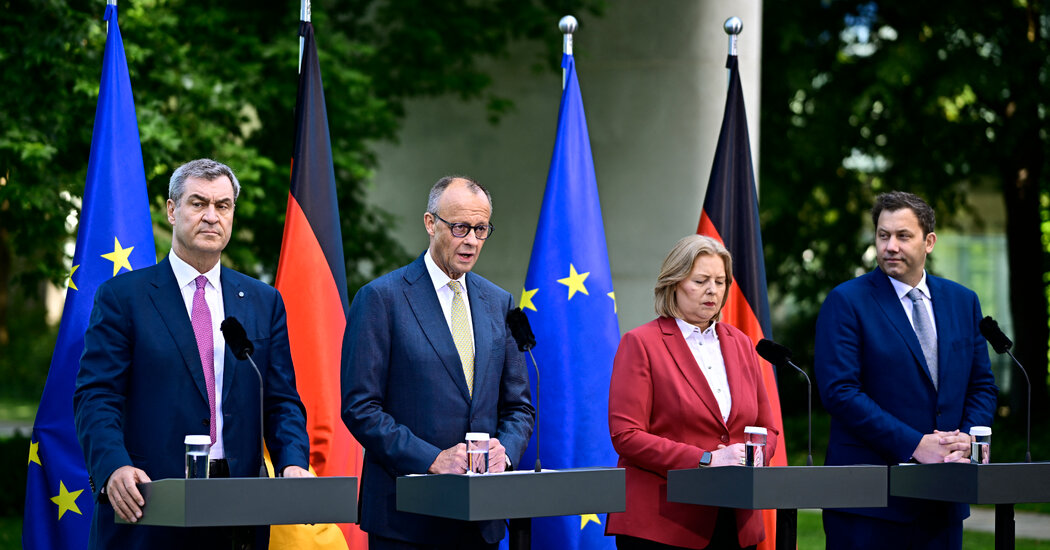
German leaders said on Thursday that they had reached a long-sought agreement meant to reinvigorate their country’s faltering economy, betting on the power of compromise to lift the national mood and stop the surge of the far right.
Friedrich Merz, the German chancellor, and his governing partners said that their 34-point package would loosen labor laws, shore up pension plans, reduce regulation and bureaucracy, and cut taxes for the middle class, while raising top tax rates for high earners.
It was a potentially landmark move from the centrist parties that have dominated German politics since World War II. The parties face a serious challenge from the far-right party Alternative for Germany, or AfD, amid national anxiety over the economy and immigration.
The agreement was also an act of political desperation, with broad implications for mainstream parties across Europe who face similar difficulties in fighting off hard-line opponents.
The package includes politically painful trade-offs that are likely to upset key interest groups on the left and the right, including labor leaders and wealthy business owners. But Mr. Merz, of the center-right Christian Democrats, and his center-left partners, the Social Democrats, said on Thursday that the sum total of the deal was ambitious enough to shock the German economy out of its yearslong doldrums.
“We were all in agreement that things cannot continue as they have in the past,” Mr. Merz said at a morning news briefing in the garden of the chancellery. “We all agree that the political center must prove itself here and now: We are shaping our country, we are modernizing our country and we are leading our country into the future.”
Before coming into effect, the agreement will have to be turned into legislative text and then survive votes in Parliament, which are planned by the end of the year. The main provisions include tax breaks that could total nearly $700 a year for a middle-income family of four by 2028, offset by increased tax rates for some high earners and an overhaul of public pensions, including an increase in the retirement age. Those changes are meant to shore up a public retirement system that will be strained in coming years by Germany’s aging work force.
Other measures are intended to reduce bureaucracy, combat welfare fraud and allow bakeries to be open longer hours.
Economists said the plans that could provide the biggest economic boost were focused on encouraging Germans to work more. They include additional flexibility in the hours employees can work in the course of a week and new restrictions meant to crack down on abuse of sick leave, which German workers utilize at relatively high rates.
“The reform package is an important contribution to overcoming Germany’s economic stagnation,” said Clemens Fuest, president of the Ifo Institute for Economic Research in Munich, who has criticized the government’s economic policies in the past. But, he added, “further measures will be necessary.”
The biggest effects, in the short term, could be political.
Mr. Merz won office last year on a promise to bring ambitious changes to all corners of the German economy, to bolster growth and lift a sagging national mood. Aside from a small package of tax changes last summer, though, he had struggled to deliver, failing to reach agreement with the Social Democrats.
Bickering between the parties has soured voters on Mr. Merz and his government. So has the flagging German economy, which was weighed down over the past year by a pair of decisions made by President Trump: new American tariffs on German exports; and the war in Iran, which sent fuel prices soaring around the world, including in Germany.
A promised “autumn of reforms” last year came and went with no deal. So did this winter and spring. All the while, the Alternative for Germany has been gaining ground in national polls, passing the Christian Democrats to become the nation’s most popular party, as recorded in polling averages.
Mr. Merz has repeatedly said that economic rescue is the key to stopping the AfD. Officials in his government set the end of June as a make-or-break date for an agreement to do so.
In an evening meeting on the first day of July, they found one. “Germany is at last moving,” Carsten Brzeski, the global head of macro at ING Research, wrote in a research note.
AfD leaders immediately criticized the plan. Alice Weidel, a chairwoman of the party, wrote on social media that the plan featured “leftist redistribution, and minimal compromises that do not deserve the name ‘reform.’”
In the news conference on Thursday, officials expressed hope that the measures would bolster the national mood — and turn a corner on a difficult first year for the coalition and the economy.
“I am firmly convinced that in a few years, we will look back on this phase in our country’s history,” said Lars Klingbeil, the vice chancellor and a Social Democrat, “and say that it was the right thing to do and that it was necessary for us to modernize our country.”