Last week, Himachal Pradesh Chief Minister Sukhvinder Singh Sukhu was in Chandigarh on a mission: he met Punjab Governor and Chandigarh Administrator Gulab Chand Kataria to seek a 7.19 per cent share in the Union Territory, arguing that Himachal, carved out of the erstwhile Punjab in 1966, was entitled to it as a successor state.
Earlier this year, Punjab CM Bhagwant Mann made Chandigarh the centerpiece of his Republic Day address, reiterating that Punjab would ensure complete control over the city.

This is a well-trodden arena. Four years ago, shortly after Union Home Minister Amit Shah announced that the Central civil service rules
will be implemented for all employees under Chandigarh Administration, replacing Punjab’s, the AAP government convened a special Assembly session to pass a resolution seeking the city’s immediate transfer.
Haryana CM Nayab Singh Saini maintains that Chandigarh remains their joint capital, while simultaneously pushing for land to build his state’s separate Assembly building in the city.
Arc of a contested city
Six decades after it became the joint capital of Punjab and Haryana, Chandigarh continues to be hotly contested. Yet, while governments continue to debate its ownership, the city itself has quietly evolved into something larger than a territorial prize.
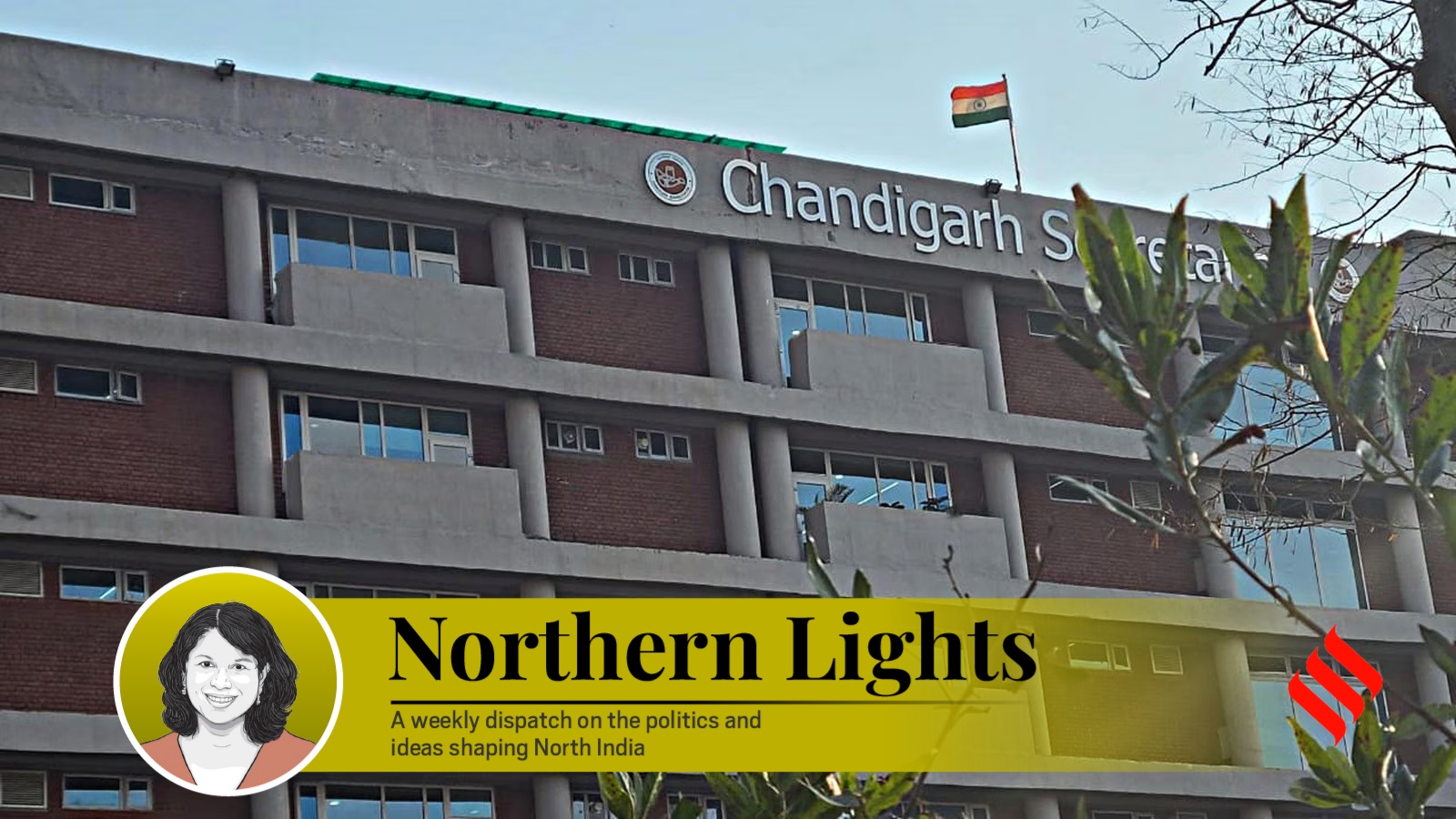
Conceived after Partition as Punjab’s replacement for Lahore, Chandigarh became Independent India’s first planned city, designed from scratch by Swiss-French architect Le Corbusier. Its Capitol Complex, comprising the Assembly, Secretariat and High Court, now enjoys the UNESCO World Heritage status and has been among India’s most significant architectural achievements.
Chandigarh’s political future, however, was never settled. When Punjab was reorganised on the linguistic lines in 1966 into Punjab, Haryana and the hill areas that later became Himachal Pradesh, Chandigarh was designated a UT and made the joint capital of Punjab and Haryana as an interim arrangement.
In 1970, then Prime Minister Indira Gandhi announced that Chandigarh would be transferred to Punjab while Haryana would receive the Fazilka tehsil, or equivalent territory, along with financial assistance to build a new capital. The proposal never took off.
Fifteen years later, the Rajiv-Longowal Accord revived the promise, fixing January 26, 1986, as the date for Chandigarh’s transfer to Punjab after the exchange of certain Hindi-speaking areas. Militancy intervened, Sant Harchand Singh Longowal was assassinated, and the accord remained unimplemented.
That has not stopped successive governments from reviving the issue whenever political circumstances demand it. The city, meanwhile, has moved on.
Today it forms the nucleus of the Tricity, a term coined by former Punjab Governor V P Singh Badnore, nestled between Mohali in Punjab and Panchkula in Haryana. People live in one city, work in another and socialise across all three.
Politically too, the region reflects India’s diversity: the AAP governs nearby Mohali, Chandigarh has a Congress MP but a BJP-dominated Municipal Corporation, while Panchkula is represented by the BJP. Civic elections here are often viewed as an early indicator of political trends in Punjab.
Chandigarh has also developed a social character unlike that of most state capitals. Built over 22 villages of Punjab and sprawling mango orchards, it drew refugees, government officials, lawyers, professionals and entrepreneurs from across India.
Justice M S Liberhan, who headed the Commission probing the demolition of the Babri Masjid, is among Chandigarh’s few prominent residents whose family belongs to one of its original villages. Industrialist Rajendra K Saboo, later the first Indian president of Rotary International, recalls arriving from Kolkata as a 25-year-old to meet then Punjab CM Partap Singh Kairon, who immediately resized an industrial plot to meet the requirements of his German collaborators.
Soul of Chandigarh
The city’s distinctive personality owes much to its first Chief Commissioner, M S Randhawa, who earned the sobriquet “Punjab’s sixth river”.
Apart from establishing the Rose Garden and starting the Government Museum and Art Gallery with nearly 2,000 Pahari miniature paintings acquired from erstwhile Himachal royals, he personally supervised the planting and watering of amaltas, gulmohar, jacaranda and other trees that make the city so beautiful. Even today, many longtime residents can identify a sector simply by the trees lining its avenues.
At 94, Shivdatt Sharma, one of the few surviving members of Le Corbusier’s team, continues to defend the city’s original vision. A Partition refugee from Lahore who later trained as an architect, Sharma insists that Chandigarh’s founding creed will endure even though the city planned for five lakh people, now houses over 12 lakh residents.
Ironically, the biggest battle over Chandigarh today is not about which state should own it but whether it can preserve the core principles of sun, space and greenery that make it exceptional. Proposals for high-rise development in Manimajra and sectors south of Sector 30 have revived concerns about altering Le Corbusier’s low-rise vision. The Punjab and Haryana High Court recently stalled the proposed flyover at Tribune Chowk, while lawyers successfully opposed the shifting of the High Court from the Capitol Complex to Sarangpur.
As Punjab heads to another Assembly election in about eight months, leaders cutting across party lines would once again use Chandigarh as an emotional bargaining chip to sway voters. The tragedy is that those shouting the loudest to stake claim to the city are the least equipped to preserve it. Sometimes, true wisdom lies not in possession, but in cherishing the city’s soul.