

Andy Burnham’s day began with a visit to a homeless shelter in central London, where he chopped mushrooms and chatted with other helpers preparing breakfast.
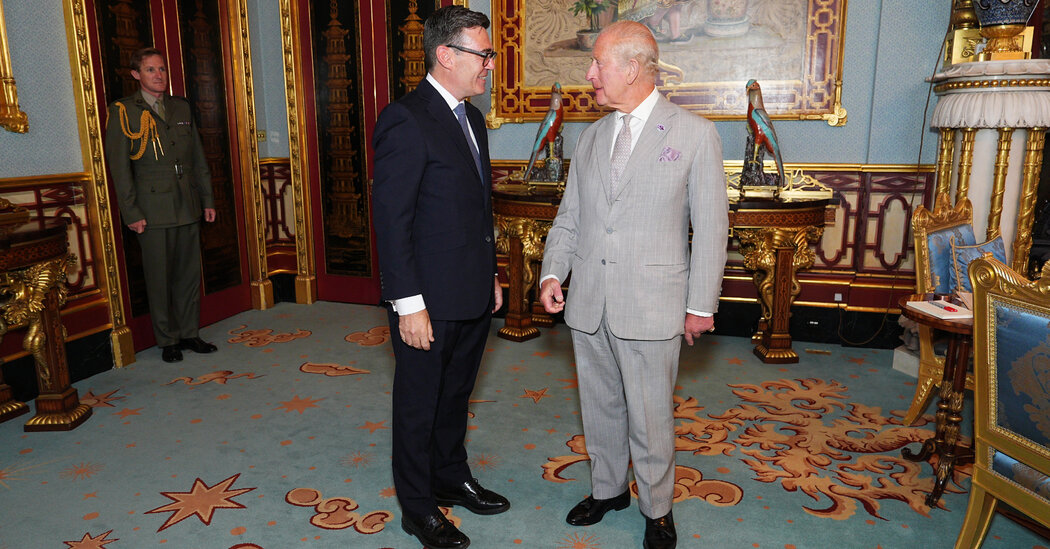
A few hours later, by now wearing a suit and tie, he shook hands with King Charles III in the gilded splendor of Buckingham Palace. Accepting the monarch’s request to form a government, Mr. Burnham, who was named leader of the governing Labour Party on Friday, became Britain’s seventh prime minister after a decade of extraordinary turbulence.
Mr. Burnham’s early-morning trip to the homeless charity seemed designed to send a signal to the country about his priorities, and to underscore his pledge to tackle social issues and reshape British politics.
On a day of ritual and ceremony, Mr. Burnham pledged in a short speech outside 10 Downing Street to “put the care of people at the heart of everything I do.” He described his move into Britain’s top job as a “circuit-breaker moment” to change the direction taken by a succession of neoliberal governments over the past four decades that favored privatization and deindustrialized the country.
“I know people at home are fed up with politics,” he told the public, speaking without notes and minus the lectern that prime ministers usually speak from outside Downing Street. “I hear you, and I want to be honest with you: We have not been good enough, and we need to be better. We will be.”
The speed of Mr. Burnham’s ascent to the top job in British politics is striking. Earlier this year, his path to Downing Street seemed blocked when he was prevented from running for a parliamentary seat that he needed to challenge Prime Minister Keir Starmer. But after a disastrous set of elections in Scotland, Wales and English municipalities in May, Mr. Starmer had to relent and allow Mr. Burnham to run in a special election — which he won emphatically.
That put him in pole position to succeed Mr. Starmer, whose popularity had sunk to some of the lowest levels recorded for a British prime minister, just two years after winning a general election in 2024.
Supporters hope Mr. Burnham will revive his party’s fortunes after more than a year during which the populist right-wing party Reform U.K. has led opinion polls, albeit with about 25 percent of voter support.
Mr. Burnham’s rise follows a period of political turmoil that began with the Brexit vote in 2016, when voters severed ties to the European Union. In his speech Mr. Burnham, the first lifelong Roman Catholic to become Britain’s prime minister, said he would move quickly to announce measures to ease the burden on voters frustrated with stagnating living standards and impatient for change.
Promising to “give people some breathing space now,” he said he would explain how such measures would be financed in the coming days. He also said that later this year he would propose a 10-year plan for the country.
Earlier in the day, Mr. Starmer made his final appearance as prime minister. “My work is done,” he declared in a brief farewell speech, saying that he left “with good grace and a smile.”
By Monday evening, many of Mr. Starmer’s closest allies had been ousted from the government as Mr. Burnham began forming his cabinet. In a surprise appointment, John Healey, a former defense secretary, was given the critical job of chancellor of the Exchequer, overseeing the nation’s finances, replacing Rachel Reeves, who left the cabinet.
A political veteran, Mr. Healey is regarded as a safe pair of hands, and he was a junior minister in the Treasury in Prime Minister Tony Blair’s government. Mr. Healey resigned as defense secretary in June, arguing that a proposed increase in British military spending was insufficient, a move that destabilized Mr. Starmer’s leadership.
In his new job, Mr. Healey will now have to find the money needed to upgrade Britain’s armed forces. But his appointment may reassure some of those in the financial markets who were worried by speculation that the job might go to Ed Miliband, who is seen as being more to the left of the Labour Party than Ms. Reeves.
Mr. Miliband, a former Labour leader, was named foreign secretary, while Shabana Mahmood kept her job as home secretary, a signal that Mr. Burnham is largely backing her efforts to crack down on legal and illegal migration. David Lammy, who was deputy prime minister under Mr. Starmer, announced that he would be leaving government.
Mr. Burnham is also expected to shift some aspects of Mr. Starmer’s agenda on energy. Lucy Powell, Labour’s deputy leader and a close Burnham ally, said on Sunday that he would take “a more pragmatic approach” to North Sea gas and oil than Mr. Starmer, but added, “I don’t think it is a change of policy, more a change of emphasis.”
In a post on Truth Social on Sunday, President Trump appeared to welcome — if exaggerate — the expected change in energy policy. People in the Scottish port city of Aberdeen, he claimed, were “dancing in the streets because the new Prime Minister, Andy Burnham, has stated that he will be opening up, all the way, the invaluable North Sea Oil!”
Mr. Burnham spoke to Mr. Trump shortly after he became prime minister, Downing Street said. According to a readout of the call, he congratulated the president on a successful run as a co-host of the World Cup. And Mr. Burnham, who was mayor of Greater Manchester for the past nine years, invited Mr. Trump to the city for a visit.
In his speech, Mr. Burnham immediately announced one concrete new policy, saying he would end “rough sleeping,” a British term for homelessness. It is an ambitious — and some have argued impossible — goal, but one that is close to his heart; he donated 15 percent of his annual salary to homelessness charities during his nine years as mayor of Greater Manchester.
Mr. Burnham pledged to end homelessness when he was mayor, too. The number of rough sleepers did drop significantly in his city by 2020, but a report earlier this year in the The Mill, a Manchester newspaper, found that it had increased steadily over the past four years.
At the homeless shelter on Monday morning, Mr. Burnham addressed that.
“We ran a scheme every night, 600 beds, called ‘A bed every night,’” he recounted, “and we funded it through various different ways. But we were the only place that was doing it, and you won’t be able to get the numbers down if you’re the only place.”
Other homeless people, he said, came to Manchester because of the support available.
“So it taught me that the only way is to do this together,” Mr. Burnham said.