


Abhishek Varma could not shake the feeling that something was wrong on his wedding day.
His parents, desperate to marry him off, had found a man in a nearby village in India who described himself as a matchmaker. All they had to do, he told them, was select an orphaned woman from a photo album and pay around $200 to join a mass wedding.
When the day came in late May, Mr. Varma and about 40 other grooms from several villages arrived at 8 a.m. in wedding kurtas and sherwanis, he said. They waited all day for their brides — until they realized they’d been duped.
“They took the bait,” said Preeti Katare, a police officer handling the case, adding that the victims were rural men in their early 20s to 40s. She added that dozens of others had not come forward out of shame.
The case — in which the purported matchmaker and his accomplices now face fraud charges in the central state of Madhya Pradesh — is an extreme example of a wedding scam in a marriage industry that is notoriously prone to it.
Many scammers in India are lured by the huge sums of money flowing to its marriage market, in which families spend years saving up for a daughter’s wedding clothing, jewelry and dowry — the traditional, yet illegal, payment of cash or assets to the groom. Marriage scams are common enough that Indian newspapers run full-page ads with tips on how to avoid them.
But fraudulent mass weddings are rare. Ram Lal Bhagat, a sub inspector with the Madhya Pradesh Police, said it was the first one he had seen in 40 years on the job.
About a dozen of the victims, including Mr. Varma, filed complaints that led to the purported matchmaker’s arrest and detention in the central state of Madhya Pradesh. In late July, the police there said they had charged the man, Dinesh Bairagi, 45, and four accomplices, including his brother, Mukesh Bairagi, 40.
A lawyer for the Bairagis could not be reached for comment. If convicted, they could face a punishment of up to three years in prison and a fine.
The police said that the Bairagis reaped the equivalent of around $4,000 by charging each man 10,000 to 25,000 rupees ($105 to $260), a significant sum for rural families but a bargain price for a wedding. They “saw an opportunity in this problem where it’s hard for a lower- to middle-income groom to find a bride in a village setting,” Ms. Katare said.
For Abhishek Varma’s parents, arranging his marriage to an orphan was a way to end his relationship with another woman, the daughter of a chauffeur.
Because he was the unemployed son of a farmer from a lower caste, he said, his girlfriend’s parents thought he had little to offer her and threatened to harm his family if the couple did not separate.
Mr. Varma said his family pressured him to choose a bride based on photos of women in an orphanage, and that the matchmakers declined to let him meet her before the wedding.
“They said it was not the rule of the orphanage to have the girls meet strange men like that,” he said in a phone interview. “I had slight doubts, but I had no option but to go along with my family. Honor is everything.”
Mr. Varma, who has a computer science degree but works odd jobs, said that some of his fellow grooms were unemployed young men like him, while others were in their 40s and 50s and considered too old for the marriage market.
More than 5 percent of men in India are unemployed, according to the Ministry of Statistics and Program Implementation, a figure that experts say does not account for the country’s sprawling informal sector. A March report by Azim Premji University in Bengaluru found that nearly 40 percent of recent graduates were unemployed.
Indian families typically prefer to marry their daughters to men who come from a different caste or have a high earning potential, to justify the cost of a wedding and a dowry, said Gaurav Chiplunkar, a business professor at the University of Virginia who has studied rural India’s marriage market. Those women tend to leave their villages, leaving local men behind.
“The marriage market is so skewed that there are just no brides, or the men are older, or they need women to work in the household while the men go to their jobs in the cities,” he said.
Matching a son to an orphaned woman typically indicates that a family is desperate enough to forego a dowry, which would provide a financial buffer for the groom’s family if he were unemployed, Professor Chiplunkar said.
India’s Parliament passed a law banning dowries in 1961, but the payments are still common and can cost hundreds of dollars, the equivalent of years of income for a rural bride’s family, according to Professor Chiplunkar’s research.
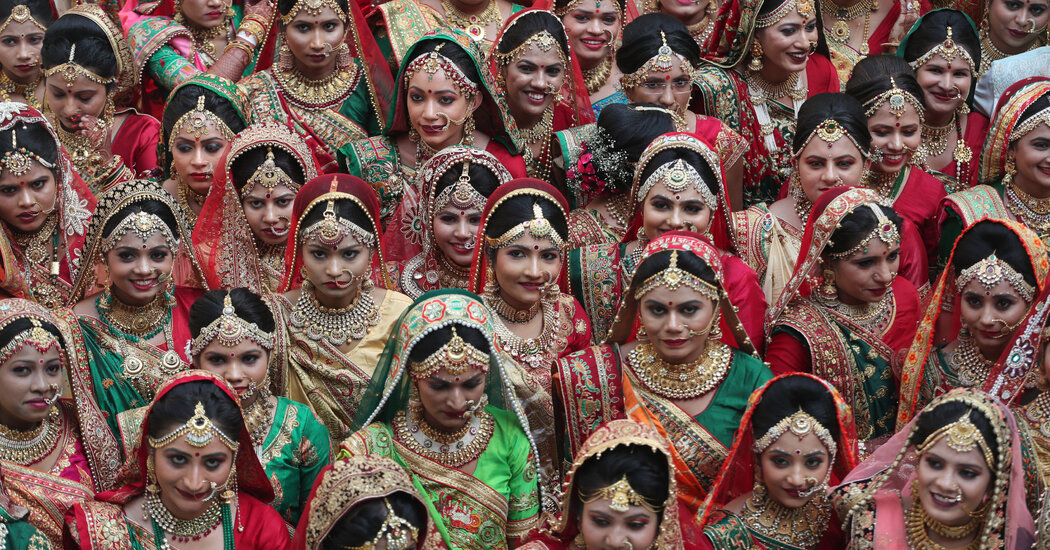
To remedy the shortage of brides, state governments offer financial incentives for mass weddings, which are typically shorter and cheaper than traditional ones that last for days. In Uttar Pradesh, for example, the bride receives around $600 in cash and about $250 worth of wedding paraphernalia. The state’s chief minister said in 2024 that around 400,000 women from poor and ethnic minority families had been married through the program.
State-sponsored mass weddings often take place before key elections. In 2022, Prime Minister Narendra Modi took a break from campaigning in his home state of Gujarat to attend a wedding for more than 500 women who had lost their fathers.
But the fraudulent mass wedding in Madhya Pradesh was not connected to a government program or an election. The police said the family behind it used their reputation in the village to gain their victims’ trust.
“In villages, trust works,” Ms. Katare said. “And they trusted this family.”
As the hours ticked by without any sign of their brides, the celebratory mood gave way to anger. The grooms and their families restlessly paced around the temple in Dewas, the small city where the purported matchmaker had told them to gather.
Around 5 p.m., Mr. Varma said there was a collective sigh of relief when a man from the Bairagi family arrived with more men from his village. They thought it meant that other Bairagis would soon arrive with their brides.
Their relief did not last long: The police were called to the temple soon after dark.
Mr. Varma said he later looked into the photos of the women provided by the matchmakers. They were not orphans, he said, but influencers who had millions of followers on Instagram.
As for his former girlfriend, he said, she is happy that his wedding didn’t work out.