

In July 1994, four small medaka fish travelled into space as part of an experiment that tested whether fish could reproduce in microgravity. The experiment was carried out during the Second International Microgravity Laboratory (IML-2) mission aboard the Space Shuttle Columbia, or STS-65.The four medaka spent 15 days in space along with Japanese astronaut Chiaki Mukai. According to the Japan Aerospace Exploration Agency (JAXA), the experiment was proposed by Dr Ken-ichi Ijiri, who was then an associate professor at the University of Tokyo. The researchers identified 43 eggs during the experiment. The fishes became the first vertebrates known to lay eggs in space.More importantly, the eggs developed normally, and eight of them hatched while the fish were still in orbit. The young fish were later called ‘space medaka’.
Finding space-ready medaka
Taking fish into space was not as simple as putting them inside a tank. Fish normally rely on their bodies and internal organs to control their position in water. In microgravity, however, they can start spinning because they no longer experience the same gravitational pull as they do on Earth.Before the mission, scientists tested many medaka during parabolic flights. In these flights, an aircraft follows a special up-and-down path that creates about 20 seconds of microgravity at a time. This gave researchers a short period to observe how the fish behaved without normal gravity.The scientists looked for fish that could continue swimming normally instead of spinning. They eventually selected a strain that was able to control its posture under microgravity.These fish had good eyesight and were better at using vision to control their position rather than depending mainly on their otoliths. Otoliths are organs that help fish maintain balance. The selected medaka were also considered highly capable of adapting to changes in their surroundings.Four fish were eventually selected for the space experiment. The two males were named Cosmo and Genki, while the two females were called Yume and Miki. Children from the Japan Space Youth Association suggested the names through an entry campaign.

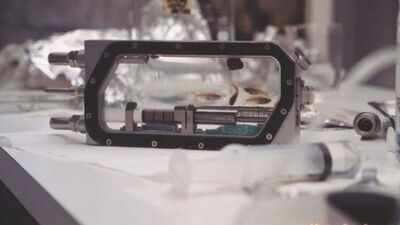
Water currents moved the eggs into a separate part of the tank, keeping them away from the adult medaka. (Photo:Jaxa)
Managing fish in space
The four medaka were kept as two breeding pairs inside an Aquatic Animal Experiment Unit, or AAEU. Before going into space, the fish had already been laying eggs regularly on Earth.The researchers wanted the fish to continue their normal breeding behaviour during the mission. To support this, the tank was kept at a water temperature of 24°C. The fish also followed a cycle of 14 hours of light and 10 hours of darkness.The lighting schedule was important because the medaka usually spawned in the morning. During the mission, they continued to lay eggs once each morning, generally within two hours after the lights came on.The astronauts also had to make sure the fish received food regularly. The feeding system was operated roughly every three days. Food had been stored inside the tank beforehand, and turning a screw released enough food for one day.The crew monitored the fish and checked whether they had spawned. They looked for fertilised eggs attached to the female’s abdomen or eggs that had been deposited in a separate egg-collection section of the tank.
Monitoring the eggs
Once the eggs were collected, the researchers could observe their development without the adult fish eating them. Water currents moved the eggs into a separate part of the tank, keeping them away from the adult medaka.A video camera was placed inside the tank on the following day, after the lights came on. It recorded the fish continuously for two hours. The filming was carried out on mission days 3, 5 and 8.Mukai was the first person to report back to Earth that a medaka had hatched.
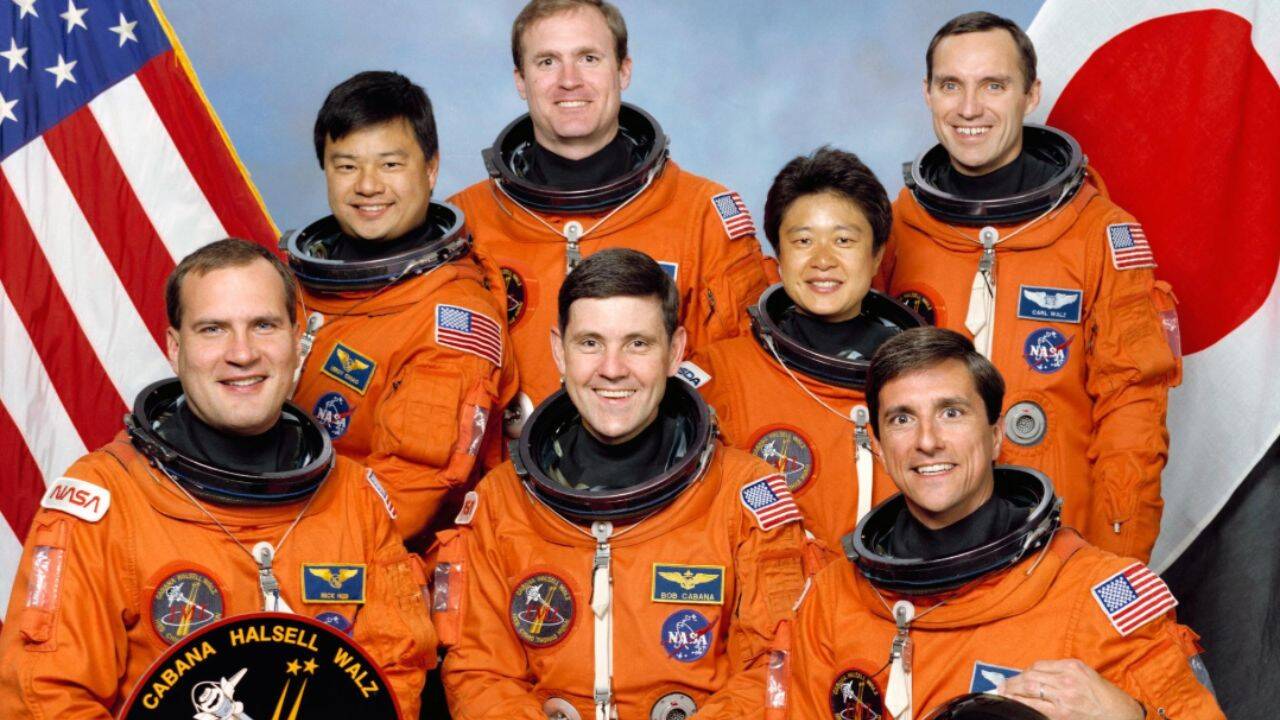
Left to right front row are mission specialist and payload commander Richard J. Hieb, commander Robert D. Cabana, and mission specialists Donald A. Thomas. Middle row is mission specialists Leroy Chiao and Dr. Chiaki Mukai. (Nasa photo)
Fish struggle on Earth
The behaviour of the four adult medaka wasobserved after they came back to Earth. At first, the fish remained motionless at the bottom of their tank for about six hours. They had not died. They were sinking because they were suddenly back in Earth’s gravity.After some time, one fish began swimming, followed by another. The fish had spent two weeks in an environment where they did not need to deal with Earth’s normal gravitational pull, and their bodies had adapted to that condition.The adult medaka had, in effect, forgotten how to use their swim bladders. Swim bladders help fish control their position in water. In near-weightlessness, the fish had not needed to use them in the same way.The fish also appeared to have used their tail fins less while they were in space. Instead, they mainly used their pectoral fins for swimming.The adult fish gradually recovered. By the fourth day after returning to Earth, they were almost back to normal. After about a week, they started laying eggs again and continued spawning every day.
Space medaka thrive
The young fish that had hatched in space behaved differently from the adults after returning to Earth. They were able to swim normally under Earth’s gravity. The fry also continued to grow after the mission. Eventually, their number reached more than 1,300 fish. Researchers found no particular effects on the offspring as a result of the parents’ time in space.The medaka experiment was one of several biological experiments carried out during the IML-2 mission. Other fish and amphibians were also taken into space.Goldfish were included in an experiment that examined how they adapted to microgravity. Newts were also carried on the mission as part of research into reproduction in space.