

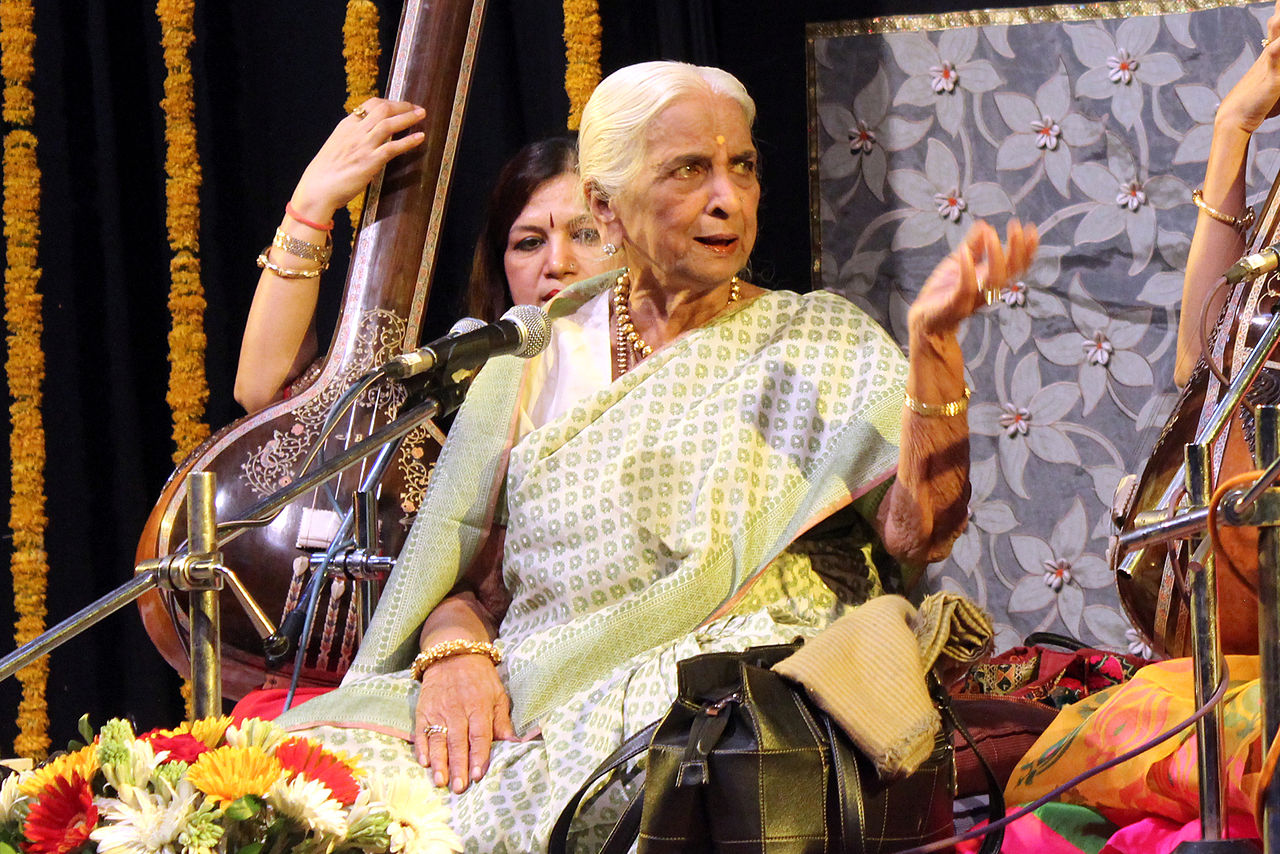
Girija Devi (8 May 1929 – 24 October 2017) . We can not go without speaking about Girija devi and her music when we talk about singers on Smule from the state of Uttar Pradesh. A state that hold prominence as a key place where basics for Hindustani Gharanas formed. A phenomenal proponent of Benaras Gharana, Girija Devi was born in the famous city of Varanasi (Benaras). Those were times for women in India never heard of freedom or a career for women as performing artist on stages.
Girija Devi learned her first music lessons from her father at very early age itself and later took lessons in singing Khyal and Tappa from vocalist/sarangi player Sarju Prasad Misra. Married to a an art-loving businessman named Madusudan Jain at at very early age of fifteen, halted her prospects to pursue a singing career. She mentioned in her many interviews about the only support throughout her life was from her father. Her mother who later was very supportive, not a very uninformed women, could not think of a girl spending time dreaming about a singing career. Girija Deviji’s day today domestic life was not at all in tune with the need for the amount of time she need to spend practicing and learning . Despite her resistances she kept studying various styles of Hindustani from Sri Chand Misra.
It was those times of India where women performing in public was not even heard of, and especially for a women from Brahman upper class family; thus it created a huge uproar when Girija Devi performed on All India Radio to the public. Devi have to agree with the social polices of that time not to sing in public anymore. But, progressive thinking people of U.P. pursued Devi to change her decision and Devi performed again in public few years later. She later held several teaching faculty positions in prestigious music teaching schools and taught many youngsters and till date she is inspiration to musicians from all across India.
See the following video where Girija Devi perform a Tappa in Raga Desh. The beautiful sound of the string instrument Sarangi is a unique to north India classical music performaces.
The following video is shot when she traveled to Bombay to sing for an invited session by Suresh Wadkar, a famous Marathi play back singer. This was one of the rarest videos of her performances where she try to display various styles of Benaras Gharana style in a short 45 minutes to students and other famous musicians.
She says in the beginning speech that she want to do this because she want younger generations to take this traditions and learn these styles.
She is one of the gem of a Hindustani artist from the state of U.P. and we dedicate this feature to the most melodious music she created for us. In the video for novice to understand what is she singing. Devi sings a bada khyal, chota khyal, Thumri and a Kajri. Just for the information of people not so familiar how a typical stage performance of a Hindustani music is; First things first, a Khyal or Khayal is the modern genre of classical singing in North India. The name comes from an Arabic word meaning “imagination“. It is thought to have developed out of Dhrupad introducing frequent taans and alankars in it.
A typical khyal performance uses two songs — the bada khyal or great khyal, in slow tempo (vilambit laya), comprises most of the performance, while the chhota khyal (small khyal), in fast tempo (drut laya), is used as a finale and is usually in the same raga but a different taal. The speed gradually increases over the time of the performance. The songs are sometimes preceded by improvised alap to sketch the basic raga structure without drum accompaniment; alap (not metered) is given much less room in khyal than in dhrupad. A best example of all the above features for people who like to learn how to enjoy a Hindustani recital is embedded here. Please pay attention to all the above mentioned factors in the following video. Accompanying wind air instrument Harmonium is something unique in Girija Devi’s performances, her dad was a Harmonium artist of the time and she was taught by her dad all the music accompanied by this instrument. Although not an essential instrument for all Hindustani performances use of this instrument is very notable in all her stage shows. Also about 21 minutes into the singing she give Sarod and harmonium to be heard by themselves. Very well planned mastery of a performer. You may also see Sonu Nigam ( earlier few times and around 27 minutes of the video) sitting next to Suresh Wadkar in the audience. About 24 minutes the the tempo catches up, you may hear the Tabla catches up fast rhythm for a short focus to set the fast tempo part of bada khyal. Over all, this performance is like a text book display of a Maestro singer on essential aspects of many styles. Such a pleasure to watch this. She in the middle says a joke about the fact that she rushes through all these styles so fast she says it feels like look into a toy binocular that display all famous places in India. It is the perfect simile. She sing a bada khyal, chhota kyal, thumri and a kajri in 45 minutes. and lastly she sing a dedication Jhoole to one of the organizers.
We hope the video above tells volumes about our mission here that carried from such great musicians like Girija Devi. The younger generations should get motivated and take an active part in learning India’s music traditions that no other country can claim, and only unique to our nation.
Come back every week to enjoy a new singer up close and sure we will have plenty of stuff to display when we are talking about INDIA.
References
- Girija Devi: Music Queen Who Wore The Wrong Crown, https://www.outlookindia.com/website/story/girija-devi-music-queen-who-wore-the-wrong-crown/303437
Written by Aparajita Lahiri our distinguished featured artist
A short tribute from a disciple to her Guruma (Appa ji)

Written by Aparajita
Padmavibhushan Smt. Girija Devi
It was during my research work that I was selected as a General Scholar to study music under the tutelage of Smt. Girija Devi ji. This initial short appointment was extended to another full year of staying under her guidance.

Seven years with Seven Notes of Hindustani
Learning music under her guidance was a source of immense happiness as was getting familiar with the fact that these seven notes can create incredible magic on minds and
Learned pure classical and semi-classical music with full dedication and devotion. Everyone used to tell me that she was more into semi-classical music (Purab Ang Gayaki). and was not that highlighted in Khayal gayaki; but from my understanding she was a brilliant performer of various raagas and its various bandishes which were totally different from that of other Gharanas and extreemly unique. ” Raag kedar’, Raag yaman Kalayan” raag Nayaki Kanada” are few examples of her signature
I would consider my self very fortunate that I get to learn a very wide range of variety of music styles considering a student status. Be it, Khayal, Thumri, Dadra, Kajri, Tappa, Bhajans. She was an institution herself loaded with sanctity and purity.
Spending long seven years, doing Riyazz in front of her, watching her doing other household works along with music I experienced that it is so easy if a person decides to do what he/she as she wants to be. She was into every aspect be it music , be it family, be it being super sensitive and jolly in nature with her students. Her students were her life she always used to say.
Travelled a lot along with her nationally as well as internationally experienced the beauty of performance and and her stage
Being her Shishya gives me immense joy and pleasure as I learned not only music but also all other aspects of being a woman. Pranams to my “Appa Ji”. I wish she could have been stayed a bit longer and longer.
Note added: Kajri, Dadra all these are lighter gayaki form very much apart from the kheyal gayaki where prem bhav, birah bhav and bhakti bhav are the main aspects to follow. Kajri is for rainy season, chaiti is for chaitra mass (month) and Dadra is totally based on birah and prem bhav (can be related to Radha prem- Birah bhav)