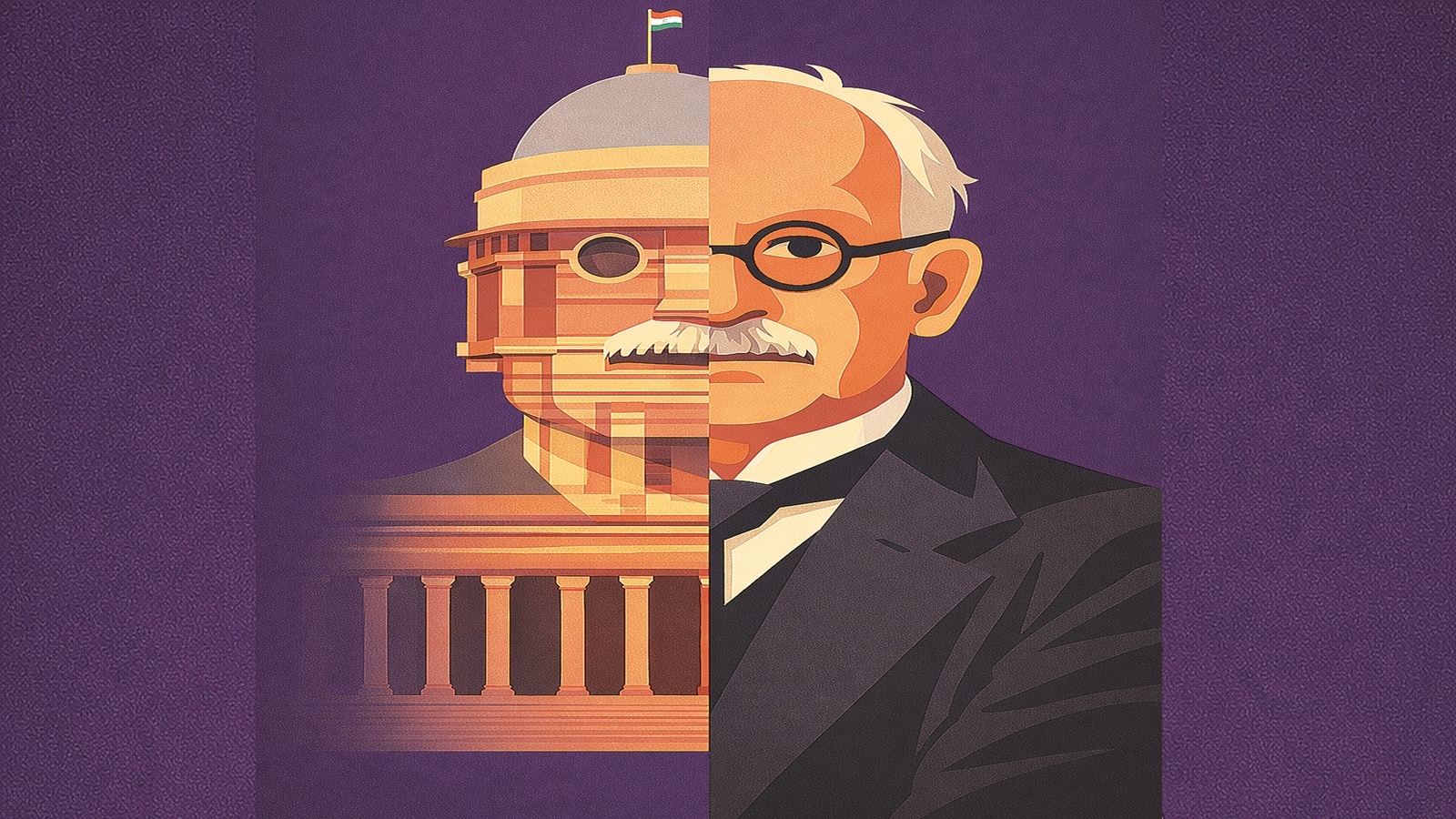
Whenever I meet a bureaucrat from Delhi who works in any of Edwin Lutyens’ buildings, I ask them what they think about Lutyens. “Iconic” is a ubiquitous response. It is not an exaggeration. Lutyens’ Central Vista is indeed an icon for the Indian Republic — refreshed and ritualised regularly through the Republic Day Parade, Independence Day decorations, and oath-taking ceremonies for new governments.
This deep identification with Lutyens’ buildings is not limited to statist psyches. In a clear contrast to Corbusier’s brutalist Chandigarh — built by the independent Indian government — Lutyens’ buildings resonate deeply with Indians. And unlike architects who adore Chandigarh, people do not have to be taught to admire Lutyens. The pictures of khadi-clad crowds on the North and South blocks on August 15, 1947, the millions of tourists and locals who visit India Gate yearly and record those visits in family albums, and the charged civic debate around the Central Vista project, are evidence that people of India at large consider Lutyens’ architecture as their own heritage — not as alien, imperial imprints.

New Delhi’s relationship with Indian sensibilities is not incidental. Lutyens’ architecture was a deliberate and learnt exercise in creating state-legitimacy for the British — one in which he reinvented himself. Before being hired in 1912 to design New Delhi, Lutyens had been practicing in Britain since 1888. Trained at the South Kensington School of Art, most of Lutyens’ buildings were private residences in the Arts and Crafts tradition. His British Pavilions in Paris (1900) and Rome (1911) were the earliest expression of a classicist-patriotic language by him.
Lutyens’ classical ideals were soon confronted by the shifting tides of colonial India. Indian presence in British politics had begun in the late 19th century with Dadabhai Naoroji, and the Indian Councils Act of 1892 had irreversibly cemented “native” power in Indian governance. Operating in this context, Viceroy Lord Hardinge insisted that Lutyens must incorporate local elements in New Delhi’s design so that Indians don’t feel ignored in the architecture of the new capital.
With some initial resistance, Lutyens agreed and travelled to various cities in India to study their architecture through meticulous sketches. These sketches can now be found in several books on New Delhi. He studied stupas, temples, mosques and tombs, and incorporated them masterfully with the Beaux-Arts-inspired axial, symmetric layout, creating the “Delhi Order”, and in the process inventing a new stylistic and climatic solution.
Rashtrapati Bhawan’s classically organised composition of podium, colonnades, strong horizontals, and a central dome worked seamlessly with the Sanchi-inspired dome, chhatris, chhajjas, and jalis. Similarly, India Gate translated the European triumphal arch into an Indian war memorial, using restrained classical detailing and local sandstone to produce a familiar and contextually specific monument.
Despite being patronised by the imperial power and designed by a thoroughly patriotic British architect, the architecture of New Delhi is uniquely Indian and cannot be found anywhere else in the world. Moreover, Lutyens’ hybrid classicism became a reference style that Indian architects and institutions had to position themselves toward, whether by emulation, adaptation, or, later by architects like Charles Correa and Raj Rewal, through explicit post-colonial rejection.
In the adaptation, learning and the spirit of mastering the challenge that was posed to him — a demand that went against his earlier education, beliefs and practice — Lutyens was also significant in defining the birth of architecture as a profession in India. He standardised the figure of the architect as a private consultant who practices outside the state’s institutions but can build public architecture, and who is unique enough to be authorial but agile enough to adapt to the demands of an all-powerful client.
This professional, unlike the sthapatis that gatekept the profession through caste and dominated the Indian side of design before the 20th century, could learn and be an architect through formalised education. Additionally, before the 1910s, most public architecture comprised engineer-dominated public works. The New Delhi commission, revolving around a named architect-consultant and large drawing offices, hence, helped legitimise the profession.
It is noteworthy that around the time that Lutyens arrived in India, a new, Western-style professional field was already emerging. The JJ School of Arts in Bombay created a five-year architecture diploma in 1913, and the Indian Institute of Architects was founded in 1929 to formalise practice and align it with RIBA standards. But for all its achievements, this wave was limited to Bombay, was commissioned largely by private clients and never received large statist commissions.
The overwhelming role of the state in the production of architecture in New Delhi also standardised the architect’s office. The Delhi project required systematic sketch schemes, working drawings, specifications, and bureaucratic correspondence. This modelled the documentation, coordination, and office-structure that would later be standard in major Indian practices and state offices. Echoing the professional structures contemporaneously being taught through British-linked curricula, Lutyens led a team of British architects, draughtsmen, engineers, and contractors in clear organisational hierarchies.
Many of the architects employed by Lutyens, such as Herbert Baker and Walter Sykes George, carried this office culture into long-term practice in Indian cities, employing Indian graduates, thereby transmitting a Lutyens-inflected model of form and profession to first-generation Indian architects. They designed some of the first modernist buildings in India. Walter Sykes George lived the rest of his life here and designed Delhi’s icons, such as Miranda House, the Arts Faculty Building at the University of Delhi, and Mandi House. George was also instrumental in establishing an architecture department at Delhi Polytechnic in 1941.
The removal of Lutyens’ bust from Rashtrapati Bhawan is a denial of this formational history and a disservice to a pivotal professional. C Rajagopalachari should not be pitted against British professionals like Lutyens who created an architecture that continues to be synonymous with the Indian Republic and is an icon for its people. Moreover, who shaped a profession that eventually bloomed into a vibrant landscape of architectural practices that we see today. Lutyens of Britain might be alien to us, but Lutyens of Delhi is our own. And most importantly, we made him our own.
The writer is a PhD scholar at the Massachusetts Institute of Technology in Architectural History and Theory