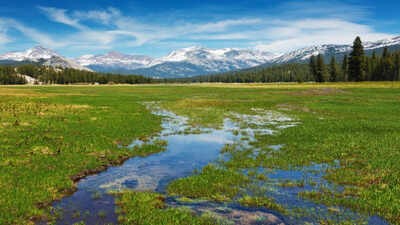
Scientists who planted 40,000 native sedge seedling to restore the damaged Tuolumne Meadows in California’s Yosemite National Park, have found early signs of improvement after. The results, however, also show that restoring the meadow’s soil and its ability to store carbon could take several decades. Three years after the planting, while the soil organic matter increased, the meadow continued to lose more carbon than it gained.The restoration project, led by researchers at Colorado State University (CSU), aims to reverse damage caused by livestock grazing more than a century ago. According to the an official release by the University, sheep grazing during the 19th century severely reduced the native plants that once covered the wet meadows. Although grazing ended long ago, the original vegetation has not returned naturally.The loss of plants has affected the soil’s ability to retain moisture and store carbon. As the soil dries and organic matter continues to decompose, carbon is released from the meadow. Researchers are now trying to restore the deep-rooted vegetation that previously helped maintain these conditions.The findings, published on Tuesdat, in the Journal of Geophysical Research, Biogeosciences, suggest that the restoration is making progress, although the meadow remains degraded. Scientists believe that bringing back native sedges could help prevent further damage, but full recovery may take between 25 and 50 years.
Sheep grazing damaged meadows
The damage to Tuolumne Meadows dates back to the mid-1800s, when large numbers of livestock, mainly sheep, grazed across the landscape. Grazing continued until years after Yosemite National Park was established in 1890.During this period, sheep heavily grazed the native sedges and help store carbon in the soil. These plants were once dominant in the wet meadow ecosystem. However, their numbers declined so sharply that they have not recovered naturally, even more than a century after grazing stopped.As the sedges disappeared, shallow-rooted plants came in their place. Unlike the original vegetation, they did not provide deep-rooted biomass that helped maintain soil conditions.With time, parts of the meadow became exposed and the soil began losing moisture. According to the researchers, more than 20% of the meadow’s topsoil remains bare.The deterioration has affected Yosemite’s wildlife and threatened the mountain meadow landscape visited by people.
Scientists planted 40,000 seedlings
To address the damage, researchers planted 40,000 native sedge seedlings across the affected meadow and monitored changes over three years. This was done in order to reintroduce the vegetation that historically dominated the area.The results of the research showed that the planted sedges were gradually increasing soil organic matter which was encouraging because organic matter plays an important role in maintaining healthy soil.However, the improvement was not enough to reverse the meadow’s overall carbon losses. The researchers also found that decomposition of existing soil organic matter was had continued. This meant the meadow was still releasing more carbon than it gained.Restoring vegetation therefore is an important first step, but rebuilding the soil’s capacity to retain moisture and store carbon will require much more time.
Meadow is still losing carbon
The researchers identified the loss of deep-rooted vegetation as a major reason for the meadow’s continuing deterioration.Native sedges previously helped maintain soil moisture and contributed carbon to the soil. When grazing removed these plants, the meadow lost an important part of the system that supported its soil health.Without sufficient deep-rooted vegetation, the soil became drier. Continued decomposition of soil organic matter also contributed to carbon losses.The restoration project is intended to reverse these changes by re-establishing the plants that once supported the meadow’s ecosystem.But the three-year results indicate that improvements in soil organic matter do not immediately mean that the meadow has regained its ability to store more carbon than it releases.
Recovery could take 25 to 50 years
David Cooper, the study’s lead author and a senior research scientist emeritus in CSU’s Department of Forest and Rangeland Stewardship, said damaged ecosystems do not always recover naturally, even when vegetation is visible.“Many ecosystems do not naturally recover from severe disturbance, and while a place may look green, it may be severely degraded and in need of restoration,” Cooper said.“We feel our approach of planting the species that was and should be the dominant vegetation is the path forward.”According to Cooper, reversing damage that has developed over roughly 150 years could take another 25 to 50 years. “I think the meadow can be restored, but these things take time,” he said.