

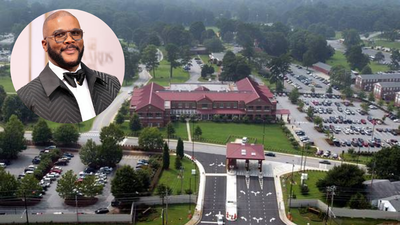
In 2015, media mogul Tyler Perry bought 330 acres of Atlanta’s former Fort McPherson Army base for $30 million. Eleven years later, the large site has become one of North America’s biggest production facilities. It has 12 purpose-built sound stages, 40 historic buildings protected under national heritage rules, and 200 acres of open green space. The project is one of Georgia’s most notable urban redevelopment efforts. It combines the facilities needed for major Hollywood productions with buildings and land that date back to the 19th century.
Military roots dating to the nineteenth century
The land now home to Tyler Perry Studios has a history that stretches back nearly 200 years. According to information published by Tyler Perry Entertainment, the site was first used for military purposes as early as 1835. It later became a Confederate Army post during the American Civil War. After the Battle of Atlanta in 1864, Major General John A. Schofield suggested naming the post after Union Major General James Birdseye McPherson. McPherson was the highest-ranking Union officer killed in action during the Civil War. Before his death, he had led the Army of the Tennessee through several major campaigns, including Fort Henry, Fort Donelson, Shiloh and Vicksburg. Over the next century, Fort McPherson changed to meet the needs of major international conflicts. During the Spanish-American War, it served as a general hospital. Later, during the First World War, it became a major training site for about 20,000 recruits. The fort also held an internment camp for German prisoners of war, an officer training centre and a medical centre. The medical centre treated more than 10,000 wounded and sick military personnel.
The multi-million dollar transaction
The military base officially closed in 2011. After its closure, local officials began looking for a workable plan to redevelop the large property in South Atlanta. According to a press release from the Mayor’s Office of the City of Atlanta, the board of the McPherson Implementing Local Redevelopment Authority (MILRA) approved a resolution allowing the authority to sign a memorandum of understanding to sell 330 acres of the former base to Tyler Perry Studios for $30 million. Under the agreement, MILRA would keep more than 144 acres of the full property for other economic development projects and community housing needs. At the time of the preliminary agreement, former Atlanta Mayor Kasim Reed spoke about the deal’s expected long-term benefits for the local economy. “I am pleased that we reached an agreement that will help create long-term job creation, business expansion and community investment in Fort McPherson and its surrounding communities,” Reed said in the city’s official announcement. “I am confident that this kind of development will bring hundreds of permanent jobs into the area, and attract robust additional investment into the Southside of our city.” Former Atlanta City Councilmember Joyce Sheperd also pointed to the community effort behind the redevelopment. In the same city announcement, she noted that local leaders wanted to turn the former military base into a major asset for the wider region.
Heritage preservation meets modern production
The property sale was completed in June 2015. As part of the purchase, Perry committed to protecting the site’s historic buildings and features. Forty buildings within Fort McPherson’s 33-acre historic district are listed on the National Register of Historic Places. “The closing of this deal represents the start of a new period of job creation, business expansion and community development in South Atlanta,” Reed said in a statement published on the official Tyler Perry Studios platform. “I am looking forward to the day when Fort McPherson is a catalyst for change in one of our most important neighborhoods.” Instead of tearing down the original buildings, the studio made the 19th-century brick quarters, officers’ homes and parade grounds part of its working film locations. Today, these historic structures serve as administrative offices and filming areas where productions can recreate scenes from earlier periods. The project also added modern production facilities. The 330-acre campus has 12 specially designed sound stages, with the largest covering 60,000 square feet. It also includes a 75,000-square-foot water tank, custom-built backlots that recreate city streets and suburban neighbourhoods, and 200 acres of protected green space.
Economic surge in south Atlanta
The purchase marked a major expansion for Perry. He started his studio business in 2006 and bought a smaller production facility in Southwest Atlanta in 2008. “I am thrilled to have my vision for Tyler Perry Studios come to life in South Atlanta,” Perry said in comments released by the City of Atlanta press office. “I believe Atlanta provides a wide array of talent. Every single person, from the skilled production crew, to the artists and entertainers, are a vital component to making our films and TV shows come to life.” State tax policies also helped support the studio’s growth. In 2008, lawmakers introduced the Georgia Entertainment Industry Investment Act. The law offered tax credits of up to 30 percent for qualifying film, television and digital productions. City reports stated that Georgia’s entertainment industry generated more than $5 billion in economic impact by fiscal year 2014. To manage the growing number of film-related applications, Atlanta created a dedicated Office of Entertainment to help coordinate permits and local hiring. Looking back on his journey from his early days in theatre to owning one of the country’s leading production facilities, Perry thanked the people who had supported him. In a statement published by his production company, he shared his appreciation for the audience that had followed his career. “From the 30 people who showed up for my first play 20 years ago, to the millions who stand with me faithfully today, ‘Thank you,'” Perry said. “This dream belongs to all of us.”