

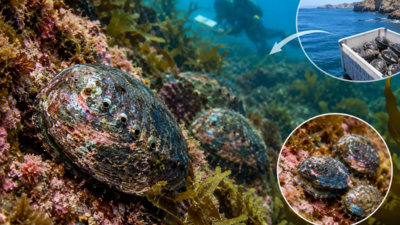
In 2023, scientists relocated 246 endangered black abalone to a protected coastal site in California to help restore a population devastated by disease. Three years later, surveys recorded 302 individuals, compared with 54 before the intervention, while the density in high-quality habitat reached one abalone per square metre. Researchers also discovered juvenile abalone, raising hopes of renewed reproduction. According to a study published in Frontiers in Conservation Science, the results suggest that carefully planned relocation and habitat restoration could help the species recover. However, scientists say further monitoring is needed to establish whether the population can reproduce successfully and sustain itself over time.
Why black abalone needed intervention
Black abalone (Haliotis cracherodii) is a marine mollusc found along the Pacific coast of North America, including California and Mexico. It lives on rocky shorelines in the intertidal zone, where it attaches itself to hard surfaces and feeds on algae. The species suffered severe population declines during the 1980s and 1990s because of withering syndrome, a disease associated with the bacterium Candidatus Xenohaliotis californiensis. Populations declined dramatically, and black abalone was listed as endangered under the US Endangered Species Act in 2009.Recovery has been difficult because black abalone reproduce by releasing eggs and sperm into the water. This method, known as broadcast spawning, works best when individuals live close enough together for fertilisation to occur. When populations become too sparse, reproduction becomes less successful, making natural recovery harder even when suitable habitat remains.
How the relocation was carried out
The conservation project moved abalone from a recovering population on Santa Cruz Island to the Jack and Laura Dangermond Preserve in California. Although the receiving site offered suitable rocky habitat, its black abalone population had remained depleted following earlier disease-related losses.The relocation took place in two phases in 2023, with the first group moved in March and the second in October. Researchers also restored selected sections of rocky habitat by clearing some mussels, algae and other organisms that occupied spaces used by abalone.The project brought together scientists from the University of California, Santa Cruz, The Nature Conservancy and partner organisations. Researchers monitored the animals and surveyed the wider site to assess population numbers, habitat conditions and evidence of recruitment, the process through which young animals join a population. The researchers reported a mortality rate of 1.6% between collection and release, suggesting that the animals could be transported with relatively little immediate loss.
Abalone numbers increased over three years
The results were encouraging. In March 2022, before the relocation, researchers counted 54 black abalone across 11,719 square metres of surveyed habitat. The number increased to 252 by March 2024 and reached 302 in February 2026. Density in high-quality habitat also rose, from 0.2 individuals per square metre in 2022 to 0.76 in 2024 and one per square metre in 2026. Greater density is important because black abalone need to live relatively close together for successful reproduction.Researchers estimated that more than 80% of the relocated animals were accounted for in surveys three years later, although tag loss and the difficulty of detecting animals in crevices prevented precise estimates of survival. Scientists therefore could not reliably distinguish every relocated abalone from those already living at the site. The increase in the overall count is promising, but it does not independently prove that the population has become self-sustaining.
Juveniles offer hope for recovery
During the February 2026 survey, researchers recorded 12 juvenile black abalone measuring between 18 and 40 millimetres, along with six small adults measuring around 50 millimetres. The discovery was significant because juveniles had not been recorded at the site during monitoring and broader habitat surveys since the disease-related decline in 1993. Their presence suggests that conditions may once again support recruitment and the survival of young abalone.However, researchers have not yet established whether the juveniles were offspring of the relocated animals. Genetic parentage analysis will be needed to determine their origin. The findings therefore indicate possible renewed reproduction rather than definitive proof that the relocated population is breeding successfully.
What happens next?
The study shows how relocation, habitat restoration and long-term monitoring can help rebuild a depleted marine population. Researchers hope the approach will inform future black abalone restoration efforts, particularly along mainland southern California, where populations remain low.The next challenge is to establish whether young abalone survive to adulthood and whether the population can maintain itself without continued intervention. For now, the rise from 54 recorded individuals to 302, alongside the appearance of juveniles, offers encouraging evidence that carefully managed conservation can give this endangered species a better chance of recovery.