

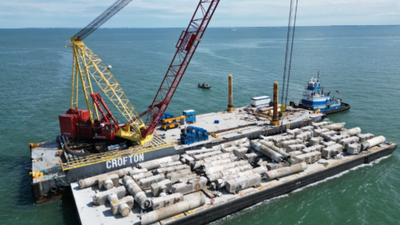
A bridge built to carry thousands of vehicles across Virginia’s waterways is getting a second life beneath them. As part of the $3.9 billion Hampton Roads Bridge-Tunnel expansion, crews are dismantling decades-old infrastructure and sending the concrete to artificial reefs in Chesapeake Bay, where it can provide shelter for marine life. By the time the project is completed, workers are expected to have removed around 100,000 tons of concrete, with 951 tons already delivered to Bluefish Rock Reef, according to a June report by WHRO.The initiative is intended to reduce the amount of demolition waste sent to landfills while adding structures to underwater habitats. Rather than treating the old bridge material solely as construction debris, Virginia’s transportation authorities and marine-resource officials are using it to expand an artificial reef programme that has been operating for decades.
From bridge rubble to underwater habitat
The Hampton Roads Bridge-Tunnel connects the Hampton and Norfolk areas of Virginia. Its expansion involves constructing two new tunnels and trestle bridges to double the number of driving lanes. Making room for the new infrastructure also requires the removal of older sections of the bridge system.Ryan Banas, the Hampton Roads Bridge-Tunnel Expansion project director for the Virginia Department of Transportation, told WHRO that the material being dismantled includes bridge decks, the beams supporting them and the piles or foundations extending into the bay floor.The scale of the planned removal is substantial. WHRO reported in June that approximately 100,000 tons of concrete, equivalent to about 200 million pounds, were expected to be dismantled by the time the expansion was completed in 2027. That figure is the projected total for the project, not the amount already placed underwater.The contractor is working with the state to redirect suitable material to artificial reef sites. Banas said the approach allows the project to reuse material that might otherwise be demolished and sent to landfills, while supporting wildlife habitat. The reuse strategy may also be cheaper than conventional disposal. However, Banas said officials had not provided a precise estimate of the savings, so the financial benefit cannot yet be quantified.
How the concrete reaches the seabed
The process involves more than dumping rubble into the water. According to WHRO, demolished sections are loaded onto barges and transported offshore. A large crane, using a block-and-pulley system, then lowers the concrete onto the bay floor. Individual pieces can weigh as much as 50,000 pounds. Their size and weight make careful positioning essential, particularly at sites used by boats and other vessels.Hunter Smith, an artificial reef specialist with the Virginia Marine Resources Commission (VMRC), told WHRO that three-dimensional imaging is used to help ensure the material is placed according to restrictions designed to prevent navigation hazards. The placement process must also follow the applicable requirements for each permitted reef site.The project’s official materials-management plan sets out conditions for using demolition material at artificial reefs, including minimum water-depth requirements and compliance with the commission’s terms. It identifies Bluefish Rock Reef among the potential receiving sites and explains that suitability depends on the conditions at each location.By June 2026, the contractor had delivered 951 tons of rubble to Bluefish Rock Reef, located approximately four miles east of Buckroe Beach in Hampton. WHRO reported that demolition had been limited at that stage, with activity expected to increase as traffic moved fully onto the new bridges.
Why artificial reefs matter
Artificial reefs create hard surfaces in underwater environments where marine organisms can attach themselves and grow. Microorganisms and other small organisms colonise the structures, attracting baitfish and, in turn, larger predatory species. The structures can also provide shelter from predators and currents.Smith told WHRO that this process helps support the food chain, from the smallest organisms to larger fish. Species associated with Virginia’s artificial reefs include black sea bass, flounder, red drum and tautog.The reef programme predates the bridge expansion by several decades. Smith said it began in the 1960s and 1970s, when decommissioned Liberty ships from the Second World War became available for reuse. The VMRC now manages 23 artificial reefs across Chesapeake Bay and Virginia’s Atlantic coast.These sites also serve recreational anglers. The commission provides online maps and a mapping application to help people locate reefs, making the structures useful for both marine habitat and fishing.Most of Virginia’s artificial reefs cover approximately half a mile in diameter, according to WHRO. Building them takes time because much of the material comes from construction projects and other donations. The rate at which an individual reef remains exposed can also depend on sediment accumulating on the bay floor.
A second life for ageing infrastructure
The concrete from the Hampton Roads Bridge-Tunnel expansion is expected to remain underwater for decades once it has been positioned, according to WHRO’s report. Its long-term value will depend on how the material settles and how marine organisms colonise the resulting structures.The project is not without constraints: only suitable material can be used, and placement must meet environmental and navigation requirements. The official materials-management plan outlines those conditions rather than treating all demolition waste as suitable for reef construction.For Virginia, the effort links a major transportation project with an existing marine-resource programme. The expansion will add road capacity above the water, while parts of the infrastructure it replaces will become structures beneath it.The full 100,000-ton reuse target remains a projection, but the initial deployments show how demolition material can be redirected towards a different purpose. Concrete that once supported vehicles crossing Chesapeake Bay is now being used to create underwater surfaces where marine life can find shelter and food.