

A die-hard fan of the Marvel superhero Iron Man, 31-year-old advocate Arvind Rao, a wheelchair user with 75 per cent disability, often jokes that while Tony Stark built a metal suit to survive, he built resolve.
“Everyone needs an arc reactor. Something that keeps you going when things get heavy,” he says with a grin, referring to Iron Man‘s fictional energy source, his distinctive, slightly slurred voice reflecting a readiness to take on the world that challenges him at every turn.
On a winter morning in February, the air outside the Delhi High Court carries a faint chill. Lawyers in black robes move briskly between courtrooms, files tucked under their arms, voices rising in urgent fragments of law and logistics.
Near the lawyers’ canteen, at a table colleagues have quietly come to reserve for him, Arvind waits. An attendant approaches, asking if he wants anything. He greets the man first, exchanges pleasantries and settles down.
“Don’t bother about my voice. It sounds as if I am heavily drunk. This is why I am not comfortable talking to people who I haven’t met. Customer care guys disconnect my call, thinking I am drunk. They don’t even listen to my grievances. I have stopped taking such calls,” he says in a calm tone.
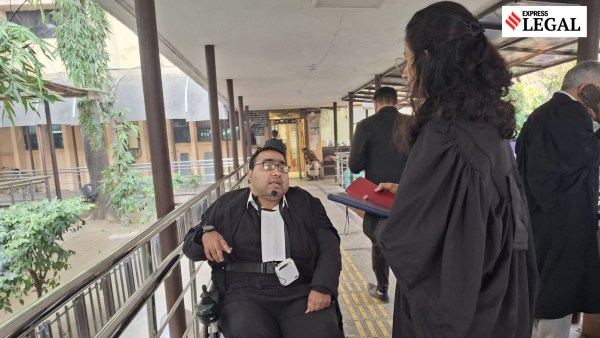 During the day, his junior Anushka Rathore assists Arvind. (Photo by Vineet Upadhyay)
It is around 9.30 am. Dressed in the classic lawyer’s outfit – black blazer and trousers, crisp white shirt and advocate’s band – and seated in his battery-powered wheelchair, an irrepressible Arvind waits for his junior, Anushika Rathore, who has been assisting him for over five months now.
A wearable microphone rests neatly against his lapel, connected to a mini-speaker that amplifies his voice. Spectacles frame eyes that miss little. And there it is – the defiant smile. Wide, unembarrassed, and constant.
Story continues below this ad
“The day is relatively light. I do not have a case in any of the main courts today. Just one matter before the registrar,” he says while adjusting his mic and speaker. There is no trace of complaint in his voice, only efficiency.
Résumé of quiet defiance
Born in 1995 and now serving as government counsel for the Centre, Arvind was diagnosed with cerebral palsy at the tender age of 16 months. Yet, the milestones he has accumulated in the three decades since tell a story of steady defiance.
In 2004, as a child, he featured in a Discovery Channel documentary on the disabled-friendly infrastructure of the Delhi Metro. For most viewers, it was a fleeting clip; but for him, it was a declaration. “It was a big achievement for me,” he says, eyes lighting up. “I still watch that clip where I feature.”
Even then, he seemed to understand something essential – visibility matters.
Story continues below this ad
Anushika arrives at around 9.40 am, playfully accusing him of delaying her arrival by handing her some work related to a case. He counters the charge with theatrical indignation. The two head toward the registrar’s court. Minutes later, they learn the matter is listed for noon.
He has nothing but praise for Anushika. “She has been my shadow and is really hardworking and skilled. She supports me throughout the day in my work.”
Time stretches. Conversation fills it.
IAS dream
There was a time when Arvind envisioned a different path – one that led not to courtrooms but to Lutyens’ Delhi, to policy files and government briefings. At his father’s suggestion to secure a government job, he began preparing for the Civil Services Examination in 2018.
He chose self-study over coaching classes, relying heavily on YouTube lectures and online study material. After graduating in political science from Khalsa College, Delhi University, he devoted a year exclusively to preparation.
Story continues below this ad
“I made good use of YouTube and various websites. There is so much available if you are disciplined,” he recalls. His routine included dabbling in the complexities of polity, history, geography, the Constitution and a number of other subjects for over 14 hours.
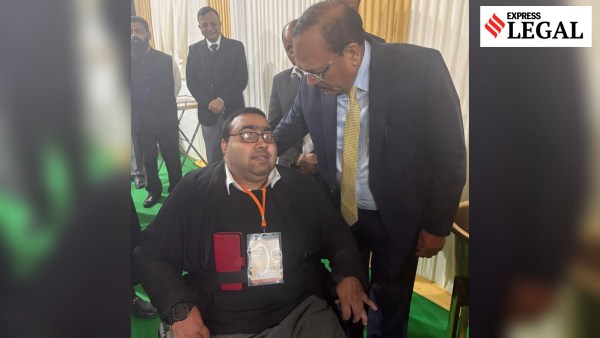 Interacting with Chief Justice of India Surya Kant on the sidelines of an event. (Photo by special arrangement)
“That phase was like exam fever. I would study hard, get tired and then start again. That became a cycle for almost a year. I was totally focused on the preparation.” When he could not clear the preliminary examination, Arvind found himself at a crossroads. “I was disappointed for some time and couldn’t decide what to do next,” he says. “I thought, why waste time? One needs to identify what is achievable and what is not.” He decided to recalibrate.
Law as inheritance, calling
Law, for him, had always been present in the background. His father, Yashwant Rao, and brother, Anubhav Rao, are both advocates. The profession felt less like a fallback and more like a second inheritance waiting to be claimed.
“Lawyers play an important role in upholding the Constitution. If you want to make your own name and contribute to society, you have to be independent. This profession offers immense possibilities,” he says.
Story continues below this ad
Arvind enrolled in the three-year LLB programme at the Law Centre II (LC II), Delhi University, but did not confine himself to lectures and notes. He threw himself into moot courts, rallies, student elections, protests and social media engagement.
“Log mujhe ‘bechara’ feel karate, lekin mujhe aisa nahi lagta tha (People used to make me feel pitied, but I never felt so myself). I never saw myself as incapable. Physical limitations have always existed, but incapability is a mindset. I decided to take charge of my life and dabbled in everything,” says the self-proclaimed ‘perfumista’.
Remembering his days in college, when he did not have the luxury of a battery-powered wheelchair, Arvind says he is grateful to his friends. “They used to help me move around in college. I am still in touch with them and feel privileged to have them in my life,” he adds, smiling ear to ear.
In 2023, he cleared the All India Bar Examination on the first attempt – a quiet but significant milestone.
Story continues below this ad
Coffee, companionship, perspective
By late morning, Arvind wheels into the Starbucks inside the court complex, drawn as much by the accessible restrooms as by the comforting coffee. The staff greet him warmly.
“Cold coffee,” he orders, smiling.
He waits for Anushika to help him sip it. As he poses for the camera with a victory sign, an air of poignancy sets in. Unaffected, he goes on to explain why he loves Starbucks so much. “This place is my refuge on the premises. It’s not that I don’t like other places, but here I feel more relaxed than ever. The washrooms here are more comfortable and friendly for me,” he says.
Arvind finds public toilets inconvenient. While hygiene is an issue, his primary frustration stems from a dislike of relying on someone else for help.
Between pauses, Anushika reflects on how working with him has reshaped her own thinking. “After failing the judicial services exam for two-and-a-half years, I was in a deep slump. Joining him changed my perspective. Within days, I realised how privileged we are. We should not waste our lives,” she says, while pointing out that Arvind’s “zindadili”, or zest for life, is his most striking trait.
He brushes off the praise, but it lingers.
Story continues below this ad
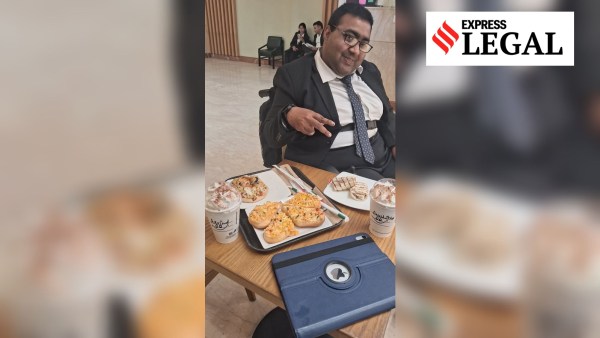 Arvind describes the Starbucks inside the Delhi High Court complex as his “refuge”. Its accessible restrooms are a key highlight. (Photo by special arrangement)
Maiden case
In 2024, Arvind filed his first case, a public interest litigation (PIL) before the Delhi High Court seeking the inclusion of “ichthyosis” in the government’s list of rare diseases. Ichthyosis comprises over 30 genetic skin disorders that cause persistent dryness, thickening and scaling, with severe forms even impairing organ function.
Appearing before the then Chief Justice Manmohan, and now a Supreme Court judge, he argued that individuals with ichthyosis required systematic recognition and support. “We studied international laws in the UK, USA and Australia. I was scared as it was my first appearance, but I gathered courage. You have to stop being afraid and take action,” he says.
The court directed the Union Ministry of Social Justice to consider his representation. It was not merely a procedural order, but validation.
Victory that felt personal
His first major win came in the Supreme Court in 2024. Representing a Class 9 student with autism who had been denied a scribe and extra time during examinations, Arvind argued that inclusion must be substantive, not just symbolic. The court subsequently directed the Central Board of Secondary Education (CBSE) to provide the necessary accommodations.
Story continues below this ad
“I was overjoyed. It felt personal. Disability inclusion must go beyond tokenism,” he says.
With the earnings from the case, he bought himself an iPad. “I love technology. Buying it with my own money was my peak moment. Maybe bigger achievements will come, but that feeling won’t be replicated.”
For Arvind, independence is measured in small, hard-won purchases. And this victory came in sharp contrast to what he had gone through in his last year of law course.
“The police had arrested a disabled person in a manner so inhuman, I was angry and disgusted. The accused was literally dragged by the police. This scared and repelled me. I approached the Supreme Court with a PIL. The judge could not understand what I was saying. I was put on mute and the court refused to hear my plea. I was told to go to the Disabilities Commission. I felt bad and humiliated then. I wondered if people with disabilities do not have the same rights as others,” Arvind says, the pain in his voice palpable.
Invisible battles
Not all battles are fought in court. “Maybe I was a camel in my previous life,” he quips, referring to his habit of avoiding water in court to reduce restroom visits that require assistance. And this is despite undergoing gall bladder surgery in 2024.
When asked if he realises that it is going to adversely impact his health, he responds, “I am aware, but I can’t even stand, and have to urinate in bottles – that too with the help of someone.”
His day begins at 6 am. His 64-year-old father sleeps beside him, turning him at intervals through the night to prevent discomfort. “Isn’t it ironic? When I reached the stage to practice law, I couldn’t even turn in bed. But I am not going to stop now.”
Morning routines, including bathing, grooming and dressing, require assistance from his mother or brother. “My parents and brother help me. Bhabhi is also kind and takes care of me, but I feel I should not trouble them all.” By 8 am, he reaches the family’s Barakhamba Road office, where he is a proud co-founder.
Case preparation follows. Tea. Strategy.
At around 9 am, his father drops him at the Delhi High Court and returns at 5.30 pm to pick him up, carefully lifting both son and wheelchair into the car, a choreography perfected over years.
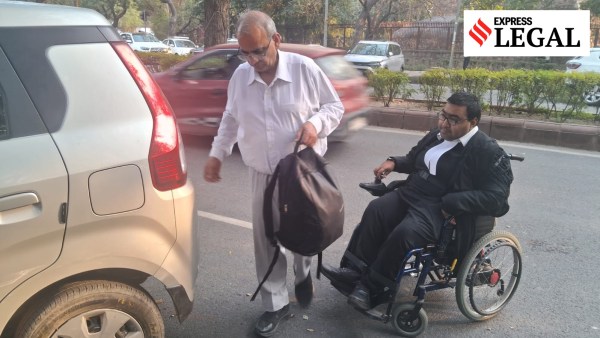 Arvind’s father Yashwant Rao drops him at the Delhi High Court in the morning and picks him up in the evening. (Photo by Vineet Upadhyay)
Weighing around 105 kg, Arvind worries about his recent weight gain. “No matter what I eat, the weight refuses to go down. I know it is important, but it’s out of control now,” he says. As winter sets in, the pollution triggers rashes and swelling. And, at times, vulnerability surfaces.
“My only insecurity is what will happen to me after they are gone? Who will take care of me? What am I going to do then? I do not want to think about it.” At the same time, he dislikes unsolicited sympathy.
Ecosystem of inclusion
As the matter before the registrar concludes, Arvind navigates ramps and lifts with practised ease. The infrastructure helps, but it is the ecosystem of acceptance that sustains him.
Advocate Sahil Chaudhary, Arvind’s best friend, once intern with him at the Delhi High Court Legal Services Committee (DHCLSC), admits that when he first saw Arvind, he wondered how this person would manage litigation. “Then I saw his fire. His dedication knows no bounds. I realised why he chose this profession. He is meticulous,” Chaudhary says.
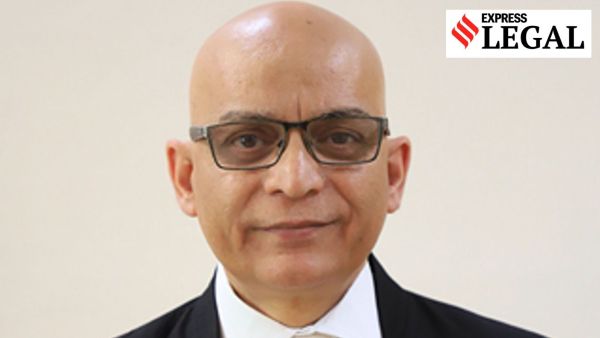 If a person with disability transcends to the bench, litigants who are disabled will perhaps feel confident that the difficulties that they face day- to- day will be addressed empathetically, said Justice Rajiv Shakder.
Justice Rajiv Shakdher (retd), former Chief Justice of Himachal Pradesh High Court and former Delhi High Court judge who headed the disability committee, was instrumental in getting Arvind his internship with the DHCLSC.
Recalling his interaction and interview with Arvind, Justice Shakdher told The Indian Express, “What is most important is to provide avenues for work. Since differently abled persons like Arvind have sharp minds, they need intellectual satisfaction. When I asked Arvind what is it that he expected from DHLSC, he said he needed work.”
Justice Shakdher also pointed out that there is an erroneous notion that differently- abled persons won’t be able to deliver. “What we did was open up the avenues for work. And, this is what the government must also do. When you provide opportunities, passionate and hard-working people like Arvind gain confidence. The government could begin by empanelling them, and ones who show their mettle could go on to become senior advocates or judges.”
This will be a big step towards inclusivity, said Justice Shakdher. “If a person with disability transcends to the bench, litigants who are disabled will perhaps feel confident that the difficulties that they face day-to-day will be addressed empathetically,” he added.
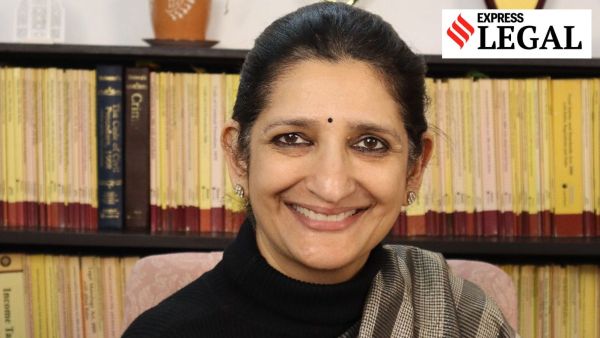 While everyone talked about their problems, Arvind talked about how he was giving free legal aid by phone to women and disabled, said senior advocate Nandita Rao.
Senior advocate Nandita Rao remembers meeting him at a Delhi High Court Women Lawyers Forum function about challenges to lawyers with special needs. “He had a never-give-up attitude. Inclusion gave him a chance, but he became an asset to the legal services front office,” she says, crediting Justice Shakdher for supporting inclusive initiatives.
She recalls, “While everyone talked about their problems, he talked about how he was giving free legal aid by phone to women and the disabled.”
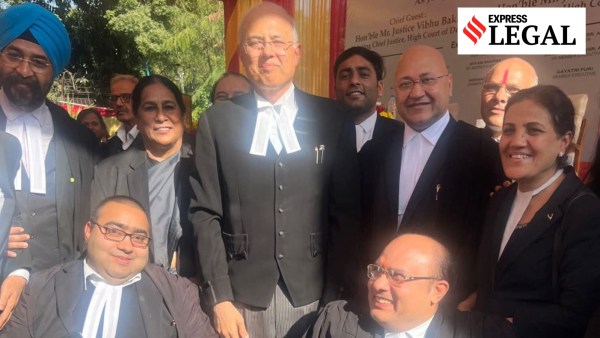 Arvind Rao with the then Delhi High Court Chief Justice Manmohan (centre), now a Supreme Court judge, and others on the premises of the Delhi High Court. (Photo by special arrangement)
“A wheelchair cannot confine Arvind,” advocate Shyam Sharma of the Delhi High Court Mediation and Conciliation Centre sums it up. “His smile teaches us about life. He is one of the most dedicated people I know.”
Turning point
Yashwant traces everything back to a high fever at 16 months that left his son Arvind with an inability to maintain balance. Treatment at AIIMS followed. In 2002, the family moved to Dwarka after discovering a school for children with special needs.
“I received a pamphlet in a newspaper that talked about special children and their education. I called them up, and a teacher told us education would empower him. We held on to that,” he says.
Yashwant recalls the time when his mother advised them against paying “double fees” and saving the money to secure his future. There were financial strains, double the usual school fees, and even attendants who quit unexpectedly. But Yashwant and his wife persisted.
Dr Mala Amit Kumar, Arvind’s former teacher at Pragati Public School, describes him as “highly determined and hardworking, proof that limitations exist only in the mind”.
“One of the most painful moments in his life was when some children laughed at him because of his physical disability. It was humiliating for him, but instead of losing confidence, he chose to focus on his studies,” Dr Mala says.
“I saw his intelligence, sensitivity, and determination. He worked hard to improve himself. Today, as an advocate, he is an inspiration to many,” she adds.
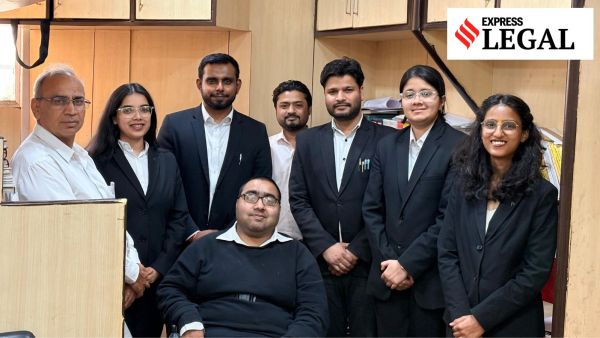 Advocate Arvind Rao with colleagues at his office at Barakhamba Road, Delhi. (Photo by special arrangement)
No armour, but a steely resolve
As evening settles, Arvind returns to his office to meet interns, review files, and prepare for the next day. “Sir is meticulous and loves what he does. He also ensures that the environment of the firm is conducive to growth,” says Devansh Sharma, an intern with Arvind.
In a world that often equates strength with physical power, Arvind embodies another kind. Unlike his favourite superhero, he does not wear armour of steel. There are no mechanical suits, cinematic battles, or explosive backdrops.
But in courtrooms and corridors, in carefully drafted petitions and hard-earned victories, in the daily negotiations with infrastructure and assumption, his resilience gleams just as bright. And perhaps that is what truly makes him invincible.
“Just treat me like a human being,” he says in a resilient tone.