

If they miss the deadline, thousands of properties, some of them centuries old, may slip into a digital void.
That fear hangs heavy outside a central masjid in Hyderabad, where small groups of men wait in silence, files pressed close to their chests. Some hold rolled gazette notifications and title deeds while others carry electricity bills, tax receipts or fragile photocopies salvaged from ageing registers. Every scrap of paper matters. A few hundred metres from the masjid, across a busy road, another queue mirrors the first. On a designated floor inside a government office, young men with sunken eyes and parched lips — evident effects of fasting — type relentlessly into laptops. Every document that can establish a property as waqf must be uploaded to the UMEED Waqf portal before time runs out.
The urgency is unmistakable, the anxiety visible. The first deadline has already slipped by. The next one, March 12, is barely a fortnight away, and the scale of the task is overwhelming.

Launched amid promises of reform, the UMEED (Unified Waqf Management, Empowerment, Efficiency and Development) portal was pitched last June by Union Minister for Minority Affairs Kiren Rijiju as a system that would “not only bring transparency but also help the common Muslims, particularly women and children”. Conceived as a centralised digital platform, it seeks real-time uploading, verification and monitoring of waqf properties, offering geo-tagged inventories, GIS integration, transparent leasing records, an online grievance redressal system and public access to verified data.
In Telangana, however, the ground reality began unravelling within days of the exercise. Thousands of waqf properties had to be identified, their paperwork traced, collated and digitised, often from fragmented, incomplete or disputed records, within a rigid timeframe. Distrust over intent, unfamiliarity with digital procedures, confusion over technical questions and legal uncertainty combined to slow the process, even as the clock kept ticking.
Matters were further complicated when the All India Muslim Personal Law Board (AIMPLB) approached the Supreme Court of India. With the outcome described within the community as disappointing, hesitation set in among mutawallis (manager, caretaker or superintendent of a waqf, an Islamic charitable endowment) and managing committees.
Besides, there was dissatisfaction over the approach of the AIMPLB. While the Board had initially discouraged uploading documents to the portal, citing apprehensions that the Union government could interpret it as acceptance of the Waqf (Amendment) Act, the position later shifted amid fears of irreversible loss.
The AIMPLB is of the opinion that the legislation is discriminatory and contradicts Articles 14 (equality before law and equal protection of the laws), 25 (freedom of conscience and free profession, practice and propagation of religion) and 26 (freedom to manage religious affairs) of the Constitution.
Explaining the dilemma, AIMPLB spokesperson and member S.Q.R. Ilyas told The Hindu says, “We had hoped for a halt on uploading till the issue was fully dealt with. But in order not to lose out, the Board then said people can go ahead with uploading. The case has to go to a larger bench of the Supreme Court, and the Board will fight it out, including on aspects of law of limitation.” The scale of what is at stake is staggering. According to Telangana State Waqf Board CEO Mohammed Asadullah, the State has 33,929 gazette-notified waqf properties while another 13,400 were identified during the second waqf survey. This is in addition to about 2,800 waqf institutions listed in the Kitab-ul-Awqaaf, the register of endowments maintained by authorities that existed before 1954.
Spread across cities, towns and remote villages, these assets form the backbone of religious, charitable and community life. And even these numbers, officials admit, may not capture the full extent of waqf-by-user properties that exist without formal records.
The problems were not merely legal or procedural; they were also technical. “After we moved the Waqf Tribunal, there continued to be some technical difficulties. The bulk approval selection was disabled. So we had to select each and every entry to either approve or reject. This proved time consuming. The number of enclosures or list of documents increased too,” says Asadullah, outlining the challenges the Telangana Waqf Board has been grappling with.
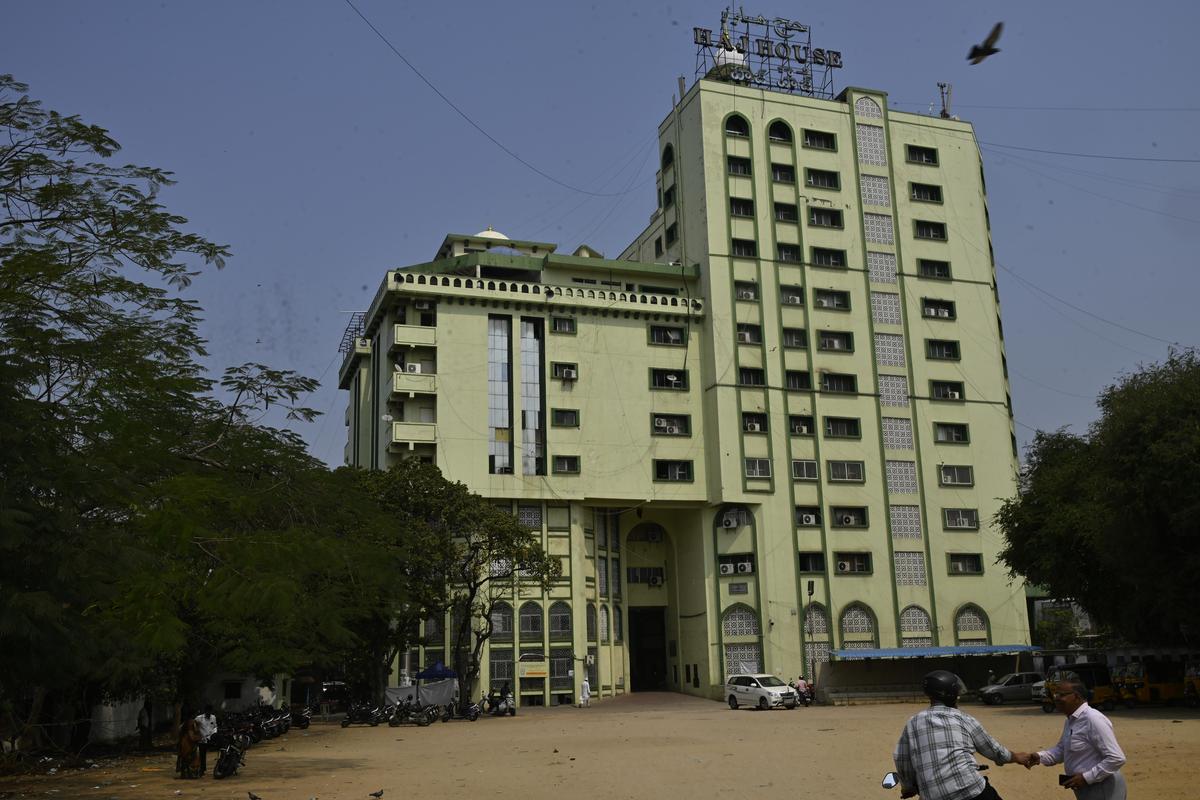
The Telangana State Waqf Board (TGWB), located at Haj House in Nampally, administers the permanent dedication of movable/ immovable property for Muslim religious or charitable purposes.
| Photo Credit:
NAGARA GOPAL
On February 23, Syed Bandagi Badeshah Quadri, a member of the Telangana Waqf Board from the mutawalli community, flagged another concern, which he says had been conveyed to chairman Syed Azmatullah Huseni. “Applications often show the status as ‘submitted’ but applicants are not informed if they are later rejected or require corrections,” he says.
Fault lines on the portal
Many, he points out, assume their applications are under process when they may not be. Since registration ultimately depends on approval on the portal, such gaps could leave properties unregistered. “There is an urgent need to alert applicants through SMS, email or portal notifications and ask them to recheck their application status,” he suggests.
Even as these technical issues and procedural ambiguities persist, the number of waqf-by-user applications has increased. This, in turn, exposed another fault line — more than one person or committee has, in several cases, staked claim to a single institution. “In this case, we decided to go according to what the records state. If the records state that a person is a mutawalli, we are not entertaining applications in which another person claims to be the mutawalli of the same waqf institution,” Asadullah explains.
When concerns around registering on the portal were at their peak last year, the human cost of the exercise played out late one night at the Shahi Masjid complex in Public Gardens. There, a room had been converted into a centre for uploading waqf property details onto UMEED portal.
A man stepped out quietly. The collar of his shirt was frayed, his trousers hung loose and worn rubber slippers slapped against cracked ankles as he walked. Hours of waiting had dulled his eyes with fatigue. He approached those assisting applicants through the night. Asked if his work was complete, he nodded. He had travelled from a place near Narayanpet, about 170 km from Hyderabad, to register a small mosque he established years ago.
“Earlier, there was no masjid for 7-8 kilometres. At our masjid, around 25 people come to pray. We need an imam (one who leads daily congregational prayers). There is a room for him to stay,” he had said.
Moments later, he climbed into a waiting autorickshaw, started the engine and drove away. His was another institution logged into a vast, still-unfinished digital exercise. Volunteers say there were many such instances: people from modest backgrounds, travelling long distances, determined to ensure that the waqf institutions they represent exist on record.
While anxiety runs high among many stakeholders, some others, particularly those associated with smaller and relatively newer waqf properties, say they have chosen not to upload documents. “It is not clear how the information will be used or whether the Central government will interfere. This is why we did not go ahead with uploading documents,” says a person, associated with a small masjid in Banjara Hills, constructed nearly five years ago, requesting anonymity.
Official data obtained on February 24 shows both, progress and backlog. As many as 17,289 properties submitted by makers were pending with checkers, while 6,638 submissions cleared by checkers awaited approval. Another 23,945 properties had already been approved. In all, records show that 62,837 waqf property registrations had either been initiated or completed. Officials, however, point out that these figures mask the scale of pending work, with verification stages, documentation corrections and approval bottlenecks continuing to slow the process.
Even as the Waqf Board grapples with numbers and technical hurdles, a new complication emerged last week, adding yet another layer to an already demanding exercise.
A new complication
The Department of Heritage Telangana (DHT), formerly the Department of Archaeology and Museums, has claimed that the Waqf Board had entered certain medieval monuments — Muslim in nature — into UMEED portal.
DHT director Arjun Rao Kuthadi told The Hindu that the department has sought the removal of these places of worship from the portal, invoking Section 3D of the Waqf (Amendment) Act, 2025.
The section renders void any declaration of a protected monument as waqf. Accordingly, any notification identifying a property as waqf would not be valid if the site is protected under the Ancient Monuments Preservation Act of 1904 or the Ancient Monuments and Archaeological Sites and Remains Act of 1958.
The Waqf Board, however, has pushed back strongly against the claims. Senior officials say while a formal response is being prepared and relevant documentation sought from the department, the issue cannot be reduced to a narrow legal reading. Questions around continuation of rituals, customs and acts of worship at such sites, they argue, must be examined and addressed.
Officials maintain that the interpretation of Section 3D itself warrants careful scrutiny. Whether the provision applies to the structure alone or to the land on which it stands, and to what extent, are matters that need deliberation, they say. A blanket transfer of institutions, along with associated land parcels, cannot be undertaken without detailed deliberation. While DHT officials have indicated that legal remedies may be explored, if required, the Waqf Board continues to assert that these are active religious places of worship and that it remains a stakeholder.
The controversy has also drawn in political voices. Hyderabad MP Asaduddin Owaisi, who is also president of All India Majlis-e-Ittehadul Muslimeen, had raised serious concerns during the introduction and passage of the amendment over how Section 3D could be implemented. He had warned that worship at such sites could, in certain contexts, be restricted or stopped altogether.
Mr. Owaisi had said the provision was not part of the original Bill but was introduced “surreptitiously” on the day of debate. The Section, he said, would “snatch masjids, imam baras and dargahs from the Waqf Board”, leading Muslims to lose their places of worship. He also cited the recommendations of the Sachar Committee, which had suggested that Muslim places of worship in Delhi under the custody of Archaeological Survey of India be handed over to Delhi Waqf Board.
Now, as legal interpretations are contested and institutional positions harden, the clock continues to tick. With the March 12 deadline for uploading documents to UMEED portal looming, Waqf Board officials say they remain hopeful of completing the process, even as the digital exercise unfolds amid unresolved disputes and rising uncertainty.