

As UPSC CSE Prelims 2026 is just a few months away, current affairs should be your primary focus. UPSC Weekly Quiz is a current affairs–based quiz on relevant topics from the past week, curated for aspirants of competitive examinations. Attempt the weekly quiz every Saturday and find detailed answers to the MCQs with explanations.
🚨 Click Here to read the UPSC Essentials magazine for January 2026. Share your views and suggestions in the comment box or at manas.srivastava@indianexpress.com🚨
The Delhi Declaration, signed during the second India-Arab Foreign Ministers Meeting, focuses on:
(a) establishing a formal India–Arab collective security alliance against maritime threats.
(b) creating a preferential trade agreement between India and the Arab League.
(c) endorsing a common currency framework for West Asian economies.
(d) the need to uphold the “sovereignty, unity, and territorial integrity” of Sudan, Somalia and Libya, and “rejects interference” in their internal affairs.
Why this question for UPSC Prelims 2026?
Story continues below this ad
A question on the Delhi Declaration at the India-Arab Foreign Ministers’ Meeting demonstrates this move toward evaluating awareness of normative views such as sovereignty, non-interference, and territorial integrity, all of which are essential to India’s West Asian outreach.
Explanation
— India hosted 22 members of the League of Arab States (AL) for the second India-Arab Foreign Ministers Meeting, 10 years after the first iteration in Bahrain.
— This meeting occurred amid escalating tensions between Iran and the US, a growing rift between Saudi Arabia and UAE, and the US President Donald Trump-led Board of Peace attempting a new approach to resolving the Israel-Palestine question.
— In a joint statement — the Delhi Declaration — after the meeting, India and the Arab League clarified their positions on a number of issues, apart from commitments to enhance cooperation.
Story continues below this ad
— The Delhi Declaration uniformly focuses on the need to uphold the “sovereignty, unity, and territorial integrity” of Sudan, Somalia and Libya, and “rejects interference” in their internal affairs.
— All three nations have been central to the growing rift between two camps in the Middle East — one led by Saudi Arabia as the principal power supported by most of the Arab League, and one led by the UAE and Israel, and supported by the US.
Therefore, option (d) is the correct answer.
QUESTION 2
Consider the following pairs:
1. Bond – A bond is a debt instrument in which an investor loans money to an entity, which borrows the funds for a defined period of time at a variable or fixed interest rate.
2. Government Security – These are money market instruments, are short term debt instruments issued by the Government of India and are presently issued in three tenors, namely, 91 day, 182 day and 364 day.
Story continues below this ad
3. Treasury Bills – These are tradeable instruments issued by the Central Government or the State Governments.
How many of the pairs given above are correctly matched?
(a) Only one pair
(b) Only two pairs
(c) All three pairs
(d) None of the pairs
Why this question for UPSC Prelims 2026?
UPSC is progressively emphasising conceptual accuracy in economic and financial tools over rote knowledge with terminology. A question separating bonds, government securities, and Treasury Bills demonstrates this trend in testing candidates’ understanding of market classification.
Explanation
— The bond market reacted sharply on Monday as the benchmark 10-year government bond yield climbed to its highest level in more than a year, a day after Finance Minister Nirmala Sitharaman presented the Union Budget and announced a record gross borrowing plan for 2026–27.
Story continues below this ad
— Bond: A bond is a debt instrument in which an investor loans money to an entity (typically corporate or government) which borrows the funds for a defined period of time at a variable or fixed interest rate. Bonds are used by companies, municipalities, states and sovereign governments to raise money to finance a variety of projects and activities. Owners of bonds are debt holders, or creditors, of the issuer. Hence, pair 1 is correctly matched.
— G-Sec: A Government Security (G-Sec) is a tradeable instrument issued by the Central Government or the State Governments. It acknowledges the Government’s debt obligation. Such securities are short term (usually called treasury bills, with original maturities of less than one year) or long term (usually called Government bonds or dated securities with original maturity of one year or more). Hence, pair 2 is not correctly matched.
— T-bills: Treasury bills or T-bills, which are money market instruments, are short term debt instruments issued by the Government of India and are presently issued in three tenors, namely, 91 day, 182 day and 364 day. Treasury bills are zero coupon securities and pay no interest. Hence, pair 3 is not correctly matched.
Therefore, option (a) is the correct answer.
(Other Source: http://www.rbi.org.in)
QUESTION 3
The 1837 Serengsia Battle was:
(a) an armed resistance by Ho Adivasis against British East India Company
Story continues below this ad
(b) a revolt led by Santhal tribes against the Permanent Settlement system
(c) a peasant uprising in Bengal triggered by European indigo planters
(d) a princely revolt supported by regional zamindars against annexation
Why this question for UPSC Prelims 2026?
UPSC is increasingly emphasising tribal resistance and subaltern engagement in the liberation fight, turning away from elite-led nationalist groups to investigate localised, early, and frequently armed opposition to colonial power. It also corresponds to UPSC’s emphasis on micro-histories that illustrate the boundaries of East India Company control.
Explanation
Story continues below this ad
— On February 2, Jharkhand Chief Minister Hemant Soren attended a state event to mark an iconic act of Adivasi resistance against the East India Company in 1837.
— This was a battle fought at Serengsia, a valley located in present-day Jharkhand’s West Singhbhum district, where Adivasi rebels exacted a heavy toll on British soldiers — only to face a great personal cost later.
— The Hos were the original, autonomous inhabitants of the Kolhan region, comprising Jharkhand’s present-day East Singhbhum, West Singhbhum, and Seraikela-Kharsawan districts.
— Around 1820-21, however, Kolhan fell under the jurisdiction of the Bengal Presidency. The British, who were looking to increase trade with Madras, needed direct control over the Adivasi regions such as Kolhan to facilitate travel along the trade routes. Around this time, the British set up a camp in the Kolhan region’s Chaibasa area, sparking a year-long conflict with the Hos.
Story continues below this ad
— Finally, in 1821, the Adivasis signed a treaty with the British. It bound them to pay eight annas per plough per year to the local Hindu king and zamindars, allowed people from other communities to reside in Adivasi lands and imposed the Hindi and Oriya languages.
Therefore, option (a) is the correct answer.
QUESTION 4
With reference to the India-Russia energy trade, consider the following statements:
1. The India-Russia energy trade was around 2 per cent of India’s energy imports before the Russian invasion of Ukraine.
2. In 2024, the India-Russia energy trade reached a record high, with Russian oil imports comprising the bulk of this trade.
Which of the statements given above is/are correct?
(a) 1 only
(b) 2 only
(c) Both 1 and 2
(d) Neither 1 nor 2
Why this question for UPSC Prelims 2026?
UPSC is increasingly testing India’s external economic recalibration in the face of global geopolitical shocks, particularly where trade data, strategic autonomy, and energy security interact. A question about India-Russia energy trade reflects this shift toward evaluating candidates’ ability to discern shifting trade patterns. It is also consistent with UPSC’s recent emphasis on data-driven statements, making it particularly pertinent for Prelims 2026.
Explanation
— The India-Russia energy trade was just 2% of India’s energy imports before February 2022 (the Russian invasion of Ukraine). That increased to more than 32% over the next few years. Hence, statement 1 is correct.
— Bilateral trade between India and Russia reached a record high of $68.7 billion in FY 2024-25, with Russian oil imports comprising the bulk of this trade, amounting to $63.8 billion. India’s exports to Russia was a paltry $4.9 billion. Hence, statement 2 is correct.
Therefore, option (c) is the correct answer.
QUESTION 5
With reference to the Graphics Processing Units (GPUs), consider the following statements:
1. India’s AI Mission subsidises GPU access for startups and researchers developing AI models.
2. India has a local GPU production capacity.
3. The Netherlands leads in the production of GPUs worldwide.
How many of the statements given above are correct?
(a) Only one
(b) Only two
(c) All three
(d) None
Why this question for UPSC Prelims 2026?
A question about GPUs highlights this move toward evaluating awareness of AI as a compute-intensive domain, the role of state assistance in democratising access to high-end hardware, and India’s continued reliance on external ecosystems for essential technology. It is also consistent with UPSC’s emphasis on distinguishing between design, production, and equipment leadership in semiconductors, making it a high-yield Prelims area for 2026.
Explanation
— As part of their interim trade agreement, India and the United States have announced that they will “significantly increase trade in technology products, including Graphics Processing Units (GPUs) and other goods used in data centers, and expand joint technology cooperation”.
— Since India does not have a local GPU production capacity, with American companies like Nvidia leading the race globally, it is understood that New Delhi will import these commodities to meet the ever-growing compute needs of its startups building AI models and applications. Hence, statements 2 and 3 are not correct.
— Under the recently announced Union Budget, the allocation for the IndiaAI Mission to Rs 1,000 crore in 2026-27 from Rs 2,000 crore this fiscal year, raising concerns over the country’s AI push. India’s Rs 10,370 crore IndiaAI Mission subsidises GPU access for startups and researchers developing AI models. Hence, statement 1 is correct.
— Under the Mission, about 40,000 GPUs have been installed so far, which is widely considered as not enough computing capacity for companies, especially given that individual American companies leading the AI race have access to significantly more computing capacity.
Therefore, option (a) is the correct answer.
QUESTION 6
With reference to the T-cells, consider the following statements:
1. These are a type of red blood cells.
2. They can either kill the harmful cells directly or signal other immune cells to join the fight.
3. These are central to immunotherapy.
Which of the statements given above is/are correct?
(a) 1 and 2 only
(b) 2 only
(c) 2 and 3 only
(d) 1, 2 and 3
Why this question for UPSC Prelims 2026?
UPSC is progressively integrating fundamental biological principles with modern medical and technology applications, rather than examining separate textbook information. A question on T-cells highlights this shift towards measuring our understanding of key immunity systems alongside their real-world significance in cutting-edge therapeutics.
Explanation
— Immunotherapy is reshaping cancer care by harnessing the body’s own immune system to fight tumours. Among its most promising forms is CAR T-cell therapy, in which T-cells collected from a patient are engineered in labs to recognise and destroy cancer cells. But for this therapy to succeed, scientists must grow large numbers of healthy T-cells outside the body — and retrieve them.
— T-cells are a type of white blood cells that act as the body’s frontline soldiers. They patrol the bloodstream and tissues, looking for infections or abnormal cells such as cancer. When they detect a threat, T-cells either kill the harmful cells directly or signal other immune cells to join the fight. Their ability to recognise and respond to disease makes them central to immunotherapy. Hence, statement 1 is not correct and statements 2 and 3 are correct.
— CAR T-cell therapy is a cutting-edge treatment that reprogrammes T-cells to better target cancer cells. Doctors collect T-cells from a patient’s blood and, in the lab, add a new gene that equips them with special receptors called chimeric antigen receptors (CARs). These receptors act like GPS trackers, guiding the T-cells to cancer cells. Once engineered, the cells are grown in large numbers and infused back into the patient.
— Globally, CAR T-cell therapy has been approved in the US and Europe for certain blood cancers such as leukemia and lymphoma. It has shown dramatic success in patients who had exhausted conventional treatments. However, it remains expensive, often costing upwards of Rs 3-4 crore abroad, and is still being tested for solid tumours.
Therefore, option (c) is the correct answer.
QUESTION 7
In which of the following years did the under-19 Indian cricket team win the World Cup?
1. 2008
2. 2018
3. 2024
4. 2026
Select the correct answer using the codes given below:
(a) 1, 2, 3 and 4
(b) 2, 3 and 4
(c) 1 and 4 only
(d) 1, 2 and 4
Why this question for UPSC Prelims 2026?
UPSC occasionally utilises sports-related questions to assess awareness of big international achievements that overlap with national prestige and youth development, particularly when such events get widespread policy and media attention.
Explanation
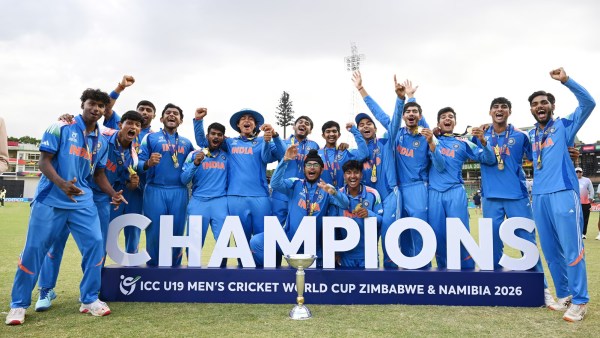
— The Board of Control for Cricket in India (BCCI) has announced a Rs 7.5 crore cash prize for the Indian Under-19 cricket team following their victory in the 2026 Under-19 World Cup. India defeated England by 100 runs in the final at Harare Sports Club on Friday to lift the title for the sixth time.
 (ICC Photo)
— India has won the ICC Under-19 World Cup a record six times, its most recent victory being on February 6, 2026, against England in Zimbabwe/Namibia. Ayush Mhatre captained India to a 100-run victory in the 2026 final. Previously, India won in 2000, 2008, 2012, 2018, and 2022.
Therefore, option (d) is the correct answer.
QUESTION 8
The Strategic Arms Reduction Treaty (START I & START II) were signed between:
(a) Russia and India
(b) Russia and Germany
(c) India and the United States
(d) The United States and Russia
Why this question for UPSC Prelims 2026?
A question about the START treaties exemplifies this shift toward raising understanding of Cold War-era arms reduction measures that continue to influence modern nuclear strategy, deterrence, and disarmament issues.
Explanation
— Following the end of the Cold War, the US and Russia signed the Strategic Arms Reduction Treaty (START I) in 1991, which meant both countries had to reduce the number of deployed strategic arsenals (1,600) and the warheads they could carry (6,000).
— The collapse of the Soviet Union and prolonged efforts to denuclearise former Soviet bloc countries meant the reductions under START I were finally completed in December 2001, and the treaty expired at the end of 2009.
— START II, a follow-on accord that was signed in January 1993, required the two sides to reduce the number of strategic warheads to 3,000-3,500 by 2003. But the agreement never came into force owing to delays in ratification by the respective legislatures of both countries and after the US withdrew from the ABM Treaty in 2002, Russia formally stepped back from START II. As a result, a proposed START III agreement never took off.
Therefore, option (d) is the correct answer.
QUESTION 9
Consider the following statements:
1. The project Cheetah was launched in 2023.
2. Madhya Pradesh’s Kuno National Park is the only home to the Namibian cheetah.
3. In India, the Asiatic cheetah was declared extinct in 1952.
How many of the statements given above are correct?
(a) Only one
(b) Only two
(c) All three
(d) None
Why this question for UPSC Prelims 2026?
UPSC regularly evaluates wildlife conservation via the perspective of policy execution and historical context, rather than viewing it as static environmental trivia. A question on Project Cheetah exemplifies this technique by mixing current conservation initiatives with fundamental facts like extinction pronouncements and species provenance.
Explanation
— Five cubs were born at Madhya Pradesh’s Kuno National Park to the Namibian cheetah. The total cheetah population in India has risen to 35.
— The Project Cheetah launched in 2022. Hence, statement 1 is not correct.
— Kuno National Park in Madhya Pradesh is now the sole location in India where translocated Namibian (African) cheetahs are maintained. Hence, statement 2 is correct.
— Drawing on the 2013 Action Plan and Supreme Court directions, it aims to reintroduce the Asiatic cheetah (Acinonyx jubatus, declared extinct in India in 1952) as a flagship animal to promote ecosystem health over broad expanses. Hence, statement 3 is correct.
Therefore, option (b) is the correct answer.
(Other Source: http://www.pib.gov.in)
QUESTION 10
Consider the following statements:
1. India’s agricultural export to the United States has consistently increased from 2020 to 2025.
2. India maintained a trade surplus in agricultural exports to the United States in the last decade.
Which of the statements given above is/are correct?
(a) 1 only
(b) 2 only
(c) Both 1 and 2
(d) Neither 1 nor 2
Why this question for UPSC Prelims 2026?
UPSC is focusing more on trade composition and sector-specific balances, going beyond headline bilateral trade data to assess deep understanding of agriculture, market access, and export competitiveness. A question about India-US agriculture trade reflects this tendency toward determining whether candidates can identify between long-term structural trends and short-term fluctuations.
Explanation
— During January-November 2025, the US exported agricultural produce worth $2.85 billion, a 34.1% jump over the $2.13 billion for the same 11 months of the previous year. The exports for the whole of 2025 are set to top $3.1 billion, which would be an all-time high.
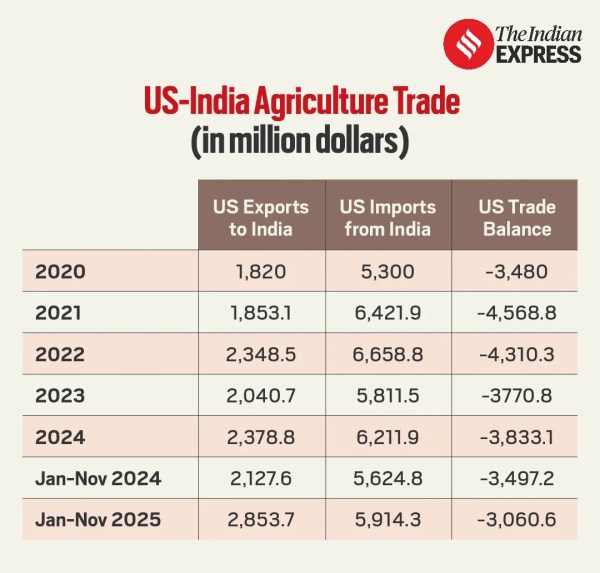
— India’s agricultural exports to the United States have not increased consistently year-on-year from 2020 to 2025. Hence, statement 1 is not correct.
— India has consistently maintained a trade surplus in agricultural trade with the United States over the last decade. Hence, statement 2 is correct.
— On the other hand, US imports of Indian farm produce have risen by only 5.1%, from $5.62 billion in January-November 2024 to $5.91 billion in January-November 2025. America’s agricultural trade deficit with India has correspondingly reduced from $3.5 billion to $3.1 billion. In 2024, the deficit was $3.8 billion (table 1) and not $1.3 billion, as mentioned by Secretary Rollins.
Therefore, option (b) is the correct answer.
Previous Weekly Quiz
UPSC Weekly Current Affairs Quiz | January 25 to January 31, 2026
UPSC Weekly Current Affairs Quiz | January 18 to January 24, 2026
UPSC Weekly Current Affairs Quiz | January 11 to January 17, 2026
UPSC Weekly Current Affairs Quiz | January 04 to January 10, 2026
UPSC Weekly Current Affairs Quiz | December 28, 2025 to January 03, 2026
Subscribe to our UPSC newsletter and stay updated with the news cues from the past week.
Stay updated with the latest UPSC articles by joining our Telegram channel – IndianExpress UPSC Hub, and follow us on Instagram and X.