
In a profession often romanticised for its prestige but tested by patience, Supreme Court judge Justice B V Nagarathna offered young law students a sobering reminder – becoming a lawyer is not a moment of arrival but a lifelong process of forging character, discipline and integrity.
Addressing aspiring lawyers at the valedictory ceremony of the 22nd edition of the K K Luthra Memorial Moot Court in Delhi, Justice Nagarathna dismantled popular myths surrounding success in the legal profession and warned against the pressure of constant comparison amplified by social media platforms such as LinkedIn.
She stressed that the making of a lawyer depends less on visible accomplishments and more on values such as patience, humility and respect for the institution of the court. “I implore you to cultivate respect and unflinching obedience in your duties towards the court,” said Justice Nagarathna.
Each lawyer has a place in the profession
Justice Nagarathna acknowledged that young lawyers entering the profession today often confront the perception that law is overcrowded and opportunities are limited. However, she reassured students that the profession still holds space for those willing to work with commitment and conviction.
“It is important to remember that despite the prevailing narrative that the law as a field is ‘over-saturated’ and that success is hard to come by for anyone except the already established, I would say each and every single one of you has a place in the legal profession and is capable of finding sufficient opportunities,” said Justice Nagarathna, addressing the gathering.
“When you are assured of your own belonging and the validity of your ambitions, free of self-doubt and self-deprecation, even the systemic challenges become one that can be worked on, worked around and worked through,” she added.
‘Great lawyers are forged’
Justice Nagarathna emphasised that professional excellence is built gradually through discipline and resilience rather than instant recognition. “Great lawyers are not born but are forged through every exam they pass, moot court they may participate in and questions they ask in class,” she said.
Story continues below this ad
Justice Nagarathna said that they are distinguished by their patience, their response to losing a case, their ability to tolerate delays and inconveniences, willingness to learn from seniors and peers, and readiness to help someone junior to them.
Competition anxiety, LinkedIn exaggeration
Reflecting on the pressures that law students face today, the judge warned against the culture of constant comparison and exaggerated professional milestones often showcased online.
She said that as a law student, it is not uncommon to feel as if one is being consumed by competition, as it feels like your peers are able to accomplish much more than you and seem to be progressing while you are stuck in a rut.
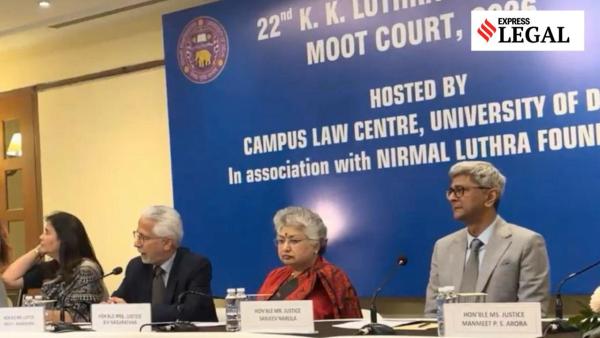 Speaking about criminal law, Justice Nagarathna said the discipline holds a unique responsibility as it deals with the state’s power over life and personal liberty.
“With the proliferation of platforms like LinkedIn, where there is mostly exaggeration, it may feel like nothing you do can ever measure up to the constant announcements of accomplishments and availing opportunities by others. In such times, it helps to remind yourself that progress is not linear, and that some of the seemingly futile endeavours you engage in today may actually pay off in unexpected ways in the future,” she added.
Story continues below this ad
Duties of a young lawyer
Asked how young lawyers should evolve to secure themselves a rightful place in the profession and society, Justice Nagarathna emphasised the need for lawyers to act with dignity and respect, uphold the integrity of the judicial system, refuse to use illegal or improper means, apply constitutional methods of advocacy and avoid long drawn-out submissions.
She also highlighted the ethical responsibilities lawyers owe to clients, including providing competent representation, maintaining confidentiality, avoiding conflicts of interest and communicating effectively.
Calling on young practitioners to become socially responsible lawyers, Justice Nagarathna encouraged them to take up legal aid and pro bono cases. She emphasised that such cases may not promise fame or financial reward, but they have the power to transform lives and strengthen access to justice.
Moot courts ‘bridge gap’
Justice Nagarathna highlighted the importance of moot courts in preparing students for the realities of legal practice. “While a moot court competition may formally have a certain set of winners amongst all participants, I am hopeful that all of you would still affirm that your mere participation is meaningful,” said Justice Nagarathna.
Story continues below this ad
She encouraged students to reflect on what they gained through the experience: “Are you better informed? Were some pre-existing beliefs of yours challenged? Were you able to present your arguments with slightly more confidence before even a hypothetical court?”
“The importance of such an exercise cannot be overstated. In a rapidly changing and increasingly complex world that you are set to enter as lawyers, mere academic knowledge of the law, as learnt in a classroom setting, cannot adequately prepare you for the legal profession. This gap is actively bridged by participation in activities such as moot court competitions, where students are given the opportunity to hone their critical thinking, reading, writing and speaking abilities,” she said.
Justice Anup Jairam Bhambhani, judge, Delhi spoke about the importance of mooting in legal education. “Mooting bridges the gap between academic learning of the law and the practise of law in a real court. So mooting trains you for that and, therefore, is important for the completion of your legal education,” he said.
On improving advocacy skills, he advised students to closely observe courtroom proceedings. “Every minute you have to spare, go and sit in a court of law and observe proceedings in a court and watch senior counsels and lawyers who do well, watch them very carefully. Their body language, their demeanour, their approach,” added Justice Bhambhani who was formerly a judge with the Delhi High Court.
Story continues below this ad
Inside the moot problem
Shubhangni, who practises at the Delhi High Court and was the problem drafter for the moot court, said it focused on fundamental criminal law principles. “Problem was on culpable homicide not amounting to murder integrated on technology which is rudimentary of criminal law. My idea was for students to go back to the basics, because sometimes as lawyers and as students we go into so many complications that we forget the first principles and it is important how cases can be won on first principles,” she pointed out.
Criminal law demands fairness, integrity
Speaking about criminal law, Justice Nagarathna said the discipline holds a unique responsibility as it deals with the state’s power over life and personal liberty.
“What is thus expected of a practitioner of criminal law is not merely legal ingenuity, an awareness of precedent and compelling strategies of advocacy, but also a sense of fairness, compassion, open-mindedness and integrity.”
Global participation
The 22nd edition of the competition drew widespread participation, receiving 138 registrations from institutions across 13 countries, with 72 teams qualifying for the oral rounds after a rigorous selection process.
Story continues below this ad
Participating institutions included leading law schools such as the National Law School of India University, Northumbria University, University of Mauritius, North-West University and the University of Zimbabwe.
Senior advocate Geeta Luthra spoke about the global participation the competition has attracted over the years. “Year after year, you get people evincing an interest in participating. One day it is Washington, the next day it is Noridge, the third day it’s Cambridge, the fourth day it’s Korea then this time it was Ethiopia, Mongolia. Earlier, we had Pakistan twice. You have participants from all over the world giving an opportunity to forge friendships, feel enriched and become integrated with each other,” she said.
Professor Gunjan Gupta said the moot has continued to grow since its inception. “Every year since 2005, we have been organising this. We have the support of our Vice-Chancellor sir and given the legacy of 102 years and a rich alumni base here, coupled with the dedication of students, the event has transpired with such a meaningful outcome,” she added.
Legacy of K K Luthra
Speaking about her father, renowned criminal lawyer K K Luthra who passed away in 1997, Geeta Luthra said, “My father was a first-generation lawyer. There will always be a first-generation lawyer, the second and third generations will have to prove their worth of the first-generation lawyer. So you can’t assume. It is equally difficult. They have to prove that they are worthy of their grandfather and father. So, every generation has its challenges.”
Story continues below this ad
She emphasised the importance of mastering the basics of criminal law and trial strategy. “My father was a brilliant criminal lawyer. He was one of the best cross-examiners I have seen. I myself am very good at cross-examination. As you grow older, your opportunity to keep going to trial court for cross becomes less. But I think it’s about how much a person thinks about their cross. How much do they think about their case?”
“When a child comes for a moot, they should have first principles: What is the issue about? What is the strength of the prosecution case? How can I show the strength and cover the weaknesses? Look for judgments which say small weaknesses should not defeat the prosecution’s case. If there are strengths, then they should talk about those strengths,” she elaborated.
With inputs from Sumit Kumar Singh.