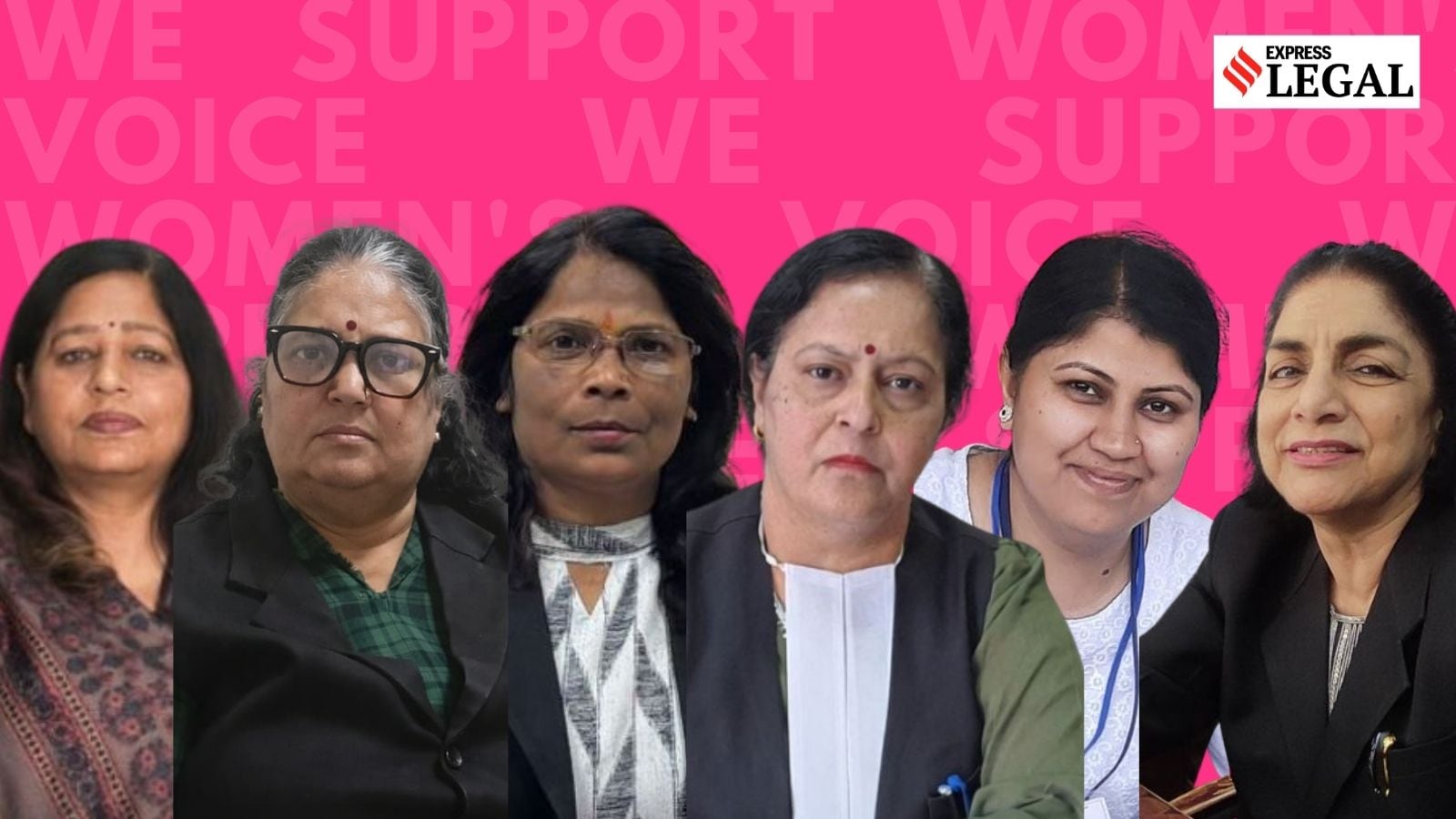
Women’s Day Special Report: Seated behind modest desks in the bustling corridors of Delhi’s courts, these women spend their days verifying identities, stamping affidavits, and signing off on documents that may even cross continents. The work seldom draws attention, but their seal carries the weight of the law.
Ahead of Women’s Day on March 8, The Indian Express spotlights a group of women advocates who have carved out a space for themselves as notaries. While balancing litigation, family pressures and health issues, these women confront professional hierarchies, ethical dilemmas and everyday sexism. Their journeys are telling – empowerment is not always loud, sometimes it is a steady hand holding a stamp.

Notary, not by choice: Advocate Abha Tomer
In the crowded corridors of the district courts, where ambition often arrives dressed in black coats and courtroom dreams, 56-year-old Abha Tomer sits behind a desk, stamping documents that travel far beyond.
A notary not by choice but by compulsion, Abha once dreamt of building a flourishing legal practice. Courtroom arguments, client conferences, the steady climb of a litigator’s career – that was the plan.
But life intervened.
A tragic accident in 2005 left Abha with a severe head injury that altered the course of her professional journey. The recovery was long, the impact lasting. By 2011, she had taken up the role of a notary at the district court, a position that was less an aspiration and more a necessity. Her health and age, she explains quietly, narrowed her options.
A notary is a lawyer authorised to draw up and validate contracts, deeds and other documents. Serving as an impartial witness during the signing of legal documents, notaries help prevent fraud and ensure that transactions, including real estate deeds, affidavits, wills, trusts, and powers of attorney, are carried out with proper documentation.
For Abha, what followed was a subtle shift in how she was perceived, at home and within the legal fraternity. “They think that it would have been better if I was practising, because you don’t have much income doing this,” she says. Even among colleagues, she senses an invisible hierarchy.
Story continues below this ad
Now, with 13-14 years behind the desk, Abha has grown accustomed to the daily rhythm of attestations and affidavits. But she hasn’t grown immune to the behaviour it invites. “Men do it more. Women come with a lot of arrogance. When they come to attest documents, they behave very rudely because they are advocates,” she says.
The slight is often subtle – a tone, a dismissive gesture, the assumption that a notary’s role is mechanical rather than meticulous. And yet, within this constrained space, she has found something that works in her favour. “They prefer women notaries more because they are regular and more reliable,” she adds. While some male counterparts are often absent from their desks, she says women show up and stay. “If we want to go for lunch or use the washroom, we will get up at that time only.”
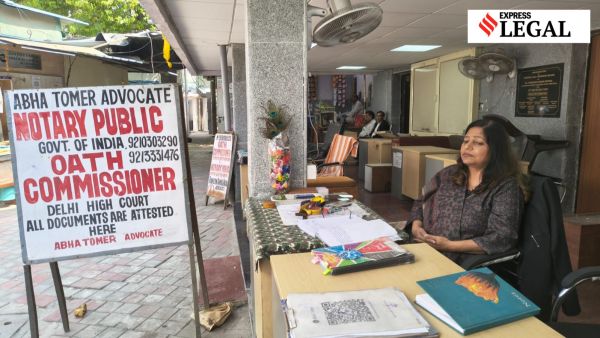 With over 13 years behind the desk, Abha Tomer, 56, has grown accustomed to the daily rhythm of attestations and affidavits. A notary’s seal is not ornamental, but authoritative, she says.
The discipline is not glamorous but unwavering: arrive at 10 am, remain seated till 6 pm, document after document passing through careful hands.
Despite her own journey, Abha has a word of caution for young advocates. “This is a time of learning. So, you should not apply for this job. It will end your practice.” To her, the notary’s desk can become a professional cul-de-sac if chosen too early. Law practice demands risk, exposure and leads to growth. Notarial work, while steady, can anchor one in a place.
Story continues below this ad
Yet, she is equally aware of the weight the role carries. A notary’s seal is not ornamental, it is authoritative. “Because the attestation of a notary is valid all over India and all over the world. All clients who are going out of India also have to do attestation. So, you have to do it very carefully,” she says.
Each signature carries legal consequences that stretch across borders. Every stamp is an endorsement of authenticity. The responsibility is immense, even if the recognition is not.
In Abha’s words lies a quiet paradox – a profession indispensable to the legal ecosystem, yet often overlooked within it.
I’m my own role model: Advocate Niharika Dudeja
With over 15 years in the legal profession, advocate Niharika Dudeja, 40, a woman notary practising at Tis Hazari Courts, does not see her role as a mechanical exercise in stamping and signing papers. For her, every attestation carries the weight of accountability.
Story continues below this ad
A graduate of Moradabad College, she completed her law degree in 2010 and traced her path from Western Uttar Pradesh to one of Delhi’s busiest court complexes.
After over a decade in active practice, Niharika decided to get a notary licence. “I applied in 2023 after 13 years of practice,” she says. The process was far from swift. The licence finally came through in 2025 after application scrutiny, interviews, merit listing and document verification.
Was the wait frustrating? “Usually, such work takes time and is slow,” she says. Even the eligibility requirement, which mandates years of experience, seems justified to her. “You need time to stamp your authority in the field. You need time to gauge the nuances of practice and advocacy,” Niharika says, stressing that experience refines judgment, a quality central to the work of a notary.
She describes notary work as a government-permitted part-time assignment. “Advocacy is social work. Notary is a part-time work undertaken by advocates.”
Story continues below this ad
The earnings, she explains, are unpredictable. On an average day, about 10 to 15 people approach her for notarial services, but only “one or two individuals” typically meet the requirements for attestation. Scrutiny is strict. “If I don’t find it genuine, I return the document,” she says firmly.
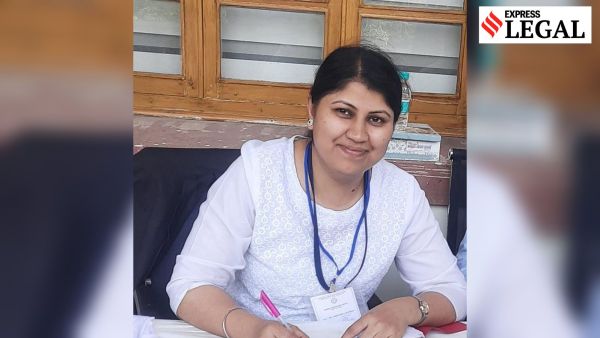 Niharika Dudeja says that if a notary is irresponsible, it can invite criminal proceedings. “Sometimes you will need to fight for those who can’t fight for themselves,” she adds.
One of the most frequent challenges Niharika faces is the absence of the actual deponent. “Their relatives or family members come. When someone appears without the actual person whose document is required to be attested, it feels like a challenge.”
She insists on verifying identities, examining clauses and ensuring that nothing illegal or questionable slips through. “When you attest any document, you are taking accountability that it is genuine. If you don’t work with responsibility, it can invite criminal proceedings,” she says.
Unmarried and self-assured, she speaks with quiet conviction about building her own path. Asked about role models, her response is immediate, “I don’t have any. I consider myself a role model.”
Story continues below this ad
On Women’s Day, her advice to young women entering the field is measured and rooted in experience. “Give complete focus and attention to your work. Consider it a social service. Sometimes you will need to fight for those who cannot fight for themselves,” she says. “And you will need a lot of patience. Many leave within months because they lose patience. Don’t. Focus on building knowledge. In this profession, knowledge is power.”
Navigating confrontations, ethical pressures: Advocate Usha Rani
In the crowded corridors of Rohini Courts, where files change hands as swiftly as arguments are made, advocate and notary Usha Rani has quietly built a career defined as much by resilience as by routine.
For her, the law has been a carefully chosen path, one navigated alongside family responsibilities, financial calculations and the unglamorous realities of practice. A resident of Kamla Nagar in Delhi, Usha completed her schooling in Haryana and graduated from the national capital.
Even before marriage, Usha knew she wanted a career. Her husband was encouraging. Her brother-in-law, then a law student, further reinforced her decision. She enrolled in an LLB programme at Kanpur University, where relatives could offer support. In 1997, she completed her degree and enrolled with the Delhi Bar two years later.
Story continues below this ad
Her entry into full-time litigation was timed with care. “Legal practice requires long hours and constant dedication, especially in the early years. I wanted to ensure that my child completed matriculation before I fully committed myself to the profession,” she says.
In 2004, she began full-fledged practice at Tis Hazari Courts. On December 12, 2006, she shifted to Rohini Courts, where she continues to practise. On April 28, 2008, she was appointed as a notary, a designation she has balanced alongside litigation. But the heart of her professional identity, she makes clear, lies in advocacy.
“Though I have been working as a notary for years, my main source of income has always been my legal practice,” she says. “The fees prescribed under the Notaries Act are very small. For attestation, the prescribed fees range from Rs 35 for smaller instruments up to about Rs 150 for higher-value instruments. When you look at these amounts, it becomes clear that it is nearly impossible to depend entirely on notary work for a livelihood,” Usha explains.
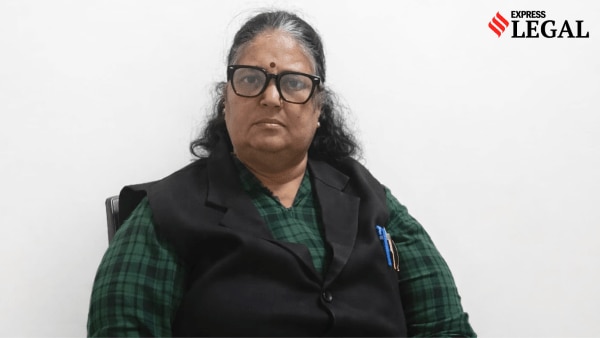 Usha Rani’s desk sees a steady stream of affidavits, settlement deeds, visa papers, travel documents and adoption-related paperwork, sometimes even documents from outside India.
Around 54 notaries function out of Rohini Courts, some appointed area-wise, others centrally empowered to work across Delhi. Seating operates through a pool system shared with oath commissioners. On allotted days, she attends to notarial work, unless court hearings take precedence. “On my pool days, I sit for notary work if my schedule allows,” she says.
Story continues below this ad
Her desk sees a steady stream of affidavits, agreements, settlement deeds, visa papers, travel documents and adoption-related paperwork, sometimes even documents originating outside India.
Yet, despite the range of documents, confusion persists between notaries and oath commissioners. Although a recent high court ruling clarified that notaries can attest court documents as well, litigants are often insistent, saying, “The oath commissioner will do it.”
The tension is frequently financial. Oath commissioners typically charge around Rs 20 for an affidavit, while notaries are prescribed Rs 35. Many litigants demand the lower rate even from notaries. “Arguments can escalate quickly, and sometimes people threaten to file complaints within minutes. These everyday confrontations make the work stressful,” she says.
There are deeper ethical pressures too.
According to Usha, one common challenge arises when only one party to a two-party agreement appears for notarisation. “Legal verification requires both parties to be present, yet requests to bypass this safeguard are common. Resisting such pressure while adhering to statutory requirements is among the toughest aspects of the job,” she says.
Usha’s journey mirrors the lived experience of notarial work, where professional integrity is tested not in landmark cases but in everyday decisions.
Claiming space, not shrinking: Advocate Shyamla Pal
Advocate Shyamla Pal has built a life that carefully balances courtrooms and kitchen tables, legal aid panels and family gatherings. Practising in Delhi since 2006 and later qualifying as a notary, Shyamla’s professional journey is all about endurance, negotiation and quiet resilience.
For nearly two decades, she has carried her black coat and her responsibilities home with equal steadiness. A mother in a joint family and a legal professional navigating a demanding system, Shyamla has learned to inhabit both worlds without apology.
She specialises in cases under the Protection of Children from Sexual Offences (POCSO) Act and serves as a professional mediator with the Delhi Dispute Resolution Society (DDRS), Shahdara. After completing her LLB and having practised law for seven years, she chose to become a notary.
Shyamla explains that women advocates who have completed seven years of practice and are enrolled with the Bar Council of India (BCI) are eligible to apply for the position. “My son is definitely interested in coming to the legal profession, but my daughter isn’t,” she shares, an unmistakable pride in her voice in being a working mother whose children have grown up watching her build something of her own.
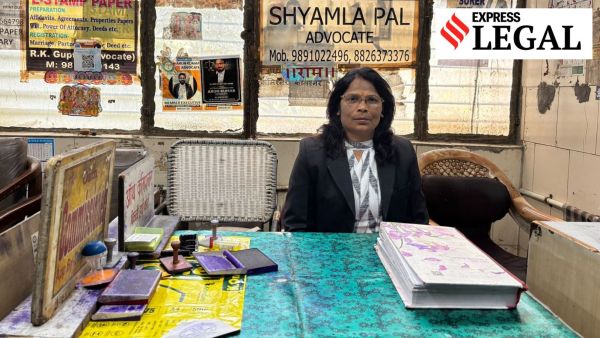 For Shyamla Pal, moving to Delhi after marriage meant she had to switch to the English medium – one of the many silent adjustments made by women like her who take on new identities after tying the knot.
The balancing act has not been without emotional weight. Many women, she reflects, operate under an unspoken burden — a constant “mom guilt” that society plants deep within. “Having supportive family and in-laws helps a lot,” she says, recalling how they stepped in to care for her children when court hours stretched long.
The early years, though, were hard amidst the quiet hierarchies of a male-dominated profession. “If you have some backing, it’s easier,” she says, opening up about discrimination and the advantage of generational support. Men with established family names in law often find doors opening more easily, while first-generation lawyers — especially women — must push harder.
There were moments of real danger too. Criminal litigation can blur the lines between courtroom confrontation and personal risk. Shyamla recalls a chilling incident when she was threatened by a criminal client, prompting her to formally report it in court.
Her challenges were also linguistic. “I studied at Allahabad University, and after marriage, I had to come here. Hindi medium runs there. The real challenge here is English medium,” she adds, shedding light on another silent adjustment demanded of women who move cities, homes and sometimes take on entirely new identities after tying the knot.
Shyamla’s philosophy, however, has hardened into clarity. Quoting a line often attributed to American author Byron Katie, she says to the upcoming generation of working women, “You cannot satisfy everyone – not at home, not outside.”
For her, Women’s Day is about awareness. “People think they need money to go to court. That is not true,” she says, emphasising that many lawyers offer services free of cost under government legal aid schemes.
Her concern extends beyond courtrooms. Speaking about the rise in POCSO cases, she says many girls growing up in uneducated or unaware households do not know their basic rights. Parents, she insisted, must teach children about bad touch and good touch – a crucial conversation that has the power to reshape society.
For Shyamla, empowerment is not abstract. It is a working woman stepping into court each morning. A mother returning home without apology. A lawyer telling clients that justice does not belong only to those who can pay for it. And it is, perhaps most importantly, women knowing their rights and claiming space for themselves in a world that once expected them to shrink.
Chance turn to law: Advocate Pooja Bhasin
Advocate Pooja Bhasin’s table, placed right at the main entrance of the notary hall in Saket Court, has witnessed thousands of signatures, conversations and quiet confrontations. The 55-year-old has been a notary here since 2010, but her journey began long before, almost by accident.
It was the summer of 1980. Fresh after completing her BSc at Gargi College, she was headed to collect MSc Chemistry admission forms from Miranda House – then one of the most sought-after destinations for science students. “We got off the bus, all of us friends, science students. My score was very good, 85 per cent, so it was very easy for me to get admission. But, on the way, we found this building – the faculty of law – and jumped in to find out what they taught,” she says.
That spontaneous detour reshaped Pooja’s life. She completed her law degree in 1990, the same year she got married. “I wanted to work. After marriage, I never gave up the idea of working and starting my own practice. That persistent aspiration finally met with reality when I somehow managed to start going to Patiala Court,” she says.
Pooja began her practice under a senior lawyer known to her father-in-law. “The picture was totally different. There were hardly any women back then. The only visual I remember is men in black suits in every corner of the court.”
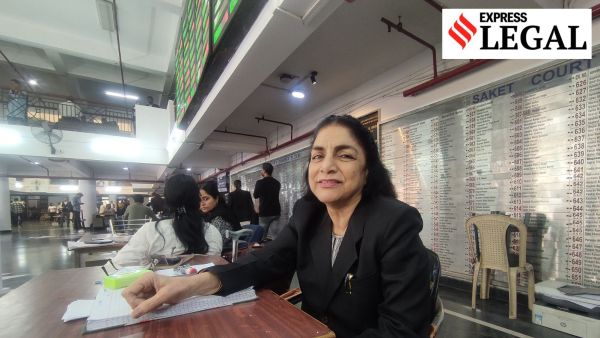 Not long after donning the black coat, Pooja Bhasin realised that the world, and especially the legal profession, rewarded confidence and courage.
In the beginning, she hesitated to voice her opinions. Confidence, she realised, was a learned muscle. “Initially, I used to hesitate when it came to raising my opinions in front of seniors. But later, I realised that the world, and especially this profession, rewards confidence and courage.”
Resistance also came from home. “My family didn’t like that I was working because money was not a problem. At one point, they started saying, ‘Which dog bit you?’.” The pressure eventually made her step back. But two years later, she returned to practise through the Delhi State Legal Services Authority (DSLSA), gradually reclaiming her space and beginning independent practice around 2000.
“I never got scared, and that is the strength that helped me sail through courtrooms,” she says. When Saket Court was inaugurated on August 28, 2010, she shifted from Patiala House to the new complex. “There was no cutthroat competition at the time. I studied law by chance, and in the same way, by doing my work, I discovered the position of notary.”
She appeared for the interview that year and was selected. “People think we just sit here. What’s so important about this? But the kind of people I deal with in a day is a challenge. Sometimes I also get threats to notarise papers that are incorrect or incomplete. Such moments teach me to build confidence and resilience as a guard.”
Leaning in, she lowers her voice: “Frankly, I also used to get scared, but I learned that I won’t be able to work if I shrink myself. So now, I just put down my pen and say, ‘Main ye nahi kar rahi, jo karna hai kar lo (I’m not doing this. Do what you want)’.”
Most people, she says, are cooperative and respectful. The work, however, has its physical demands. Long hours in court corridors and limited breaks led to a urinary tract infection (UTI) in 2019. Since then, she has been cautious.
On an average day, Pooja earns between Rs 3,000 and Rs 5,000. On lean days, it dips to Rs 2,000. The income fluctuates, and the work is often labelled “monotonous.” But at 55, she is experimenting with a new space – social media. She has begun writing about law on LinkedIn and Instagram, determined to build a presence beyond court corridors. “People know me in my fraternity, but I also want to be recognised outside of this bubble,” she says.
The young woman who once stepped into the faculty of law out of curiosity now sits firmly at her desk in Saket Court, not by coincidence anymore, but by choice, persistence and hard-won confidence.
Radically content in a world of ambition: Advocate Prabha Rani
“Sab kuch seekha humne, na seekhi hoshiyari…”
Advocate Prabha Rani hums the lilting line from the 1959 classic Anari, smiling at the irony. The song, picturised on Raj Kapoor and Nutan, speaks of innocence in a world that prizes cleverness.
Seated at her desk in the notaries’ chamber tucked beside the lawyers’ block at Dwarka Courts, Prabha says the line fits her perfectly. “My family says I am not worldly wise,” she laughs, pausing mid-sentence to read through a stack of affidavits. “I don’t bargain much when someone asks for a discount in my fee,” she says, clad in a green salwar suit.
There is no trace of regret in her voice, only quiet conviction. Mother to a son and a daughter, Prabha completed her Hindi (Honours) from Shyama Prasad Mukherjee College for Women in Delhi, before pursuing law in Lucknow and graduating in 1999. But the seed was planted earlier.
“‘Meri beti wakeel banegi ek din (My daughter will become a lawyer one day).’ My mother used to say that all the time,” she recalls, her eyes lighting up. I am living my mother’s dream happily,” says Prabha.
For nearly 26 years, the black coat has been her armour and identity. Since 2008, she has served as a notary, a role she stepped into after a decade of active litigation.
Law, she says, is not just a profession, it is persistence. “Women have to strive harder than men. We take care of children, husband, household responsibilities and then we come here and fight our cases. To sustain yourself, you have to work harder,” Prabha says matter-of-factly.
The balancing act is invisible labour, she adds. Her own career path changed after a cardiac surgery forced her to reassess the pace of litigation. “I used to actively appear in cases and had a successful stint. After my health issues, I chose notary work to lighten the workload. But I still handle more than 50 cases,” she says.
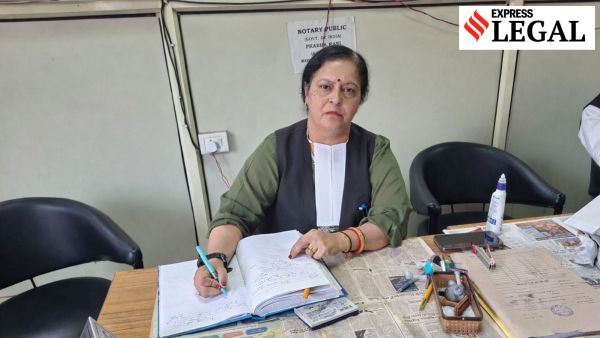 Prabha Rani’s career path changed after a cardiac surgery forced her to reassess the pace of litigation. Nevertheless, she still handles over 50 cases.
In a profession often measured by courtroom victories and hefty briefs, Prabha speaks about identity instead. “This profession has a strong identity, charm and a ring to it, at least for me. I grew up watching my uncle and brother practise law. This is what I wanted to do since I was a child.”
Does she feel notaries receive less respect than litigating lawyers? “It’s about what you want in life. If you are satisfied, that is enough. I never faced disrespect. My male colleagues have always supported and respected me. Yes, active litigation may bring more money. But I am happy.” Her contentment seems almost radical in a world driven by ambition.
If there is one message she wants to pass on, it is about selfhood: “It is of utmost importance that women have their own identity, independence and high self-esteem, something that comes from the life they build for themselves.”
After more than two-and-a-half decades in law, Prabha measures success not in fame or fortune, but in integrity. “I have worked honestly for more than 25 years,” she says, returning to her papers. “I have absolutely no complaints or regrets.”
And as the afternoon hum of Dwarka Courts rises around her, the old song lingers – a gentle reminder that sometimes, not learning “hoshiyari” is its own quiet strength.
In courtrooms where loud, spirited arguments often command attention, the work of these women unfolds quietly, even as they stand tall within the architecture of the law and in the justice system they help sustain.
With inputs from Sumit Kumar Singh.
(Sumit is an intern with The Indian Express)