


On International Women’s Day, it is business as usual in the busy Vadodara Railway Division. In Miyagam Karjan, ‘pointsman’ Damyanti Parmar inspects a railway engine and tightens the nuts and bolts. About 114 kilometres away in Godhra, Chaku Patel and Kamla Patel – also ‘pointsmen’ – assess the air brake hose assembly before clearing the train for its further run. Similarly, Dipika Ayre in Vadodara Railway Yard has just waved a green flag signalling a train to depart.
Arti Paunikar, a loco pilot (engine driver), is checking on her next shift to take passengers safely across to their destination.
‘Trackman’ Vaishali Dhote is busy inspecting the rails – welds and fittings, packing and sleepers – in Vadodara. Coaching controller and time table controller Shipra Ghosh, stationed in Vadodara, is planning to meet the annual demand for special trains for the upcoming vacation rush. She also monitors the “bad runners” (delayed trains) so that the timetable can be tweaked in real time to ensure punctuality without a cascading effect.
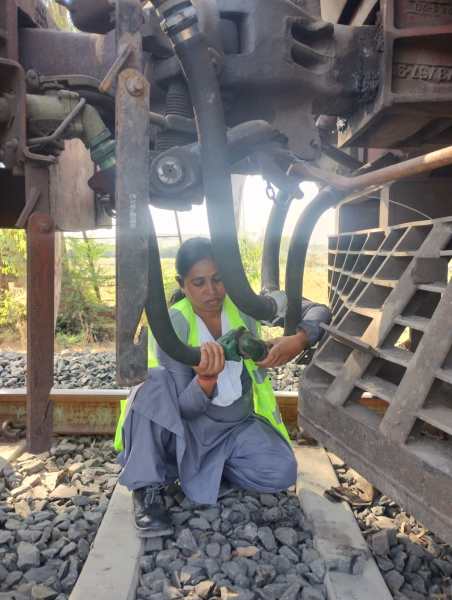 ‘Pointsman’ Damyanti Parmar inspecting a railway engine. (Express Photo)
A rare but efficient team of women is part of the railway workforce of the Vadodara Railway Division – one of the busiest junctions on the Delhi–Mumbai route. The Vadodara Division sees a daily average of 250 trains and about 2.75 lakh passengers running within and through the 900-kilometre network. The Division also has under it the busy ports of Dahej and Hazira and is planning to expand connectivity to Dholera, which lies in the neighbouring Ahmedabad Division.
At the head of the passenger and business operations that power the Vadodara Division of the Western Railway is Rini, Senior Divisional Operations Manager, who urges the women workforce to be “gender neutral” at work. In the past year since her appointment to the post, Rini’s team has seen more women volunteering for field jobs in a male-dominated department.
From Operation Sindoor to the Gambhira Bridge Collapse, to the rush during the Bihar Elections, and the festivals of Chhat and Diwali, as well as the emergency response to the recent aviation crisis in the country when Indigo flight cancellations shifted the burden of transport on the Railways, Rini and her team have “conquered it all”.
Operation Sindoor
During the high-priority military action, Operation Sindoor, in May 2025, the Vadodara Division of the Railways played a critical role in transporting logistics, personnel, and arms to the Indian armed forces, along with passenger movement. Rini explains that, along with immediacy, the entire assignment also needed to be confidential. “We would receive calls for urgent movement of goods, personnel, and logistics, and other necessary support for the armed forces and the entire team coordinated to ensure high-priority and safe passage for the same, not just in Gujarat but also outside the state… Time was the most critical. We had some regular army stops, and some were converted into special stops… We also carried tanks…” Rini recalls.
Story continues below this ad
She adds that a team of about five persons was involved in the logistical support to the armed forces: “During that time, we also received some dubious calls from persons posing as passengers and seeking information about the specific trains… We did some quick thinking and revised the action plan within 30 minutes and rescheduled the movement, even using codes for communication instead of phone conversations…”
Aviation crisis
With a motto to “never say no”, Rini and the team successfully saw through the aviation crisis, adding new trains on notice of 12 hours. She says, “We regularly add trains within a day for festival rush, depending on the demand. During the Indigo crisis, we worked on adding additional trains within 12 hours. I received a call from the DGCA, and we added trains between Mumbai and Vadodara as well as Ahmedabad to clear the stranded passengers.”
Bridge collapse
In July 2025, when the Mujpur-Gambira bridge collapsed, killing 23 and cutting off crucial connectivity between Vadodara and Anand, Rini and her team set out to assess the possibility of introducing rail connectivity between Anand and Vadodara. “We were aware that the route was important. I travelled with my team to understand how railway accessibility could be improved to meet the demand. We identified Kathana station in Anand and turned it operational within days, running Vadodara-Anand MEMU,” she adds.
Similarly, for the first time last year, trains were run from Ankleshwar to UP and Bihar to clear Chhath and Diwali rush as those originating from Surat were “already full before they reached Ankleshwar”, which is also heavily populated by migrant workers.
Story continues below this ad
Rini says that the department not only drives the daily passenger movement but also charts out strategic business alliances for the Railways. “Operations also include freight movements… We transport coal for the Gujarat Electricity Board (GEB), for instance, and recently, even automobiles… We are connected to Dahej and Hazira, and we have to ensure the timely evacuation of goods. The faster they are evacuated, the more efficient the port operations will be… We recently hosted India’s first Business Conclave of Railways in Vadodara, where more than 98 companies participated, and we were able to reach out to new customers for business alliances.”
While there are “no shortcuts or loopholes in ensuring safe running” of the railways, Rini adds that even the most driven women in the workforce face challenges. “We are a minority, and we have to prove ourselves twice… Many times, there are questions within and also from outside… Over the years, women have begun taking up field posts in the Railways. Today, we have male and female running rooms as well as male and female changing rooms. We are sensitising to ensure that we also take care of some basic needs that women have even when we are not expecting any special considerations… We are soon planning to start a creche for the children of the women workforce.”
She says that she frequently interacts with the women to motivate them to work without “getting affected by negative comments”. She says, “I am also the chairperson of the Internal Complaints Committee (ICC) [which looks into complaints of sexual harassment], and I often tell the women workforce to be brave and stand up against critics. I try to create an environment to empower women so that they don’t feel lonely and insecure. I take it as my responsibility to ensure that they aren’t vulnerable in a male-dominated field.”