India 255 for 5 (Samson 89, Kishan 54, Abhishek 52, Neesham 3-46) beat New Zealand 159 (Seifert 52, Santner 43, Bumrah 4-15, Axar 3-27) by 96 runs
By the time they had piled on a massive total of 255 for 5 – two better than they had managed in the more cramped environs of the Wankhede – New Zealand were in need of a display even more eye-popping than they had produced in their own semi-final against South Africa, where Finn Allen had belted a tournament-record 33-ball hundred.
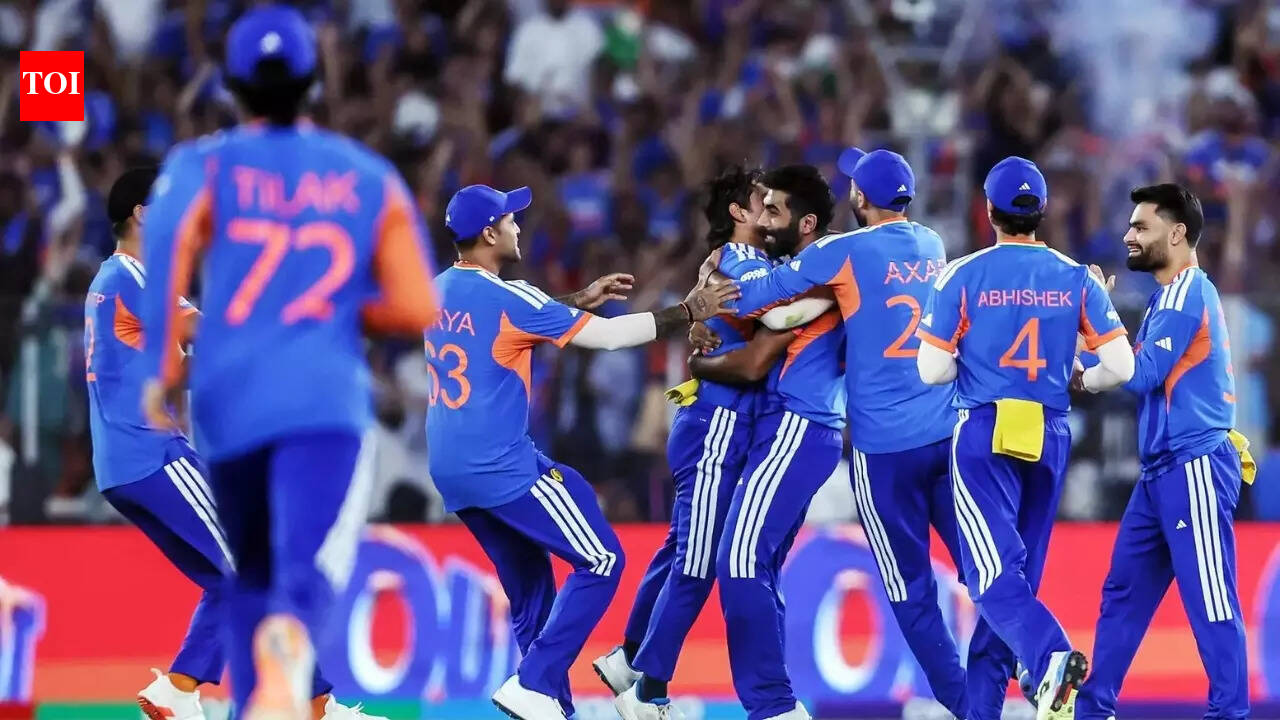
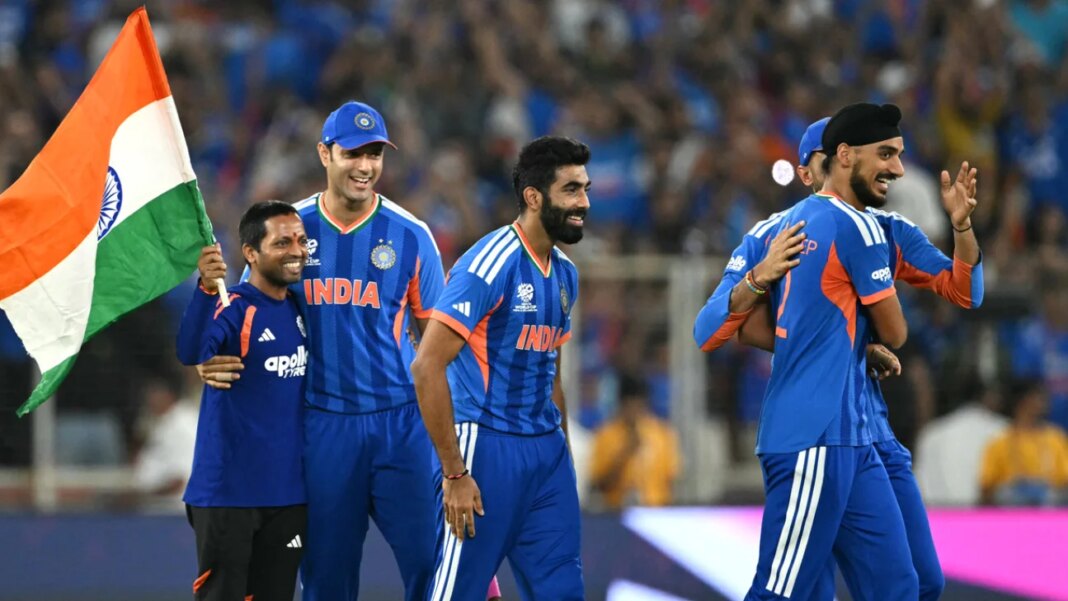
It was left to Tilak Varma to seal victory with another well-judged take at long-on off the lesser-spotted spin of Abhishek, as India became the first team to retain their title in T20 World Cup history, and give Ahmedabad the home coronation that had eluded them against their previous Antipodean opponents, Australia, at the 50-over World Cup in 2023.
For New Zealand, alas, it was a familiar tale of last-hurdle woe. This was their fifth final across ICC events since they first broke their semi-final hoodoo in 2015, but this was the most emphatic beating of the lot.
Abhishek batters the best-laid plans
New Zealand’s battleplan was to be elusive, to burgle cheap overs through a churn of rotating options and hope that India’s batters would fail to line each new man up before it was time to assess another one.
For precisely two overs, the ploy worked a treat. Matt Henry trusted himself to aim full for four consecutive dot balls to Sanju Samson, who then pumped a shorter ball over long-on, as if to prove the point. And in the absence of Cole McConchie, whose solitary over had wrecked South Africa in the semi-final, Glenn Phillips’ offspin filled the void instead, with three singles and a two in the first powerplay over of his T20I career.
But then, as quickly as the plan had taken shape, it unravelled. Jacob Duffy bowled the third over, but lost his radar after being called for a marginal wide, and Abhishek pounced with two fours in as many balls. Lockie Ferguson bowled the fourth, but was launched for 24, with Abhishek slicing him over the covers for six, before Samson launched a leading edge over deep third. Neither stroke was remotely timed, but both carried the ropes comfortably to confirm the true nature of this mixed-soil surface.
Henry returned for the fifth change in as many overs, but by now India’s horse was bolting. A diet of slower balls and wides – four in six balls, out of a total of eight in the powerplay, the most they’ve ever conceded in a T20I – confirmed that New Zealand were already trying to hide their deliveries outside of the hitting arc. But after the tournament he has endured, Abhishek wasn’t in the mood to play cat and mouse.
By the end of Duffy’s second over, Abhishek had hacked his way to an 18-ball fifty, the fastest ever in a T20 World Cup knockout game. True to his tournament form, Abhishek still hadn’t truly found the middle of his bat despite smacking 20 runs in five balls, including a top-edged swing that just eluded Mark Chapman before rolling away for four. But the “how many” mattered significantly more than the “how”. On his watch, India had racked up 92 for 0 in the powerplay, 80 of which had come from its last four overs.
Samson on the charge
Abhishek’s fun ended soon afterwards, as he snicked a wide one off Rachin Ravindra’s first ball. Their next eight overs realised a further 105 runs – technically at a slower rate than what had gone before, but the purity of the strokeplay was now off the charts.
Samson had not needed to extend himself in reaching his fifty from 33 balls. But now he celebrated with two brutal sixes off the hapless Ferguson, who retreated with figures of 2-0-48-0, and was not seen again. And, with his eye now truly in, Ravindra was planted into the stands three times in a row, including one of the flattest, fiercest inside-out drives imaginable, to take India to drinks on 191 for 1 after 14 overs.
At the other end, there was Kishan, whose timing was Rolex-worthy, right from the moment of his first-ball drive to long-on. Mitchell Santner had kept his team-mates relatively becalmed in conceding 13 runs from his first 14 balls, but Kishan clubbed him deep into the midwicket stands with a glorious slog-sweep, then repeated the dose in Santner’s final over en route to a 23-ball fifty.
Neesham nails the middle order
For those first 15 overs, the catchers in the crowd had had more success than New Zealand’s fielders – with at least two excellent efforts in the stands. All that changed in Jimmy Neesham’s second over, which began with a real sense that 300 could be on, and instead ended with that same crowd stunned into silence by three wickets for one run in six balls. His first ball to Samson was a high full-toss, and McConchie, who wasn’t in the XI, still found a means to make his mark on this final with his sure-footed take at the long-on boundary.
Four balls and a single later, and India’s other set batter was gone – this time to the low full-toss. Kishan couldn’t connect cleanly on a lusty swing, and Chapman, at long-on, had a far simpler take to complete. Suryakumar Yadav, however, required a rather more superhuman effort to extract him. His first-ball pick-up over backward square seemed to have been timed to perfection, but Ravindra galloped round the rope for a brilliant diving take.
Astonishingly, New Zealand could and should have made it four wickets for two runs in eight balls but Tilak’s first-ball cut off Duffy burst clean through Finn Allen’s taped-up hands at backward point. It didn’t prove to be especially costly, with Tilak failing to find the boundary in his eight-ball stay, but it was indicative of a fielding effort that wasn’t as good as those isolated moments of brilliance had suggested it could have been.
After limiting India to 28 runs in 24 balls from overs 15-19, Shivam Dube was on hand to apply a final smack-down, as he clubbed Neesham’s final over for 24 with two sixes and three fours, the first of which was helped over the rope by a full-length fumble from Santner at long-off. It would have been a blinder had he reached the catch, but those were the standards his team’s situation required.
Full report to follow…
Andrew Miller is UK editor of ESPNcricinfo. @miller_cricket