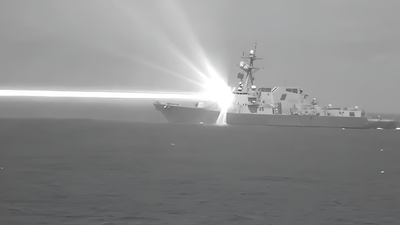
High-energy lasers are increasingly being viewed as a cost-effective way to defend against drones and missiles, especially those launched by Iran at oil refineries and US bases across the Middle East. Shooting a laser costs as little as $3.50 per shot, compared with systems like Patriot missile interceptors, which can cost more than $3 million per shot to neutralize a drone, according to some estimates.US President Donald Trump told reporters this week that lasers would soon be able to do the work of Patriot missile interceptors “at a lot less cost.”“The laser technology that we have now is incredible,” he said. “It’s coming out pretty soon.”
Decades in the making
According to NYT report, The idea of using lasers as weapons is not new. US military leaders have spent decades trying to develop the technology, pursuing a dream of a weapon that can hit a target at the speed of light and never run out of ammunition. Other countries, including Israel and China, have also deployed high-powered lasers.But the US military faces significant challenges in building and deploying lasers at scale. Experts told The New York Times that it could still be years before US soldiers routinely use lasers this way.
How lasers work
High-energy lasers concentrate beams of light on a drone’s weak spots, frying its components “like a blowtorch at a distance,” said David Stoudt, executive director of the Directed Energy Professional Society, who helped invent a device to counter improvised explosive devices in Iraq.Like a magnifying glass focusing the sun’s rays to start a fire, lasers must lock on a drone for a period of time — often three seconds or longer under cloudy conditions — raising questions about effectiveness in bad weather or against swarms of drones.“This isn’t ‘Star Trek,’ where your target is disintegrated instantaneously,” said Jared Keller, author of the Laser Wars newsletter on military technology. “Lasers aren’t magic. They run headlong into physics wherever they are operating.”
Limitations in the field
High-energy lasers are powerful under the right conditions, but they are not silver bullets. Humidity can bend rays of light, fog can block beams, and sea spray or sand can damage sensitive optical components, making them tricky to use or repair quickly.Four 50-kilowatt lasers were deployed to defend US bases in Iraq from drone attacks in 2024, but soldiers reportedly found them “cumbersome and ineffective,” according to a report by the Center for a New American Security.Scott Keeney, CEO and co-founder of nLight, a Washington-based company producing military and industrial lasers, said the technology has advanced but should not be oversold.“It is being used, and it will be used in more and more applications,” he said. “But lasers are not the solution in every environment at all times. No one should be saying that.”A 100-kilowatt laser contains roughly half the horsepower of an average car, Keeney added. Yet concentrated into a narrow beam, it can damage a plane’s engine.
Civilian risks
The use of lasers also poses risks to civilians. Pointing a laser at an aircraft can incapacitate a pilot, endangering passengers, as seen in the recent closure of an airport in El Paso, Texas. Nearly 11,000 laser incidents were reported to the Federal Aviation Administration last year.
Global adoption
Israel has experimented with a system called Iron Beam, produced by Rafael Advanced Defense Systems. The 100-kilowatt laser delivered in December is not yet ready for operational use, according to The Jerusalem Post.Australia’s Electro Optic Systems has supplied a 100-kilowatt laser to South Korea. Ukraine is deploying a smaller mobile system called Sunray, which fits in a car trunk, reported The Atlantic. China unveiled a 180-kilowatt laser, the LY-1, on a ship in September.
Cost and scale
While firing lasers is inexpensive, the systems themselves can be costly. Lockheed Martin received a $150 million contract in 2018 to build two prototypes. This resulted in HELIOS, a 60-kilowatt ship-mounted system deployed on the USS Preble in Japan.The Navy is still testing how well the system holds up under saltwater and humidity exposure. Some media reports misidentified a laser on a Gulf ship as HELIOS, but it was actually ODIN, a less powerful drone-disabling system, according to Keller.Emil Michael, undersecretary of defense for research and engineering, encouraged smaller companies to compete for laser contracts last year, designating “scaled directed energy” — including lasers and microwaves — as a Defense Department priority. Under a $35 million contract, nLight delivered a 70-kilowatt laser to the Army.Materials and production hurdlesScaling production is another challenge. High-energy lasers require rare-earth metals like ytterbium and gallium, largely produced in China. Manufacturing components such as diffraction gratings, mirrors, and lenses is slow and produces small numbers, according to a 2024 report by the National Defense Industrial Association.“Efforts to scale up production would quickly run into issues including producing optical components, beam directors, batteries,” the report said.