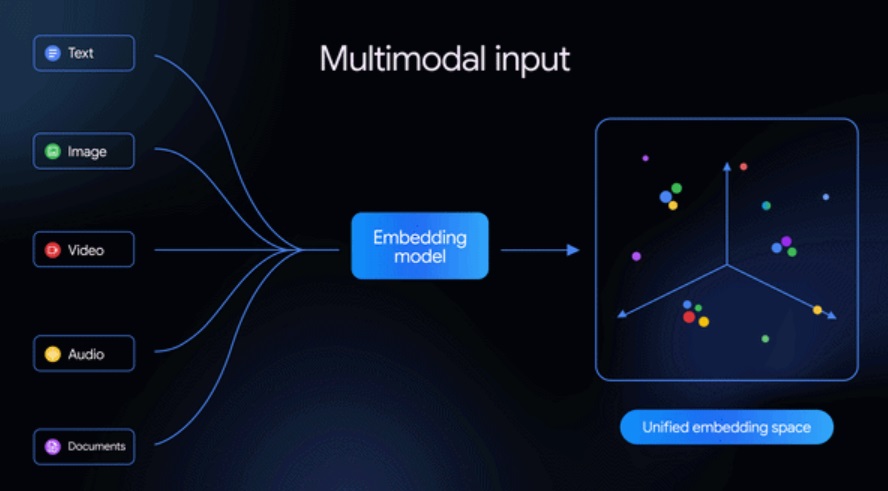
Google has introduced Gemini Embedding 2, a new multimodal embedding model built on the Gemini architecture. The model is designed to process multiple types of data, including text, images, video, audio and documents, placing them in a single integrated space.
Unlike previous embedding models that focused primarily on text, Gemini Embedding 2 extends capabilities to cross-modal understanding, enabling developers to build AI systems that analyze and connect different forms of media.
The model supports over 100 languages and can power artificial intelligence applications such as Regression Augmented Generation (RAG), semantic search, sentiment analysis, and large-scale data mining.
Gemini Embedding 2 leverages the multimodal capabilities of the Gemini architecture to generate embeddings on various data types. The model can handle interwoven multimodal data, allowing developers to combine multiple forms of data within a single request.
For example, apps can analyze text descriptions alongside images or videos, enabling AI systems to understand relationships between different media formats.
This approach helps developers work with complex datasets containing multiple types of content.
Main features
Multimodal login support
Gemini Embedding 2 supports a wide range of input formats:
- Text: Up to 8,192 input characters
- Images: Up to six images per request (PNG and JPEG formats)
- Video: Up to 120 seconds per input (MP4 and MOV)
- Audio: Live audio processing without transcription
- Documents: Supports PDF files up to six pages
Cross-modal multimodal inputs
The model can process multiple media types in a single request, enabling contextual understanding of all input such as image and text together.
This capability is particularly useful for applications that require cross-media analysis and contextual search.
Matryoshka Representation Learning (MRL)
Gemini Embedding 2 includes Matryoshka Representation Learning (MRL), which allows embedding vectors to scale to different dimensions.
The default inset size is 3072 dimensions, but developers can reduce the size depending on their storage and performance requirements.
Recommended insert dimensions include:
This flexibility allows developers to optimize infrastructure performance and costs.
AI capabilities and use cases
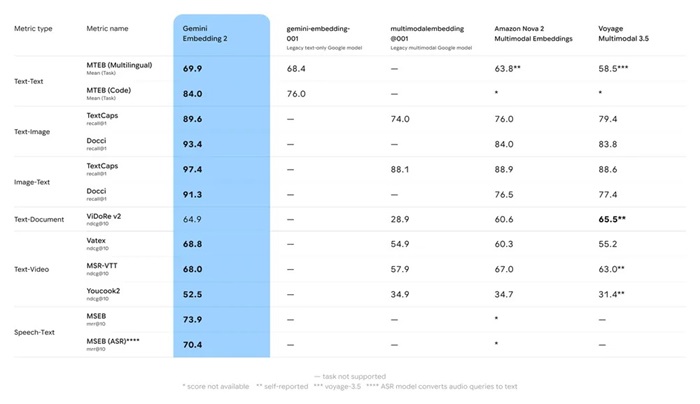
Google says Gemini Embedding 2 enables multimodal embedding in text, image, video and speech tasks, while introducing native audio processing.
The model is designed for several AI applications, including:
- Return Augmented Generation (RAG)
- Semantic search
- Sentiment analysis
- Data collection
- Large-scale knowledge management systems
Availability
Gemini Embedding 2 is currently available in Public Preview via:
Developers can integrate the model with popular AI frameworks and vector database tools such as:
- LangChain
- LlamaIndex
- Straw
- weave
- Qdrant
- ChromaDB
The model can also be combined with vector search systems to enable advanced multimodal data processing and retrieval.