4 min readMar 15, 2026 03:37 PM IST
Young innovators captured attention at the Progressive Punjab Investors’ Summit 2026, where student-led engineering projects in robotics, aerospace, and artificial intelligence were among the highlights.
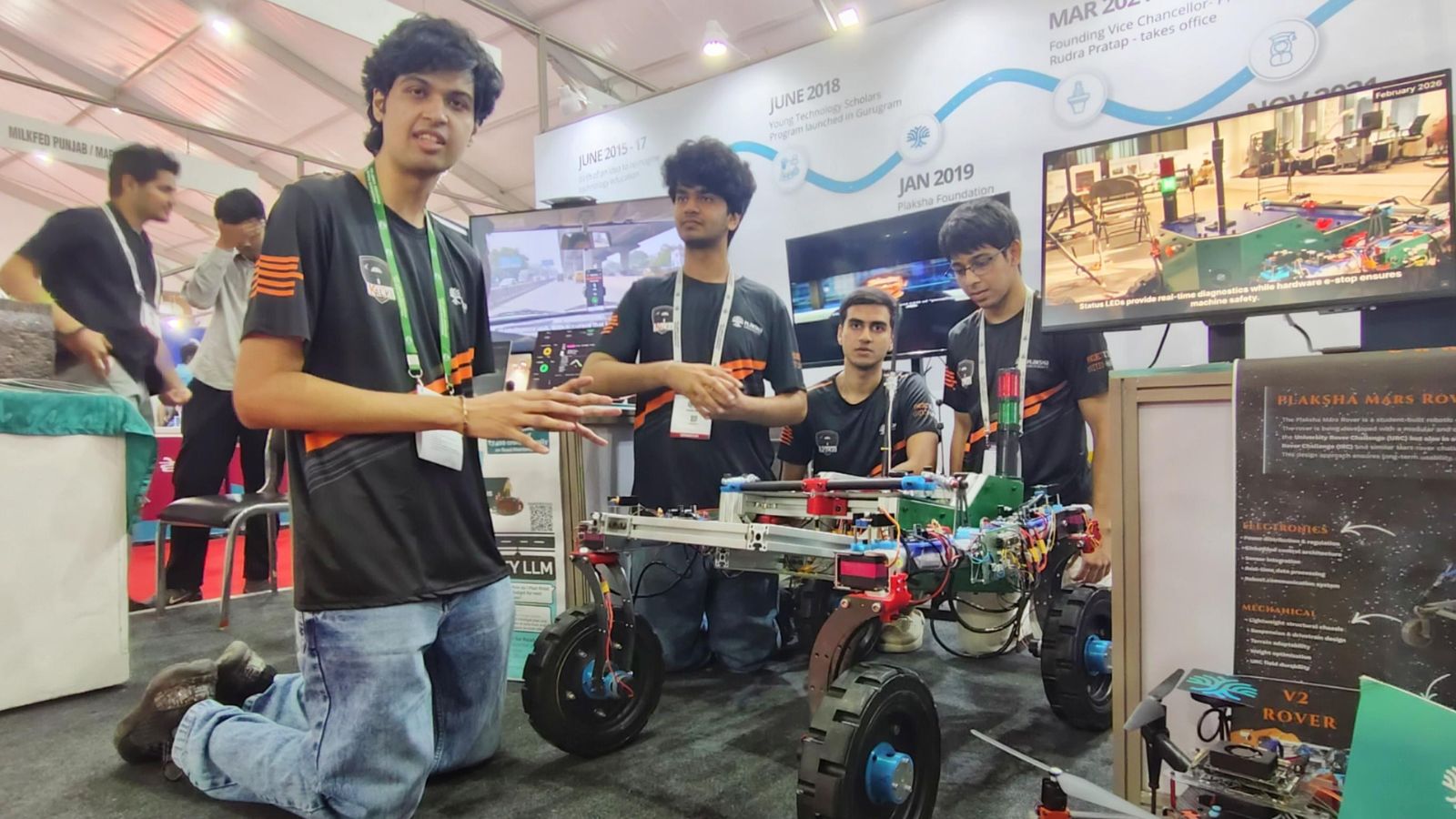
One of the key attractions was “Team Kalki”, a 45-member student engineering initiative that showcased advanced robotics and aerospace technologies. Led by Mannan from Gujarat, the team brings together students from disciplines including mechanical engineering, electronics, artificial intelligence, biosciences, and management.

The initiative focuses on moving beyond classroom theory by giving students hands-on experience through real-world engineering projects and participation in international technology competitions.
During the exhibition, the team demonstrated a rover-based system designed to perform multiple autonomous tasks. One of its core capabilities is fully autonomous operation without human intervention. Equipped with cameras and sensors, the rover can navigate large, undefined terrains and transmit real-time information to a central computer control room.
Another module focuses on bioscience exploration, where the rover is programmed to collect soil samples at intervals of about 10 centimetres during planetary missions. The samples are analyzed through onboard systems, and the processed data is transmitted directly to a server room.
The technology is also being designed with human-support applications in mind, meaning it could potentially be adapted for use in hospitals, military operations, and emergency response environments.
Team Kalki was established in 2025 after participating in the CanSat competition, and since then the students have been actively developing robotics and aerospace systems for international engineering challenges.
Speaking to The Indian Express, Mannan explained that the rover could assist in searching for objects across vast areas — potentially spanning hundreds of kilometers — even without clearly defined boundaries. “The system is designed to autonomously explore and identify targets across large terrains,” he said.
The team is currently preparing a Mars rover for the University Rover Challenge (URC), an international robotics competition held in the Utah desert in the United States, where university teams design rovers capable of navigating rugged terrain, collecting scientific samples, and performing tasks similar to real planetary exploration missions.
Story continues below this ad
In addition, the team is also developing a CanSat project, a miniature satellite that fits inside a soda can and is launched using a rocket. In the previous competition cycle, Team Kalki secured 10th position in India and ranked 35th globally in the first round.
Another highlight at the exhibition was an underwater robot developed by students of Plaksha University, entitled “AUV-MINA” (Autonomous Underwater Vehicle for Marine Intelligence, Navigation and Autonomy).
Speaking to The Indian Express, team leader Saswata Sarkar said the robot has been designed for marine research and exploration, enabling scientists to monitor underwater environments using advanced technology.
“Our goal is to develop low-cost but highly effective technology that can support environmental research and marine surveys in the future,” he said.
Story continues below this ad
The robot uses artificial intelligence (AI), multi-agent reinforcement learning, and 3D scene reconstruction technologies to autonomously navigate underwater and complete a variety of mission tasks.
The project was developed under the guidance of Dr Sandeep Manjanna, with contributions from students Hussein Akolawala, Jorawar Singh, and researchers Rahul Kumar and Nidugondi L N Sai Pranav, along with other team members.
According to the researchers, the technology could be used for seabed mapping, monitoring underwater cables, inspecting offshore infrastructure, collecting samples from oil spills or chemical pollution, and studying marine life, making it valuable for both scientific research and environmental monitoring.