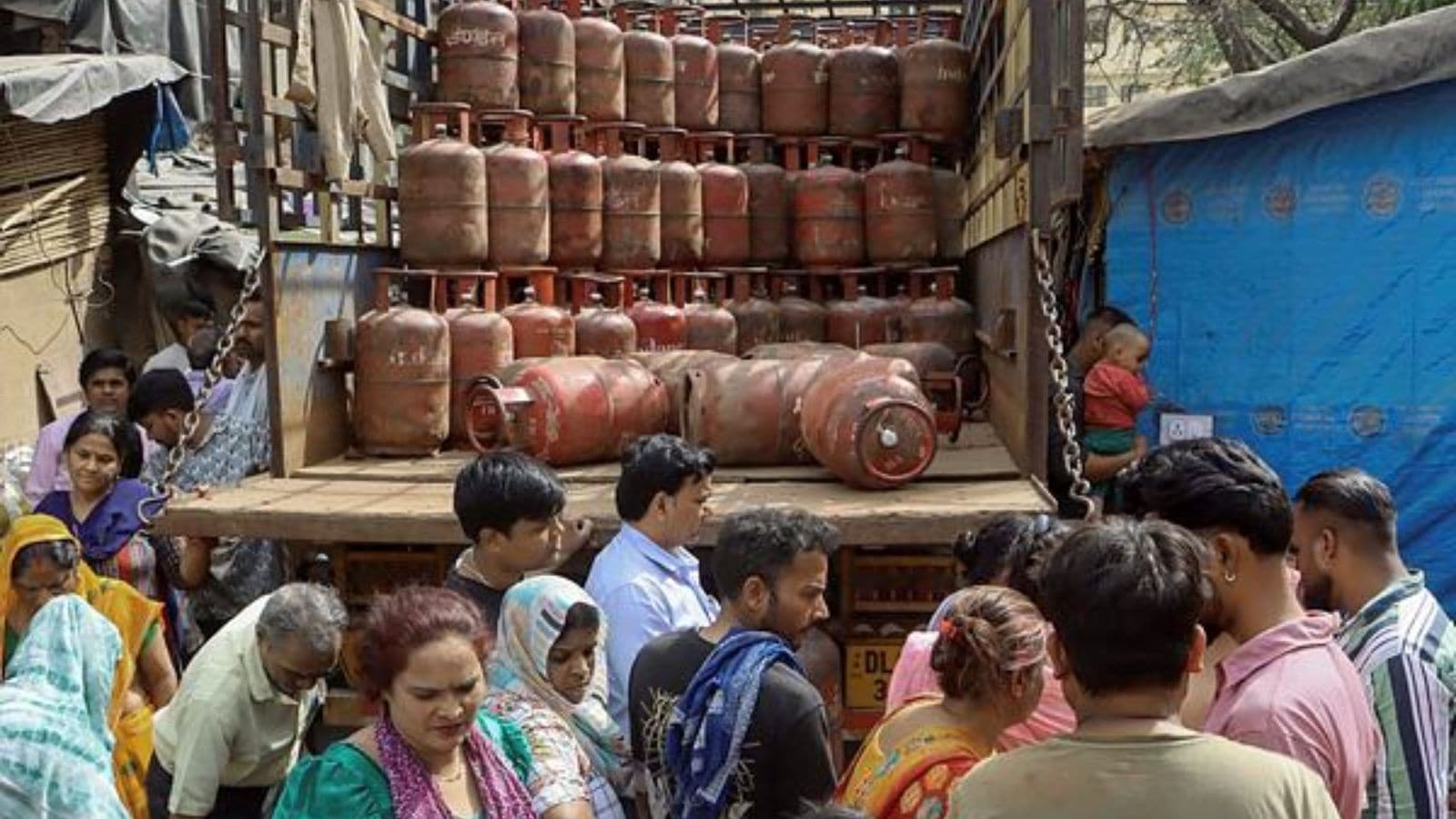
Shyam Kumar, a migrant from Sitamarhi in Bihar, had known since the time he arrived in Delhi 17 years ago, at the age of 12 in search of work, that life here is extremely difficult for the poor, and that they must always be prepared for unexpected challenges. However, he never imagined that even a cooking gas cylinder could become a problem, even when he is willing to pay a higher price.
“I do not have an LPG card, so I have to buy cylinders from the black market. Earlier, I used to get a 14.2-kg cylinder for around Rs 1,100. Over the last six days, I have tried every possible way to get one, but I could not. Now they are selling it for Rs 2,500-3,000. I am ready to pay,” said Kumar, a vegetable seller who lives on rent in Delhi’s Kalkaji with his wife and three children. He also intermittently works as a daily-wage labourer.

The government fixed the price of a 14.2-kg domestic LPG cylinder in Delhi at Rs 913, against the earlier rate of Rs 853.
“On the first night, when the cylinder suddenly ran out, we had to spend the night eating bananas and roti. Since then, we have been relying on food from a nearby dhaba that has become very expensive…Because of the ongoing crisis, the prices of roti, chawal, dal etc. at the dhaba have nearly doubled. Ameeron ke yahan kabhi supply nahi rukti hai, saari mushkil hamare liye hi hai (LPG supply never stops for the rich; people like us face all the difficulties),” added Kumar.
Almost 2,500 km away from Kumar’s home in Delhi lies the Strait of Hormuz, where the ongoing war in West Asia involving Iran, Israel and the United States has upended oil supply pathways. Sirens echo across the waters as Iranian naval forces restrict the movement of ships passing through the narrow shipping lanes — each barely about three-km-wide.
From this distant battlefield, the shockwaves have quietly reached small households since the war has choked the global oil and gas supply, resulting in the shortage of LPG cylinder supply across India. Almost 90% of India’s total LPG import passes through the Strait of Hormuz. India’s annual LPG consumption is currently estimated at around 33 million tonnes, of which domestic production is around 13 million tonnes, or around 40%, and it depends on import for 60% of its total LPG supplies, which is sourced from countries like Qatar, Saudi Arabia, United Arab Emirates (UAE) etc.
Kamal Goswami, a tea seller in Ghaziabad’s Vasundhara has stopped selling tea since mid-last week. The cylinder he used with his stove is missing, the pipe hanging from the stove down to his gumti (small stall) silently speaks of the crisis.
Story continues below this ad
“I have done it deliberately so that people can understand the gravity of the situation. It has become extremely difficult to get a cylinder right now. Even if we are ready to pay a higher price, we are not getting one. The government says it is taking action against hoarders, but where is the action on the ground? Earlier, at least we could get a cylinder in the black market by paying Rs 200-300 extra, but now even that is not possible,” he said.
Rekha, who works as a househelp in Ghaziabad’s Indirapuram, is anxious as her LPG cylinder is about to run out soon. “I checked with the vendor from whom I used to buy a cylinder for around Rs 1,200 in black, but he said he would not be able to provide one this time. He told me that it might cost at least Rs 3,000 now. I am trying other places as well. I am afraid that we might have to go back to cooking on a chulha (wood-fired stove) again. But in a rented house, even that is not possible,” she said.
Unavailability of mandatory documents, discrepancies in data, delays in KYC, and hurdles on the part of distributors to get a registered connection are some of the key reasons why people rely on the black market for LPG cylinders.
“We tried to get an LPG connection several times. All our documents are from West Bengal, and they asked for local address proof, such as a rent agreement. But the landlord did not give us one. Also, it is not certain how long we will stay in one house. In such circumstances, it becomes difficult to get a connection,” said Rekha.
Story continues below this ad
Many vendors have also increased the prices due to the shortage. “LPG cylinder ki killat ke kaaran har parathe par 10 rupaye badhaye gaye hain (Owing to the shortage of LPG cylinders, the price of each paratha has been increased by Rs 10),” reads a whiteboard placed in front of a shop in ITO, a busy spot frequented by office-goers for a quick meal.
The government’s move to prioritise the supply of domestic LPG to households with registered connections has created difficulties for other households that were dependent on the black market for LPG cylinders. Officials said action is being taken against hoarders and black marketeers involved in illegal trading. They also claimed that misinformation and rumours about a possible shortage of LPG are leading to panic-booking of cylinders.
According to data shared by the Petroleum Ministry on Saturday, the average booking during the April-February period was 55.7 lakh cylinders per day, but the number jumped over 35% to 75.7 lakh on Thursday, and further to 88.8 lakh Friday.
The ministry said that 62.5 lakh LPG cylinders were delivered on March 13, 50 lakh on March 12, 48.7 lakh on March 11, 52.1 lakh on March 10, and 47.8 lakh on March 9. Across the country, there are a total of 33.37 crore LPG consumers. There are about 1.01 lakh retail outlets and 25,605 LPG distributorships operating across states.