3 min readBengaluruFeb 11, 2026 11:13 AM IST
Recent research by a team at Bengaluru’s IISC – including India’s first International Space Station Astronaut – has found that a toxic chemical in the soil of Mars could help bacteria from Bengaluru’s soil in creating “bricks” from the soil, in the context of potential space missions to Mars. This is the latest step in research on Martian soil bricks, which began at IISC several years ago.
What did IISC’s previous research on Martian bricks involve?
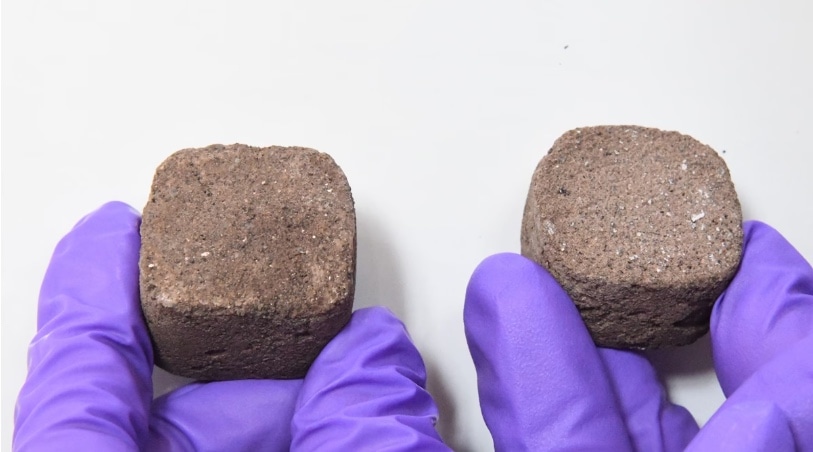
IISC has been conducting research into brick analogues made from lunar and Martian soil for several years. As previously reported by the Indian Express in 2022, the bricks were created by mixing a slurry of simulated Martian soil, guar gum, nickel chloride, urea and the bacterium Sporosarcina pasteurii.

This was itself an advancement of an earlier method that was tested on lunar soil – the previous method could only create cylindrical bricks. The new method enabled bacteria to form crystals after consuming the urea, acting as a “cement” with the aid of biopolymers secreted by the bacteria, making the brick less porous.The addition of nickel chloride would aid in the growth of bacteria, which were initially hampered by the high iron content in Martian soil.
What have they recently discovered regarding a chemical in Martian soil?
In the new study, the researchers – a group consisting of Associate Professor Aloke Kumar, IISER professor P Bhadury, researcher and former astronaut Shubhanshu Shukla, University of Florida PHD Student Swati Dubey and R Dixit – had tested the application of perchlorate, a toxic chemical found in Martian soil. This chemical is not normally used in synthetic Martian soil as it is flammable.
The researchers found that if guar gum and nickel chloride were present, the bacteria (which was under stress from the perchlorate) would release an “extracellular matrix” into the environment, which would in turn form “bridges” between the bacteria and chemical precipitates.
Dubey said in a statement to the press, ” “When the effect of perchlorate on just the bacteria is studied in isolation, it is a stressful factor……but in the bricks, with the right ingredients in the mixture, perchlorate is helping.” The team is also planning to study the effect in a high-CO2 environment to mimic Martian conditions.
What are the potential applications of this discovery?
IISC noted in a statement that the team’s aim was to create a sustainable, less carbon-intensive building strategy that could be applied either on Mars or Earth. In the Martian context, the bricks could be used for roads, launch pads, and landing sites for rovers and landers, preventing them from toppling in uneven terrain.
Story continues below this ad
Shubhanshu Shukla stated, ” “The idea is to do in situ resource utilisation as much as possible….we don’t have to carry anything from here(Earth); in situ, we can use those resources and make those structures, which will make it a lot easier to navigate and do sustained missions over a period of time.”