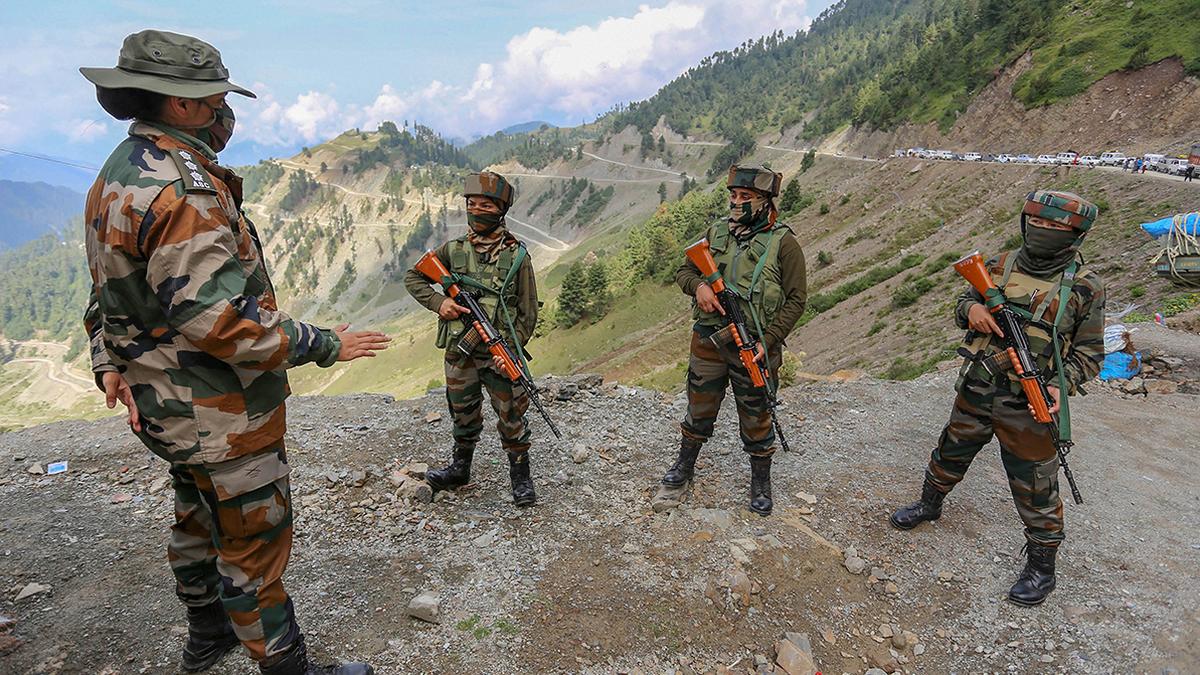
Representational image only. File
| Photo Credit: PTI
The Supreme Court of India on Tuesday (March 24, 2026) declared that systemic and long-held presumption that women officers had no substantive or long-term career in the Armed Forces led to an uneven playing field, crippling their chances for permanent commission.
A three-judge Bench headed by Chief Justice of India (CJI) Surya Kant upheld permanent commission and consequent pensionary benefits for batches of women officers in the Army, the Air Force and the Navy. The court upheld the women officers’ right to equal opportunity and treatment and dignity in three separate judgments, all authored by the Chief Justice.

The appellant-women officers were represented by senior advocates Rekha Palli, V. Mohana, Menaka Guruswamy, advocate Pooja Dhar, Abhimanue Shrestha, Anshuman Ashok and Sudhanshu S. Pandey. Additional Solicitor General Aishwarya Bhati represented the Centre.
The judgment found that the Annual Confidential Reports (ACRs) of Short Service Commission Women Officers (SSCWOs) were graded casually for years, without adjudging their suitability for career progression, affecting their overall comparative merit with their male counterparts.

“Since they (SSCWOs) had no scope for career progression, the assessing officers graded their ACRs casually and gave them lower scores. This assumption resulted in a casual approach towards assessment, with higher grades being informally reserved for male SSCOs who were eligible for permanent commission (PC) and for whom such grades would materially affect their future prospects,” Chief Justice Kant observed.
The Supreme Court said women officers were routinely assigned “average or middling scores”.
The cumulative consequence of the systemic low grading given to them, owing to no fault of theirs, found them in dire straits when events led to Supreme Court’s multiple interventions and judgments upholding SSCWOs’ right to equal career progress and PC in the Armed Forces.

“This phenomenon (low grading) came back to haunt the SSCWOs as they were subsequently and quite abruptly placed in a competition for PC with their male counterparts, who did not undergo such hindrances in grading over the course of their decade-long service. It is, therefore, not surprising to us that the differential treatment meted out to officers ‘with a future’ in the Army and those deemed to be without one has resulted in an unequal playing field,” Chief Justice Kant observed.
The Chief Justice agreed with the SSCWOs that they were neither incentivised nor recommended for various career-enhancing courses during their service. The result was a diminished service profile. The court found they were victims of “the consequences of unequal opportunity structures” within the Armed Forces.
“The inclusion of SSCWOs in the zone of consideration for PC is not a matter of discretion, but of Constitutional obligation. Any expectation to the contrary is inherently illegitimate. The claim made by the male SSCOs that they ought not to be considered alongside SSCWOs is liable to be outrightly and decisively rejected,” the Supreme Court held.
“In the instant case, when SSCWOs have been found to suffer the cumulative effects of an unfair evaluative regime, the invocation of the vacancy cap as a shield against remedial action would be unfair to sustain. Owing to this, the respondents’ (Union government) plea regarding the sanctity of the ceiling on vacancies falls flat,” Chief Justice Kant noted.
It said the Armed Forces need not hold any annual cap on PC vacancies “neither sacrosanct nor immutable”.
Published – March 24, 2026 03:30 pm IST