5 min readMumbaiMar 24, 2026 11:33 PM IST
In a year where Indian chess has not had too much to celebrate so far from the usual quarters, heartening scenes were witnessed at Guwahati airport last week. In a video that has now gone viral on social media, Mayank Chakraborty, fresh from becoming India’s 94th grandmaster, can be seen being received by a large welcoming party at the airport. The throng of friends and relatives cover him with way too many marigold garlands and place not one but two traditional Assamese japi hats on the 16-year-old’s head as drumbeats mark his arrival at the airport.
The celebrations continue with the entourage accompanying the teenager and his mother all the way to their residence.
It’s a welcome fit for a history-maker. Indian chess has seen similar scenes when Gukesh returned to Chennai after becoming the youngest world champion in chess history in December 2024 and when Divya Deshmukh went home to Nagpur after winning the FIDE World Cup, thus becoming a grandmaster and earning a spot at the Women’s Candidates tournament in one go. And why not? Mayank’s feat was equally commendable for the distance he had to travel, and not just geographically. The fact that he became Northeast India’s first grandmaster is a sign that the reach of the sport at the elite level is growing.
ALSO READ | The men, the machines (and the psychic mediums) that helped top grandmasters prepare for elite tournaments
What makes the clip from Guwahati airport heartwarming is that after focussing on the joyous celebrations around the grinning Mayank, the camera then goes on to find his mother, Monomita, who is weeping without restraint a few paces behind her son. As someone who quit her own career as a gynecologist with the Assam government to become a full-time chaperone for her son, no one understands the value of these moments better than her.
“I was overwhelmed by the huge response from the people of Assam. This is a moment I had been awaiting for a long time,” she later recounted in an interview with Chessbase India.
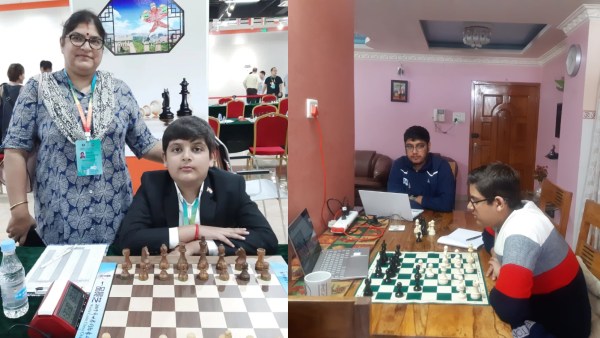 (Left) Mayank with his mother Monomita at a tournament; (right) Mayank training at his home with Swayams Mishra. (Photos courtesy: Chessbase India)
The short clip reveals so much about the pursuit of perfection on the chessboard and the cost it exacts from not just players but their parents too. Just like Monomita’s decision, Gukesh’s father Rajini Kanth famously quit his practice as an ENT surgeon to be his teenage son’s plus-one at every tournament. Praggnanandhaa’s mother Nagalakshmi too spends most of her time tending to her kids so that they can single-mindedly focus on the sport. (When Gukesh’s father was once asked about the ‘sacrifice’ he had made of his own career to propel his son’s career, he had set the record straight by pointing out that helping one’s own child is no sacrifice, it’s a duty.)
Story continues below this ad
Right after Mayank had earned his third and final grandmaster norm to seal his GM title, Monomita had told The Indian Express about the lack of support her son had received so far in his career.
Barring the occasional sponsorship from a benefactor here and there, it was Mononita and her husband who powered his career. Occasionally, as she told Express, she would make him play in tournaments where the opponents were not at his level because he could win prize money which could be used to fund his travel for bigger events. These jaunts into lower-rated events would be counter-productive.
ALSO READ | Guwahati teenager Mayank Chakraborty overcomes obstacles to script chess history for the Northeast
“Actually, you don’t gain much in terms of money. It’s a lose-lose situation at any cost. Because after taxes, the prize money is not too much, and there is a chance—like it has happened a couple of times with Mayank—that he ends up losing rating points even if he wins the event,” Monomita had said.
Story continues below this ad
Being from the Northeast came with its own set of challenges. Regular face-time and hands-on coaching from an elite level grandmaster was rare, and only to be accessed in short phases, unlike the rest of his contemporaries from metro cities like Chennai.
But after the grandmaster title has been achieved, with some help from the occasional sponsors and rare training stints from grandmasters, Monomita could not help but speak with gratitude about the village that raised her grandmaster son. There are no complaints about the hard hand that geography dealt them. Just a grateful mother and her history-making son.


© IE Online Media Services Pvt Ltd