

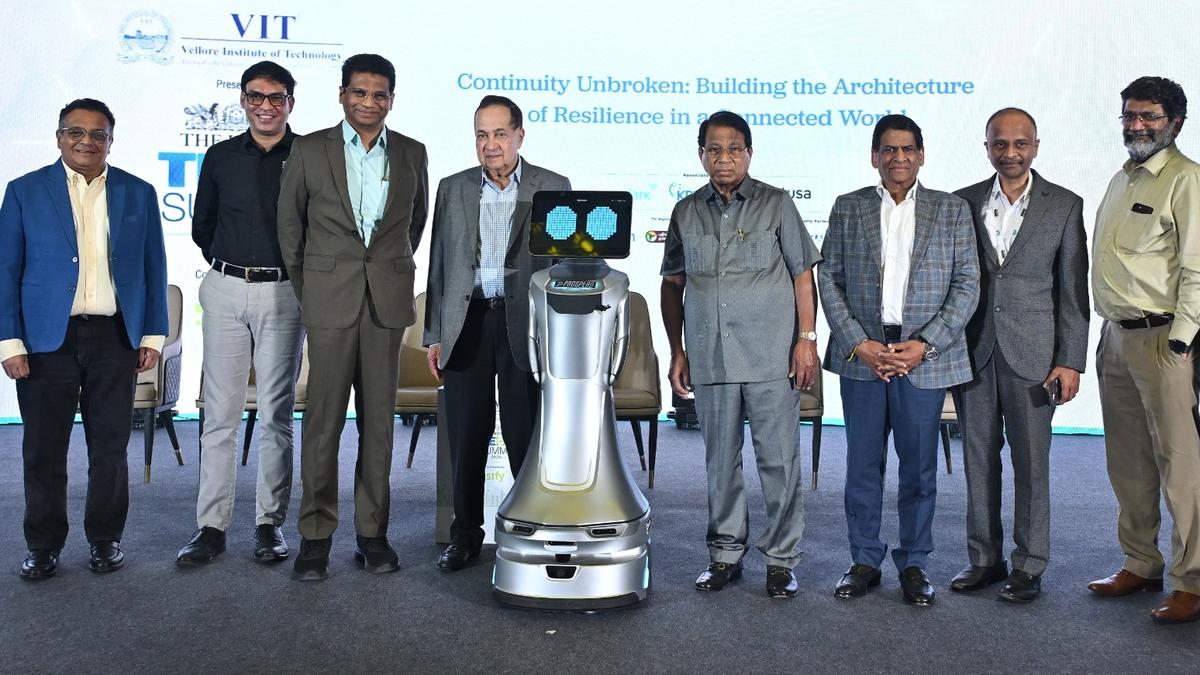
G. Vishwanathan, Founder and Chancellor, Vellore Institute of Technology; N. Ram, Director, The Hindu Group; Suresh Nambath, Editor, The Hindu; L. Navaneeth, CEO, The Hindu Group; and Raju Vegesna, Chairman and Managing Director, Sify Technologies at the inauguration of The Hindu Tech Summit 2026 in Chennai on Thursday
| Photo Credit: B. Velankanni Raj
Providing quality education and increasing enrolment in colleges and universities hold the key to improving the economy of the country and curtailing inequality, G. Viswanathan, Founder and Chancellor, Vellore Institute of Technology (VIT), said in Chennai on Thursday (February 12, 2026).
At the inaugural session of The Hindu Tech Summit 2026, jointly organised by The Hindu Group, Vellore Institute of Technology, and Sify Technologies, Dr. Viswanathan said that in the past 20 years or so, the economy has grown to place India as the fourth-largest economy in the world, overtaking Japan in 2025. Alongside, inequality has grown as well, with only about 70 lakh people in the country declaring themselves as belonging to the higher income group. “They say India is the most unequal country in the world, next only to Russia. Unless we provide education, this cannot be curtailed. It requires government policy,” Dr. Viswanathan iterated. For this, education should reach all children belonging to poor families and the middle class.
Quoting figures, he said Japan’s per capita income was 12 times that of India. While India’s per capita income stood at USD 2,900, Japan’s was USD 36,000. While some government officials exuded confidence that India could overtake Germany in a few years, it should be borne in mind that Germany’s per capita income was USD 58,000 – 20 times that of India. “In the year 2000, there were only nine billionaires in the country. Now, we have grown beyond 300,” he maintained.
The new education policy’s thrust to improve gross enrolment ratio from the present 28% to 50% in the next 15 years would mean that the number of students in colleges and universities needed to be doubled. This, Dr. Viswanath said, meant that someone had to pay for them. In the present scenario, the burden of higher education was mostly on the learner; the government spent barely 3% to 4% of the GDP, although the Kothari Commission in the sixties had recommended an expenditure of at least 6% of the GDP.
Due to lack of spending, only four crore children out of 14 crore eligible for higher education are in colleges and universities. Similarly, if India were to compete with developed countries, the spending on research and development should be increased manifold from the present 0.7%.
Tracing the history of VIT, Dr. Viswanathan said that what started in 1984 with 180 students has now grown to accommodate 1 lakh students from all Indian States and 75 other countries.
Role of AI
“AI is not a disruptor; AI is an evolution,” said Raju Vegesna, Chairman and Managing Director, Sify Technologies, delivering the keynote address. “Just as the internet enbaled us to reach places and share knowledge, we will get all those benefits from AI as well,” he added. While India could be lagging behind in higher education, Mr. Vegesna exuded confidence that the country will have its unique way to address the transformations and the market.
Giving an example, he said that AI was like giving a bicycle rider a motorcycle; it ensured that they reached more places faster, although the tech will have to be adopted with caution. India’s chances in the game was on how to adopt AI technology for the benefit of enterprises.
Among those present at the inaugural session were Santhosh T.G., Chief Digital Officer, Switch Mobility, Suresh Nambath, Editor, The Hindu, L.V. Navaneeth, Chief Executive Officer, The Hindu Group, and Suresh Balakrishna, Chief Revenue Officer, The Hindu Group.
Published – February 12, 2026 02:23 pm IST