When people ask me about Yuvraj Singh’s 2007 T20 World Cup heroics, my mind wanders to a day when he was just two and a half years old.
It was months after the demise of my father. I got a plastic bat and asked my mother to bowl to the then two-and-a-half-year-old Yuvraj in our drawing room in Chandigarh. Within minutes, Yuvi hit the ball with such ferocity with his backlift that it broke one of the windows. He was in a bathrobe kind of dress and was barely wearing anything below. He still has a photograph from that day but does not show it (laughs). That day only, I told my mother, “Sade ghar Sir Garfield Sobers paida hoya hai” (Sir Garfield Sobers has been born at our home).
As a cricketer and coach, I am only a fan of three players: Sir Garfield Sobers, Viv Richards and Yuvraj Singh. While Viv Richards was very hard-hitting, both Sir Garfield Sobers and Yuvraj Singh were like poetry on the cricket pitch. The kind of elegance and effortless display of batting they did was something to be watched again and again.
Yuvraj was 12 when he started training at the DAV College Ground. While my emphasis was on him hitting grounded shots and I would scold him too during training, there were moments when I would turn my back and he would hit a six and tell me, ‘Dad, see the ball went where…’ So when somebody talks of his 2007 T20 World Cup heroics, I just tell them to learn first from where that ease and hard-hitting came.
During training as a 12-to-14-year-old, Yuvi would face almost 1,500 balls per day and would practice for almost every kind of shot. Whether it be grounded shots and the lofted shots or the punch on the backfoot or the sweep against pacers. I would make him face the bowling machine and the focus was on developing a range of shots.
In 2007, T20 format was at a very nascent stage. I remember me and Yuvraj had a discussion prior to the T20 World Cup in South Africa and Yuvi told me, “Papa, maar dhaad wali game hai… Chakke te chauke di game hai” (It’s a game of thrashing. It’s all about sixes and fours).
Story continues below this ad
And we would talk about how other batsmen needed to develop new shots for this format and how Yuvi almost had every shot in his playing book to succeed in this format. Whether you talk about his sixes coming sweeping pacers like Stuart Broad at Durban in the T20 World Cup or against Australian pacer Mitchell Johnson in the third ODI at Hyderabad later that year, they don’t come in a day. They came as Yuvraj worked on getting the shots in his armour and developed the 360-degree game. He was always very good in down-the-line lifting shots as well the punch on the backfoot, but shots like the lift as well flicks were also in his batting.
One thing which I remember telling him was that ‘single-double vi koi cheez hai in T20s’ (single doubles are also a thing in T20 format). But he would tell me that most often time will be less for a batsman like him down the order in this format or if coming in the top order, time will be less to set the pace. The fact that he understood this facet of the T20 format very early in his career speaks a lot about his ability.
And then during his knocks against England and then Australia in the semi-finals, he showed the world how the T20 format is to be played. He came to bat in the 17th over against England and changed the game in one over. That kind of over, whether it comes at the start or at the end, can break the opposition and that’s what Yuvi did.
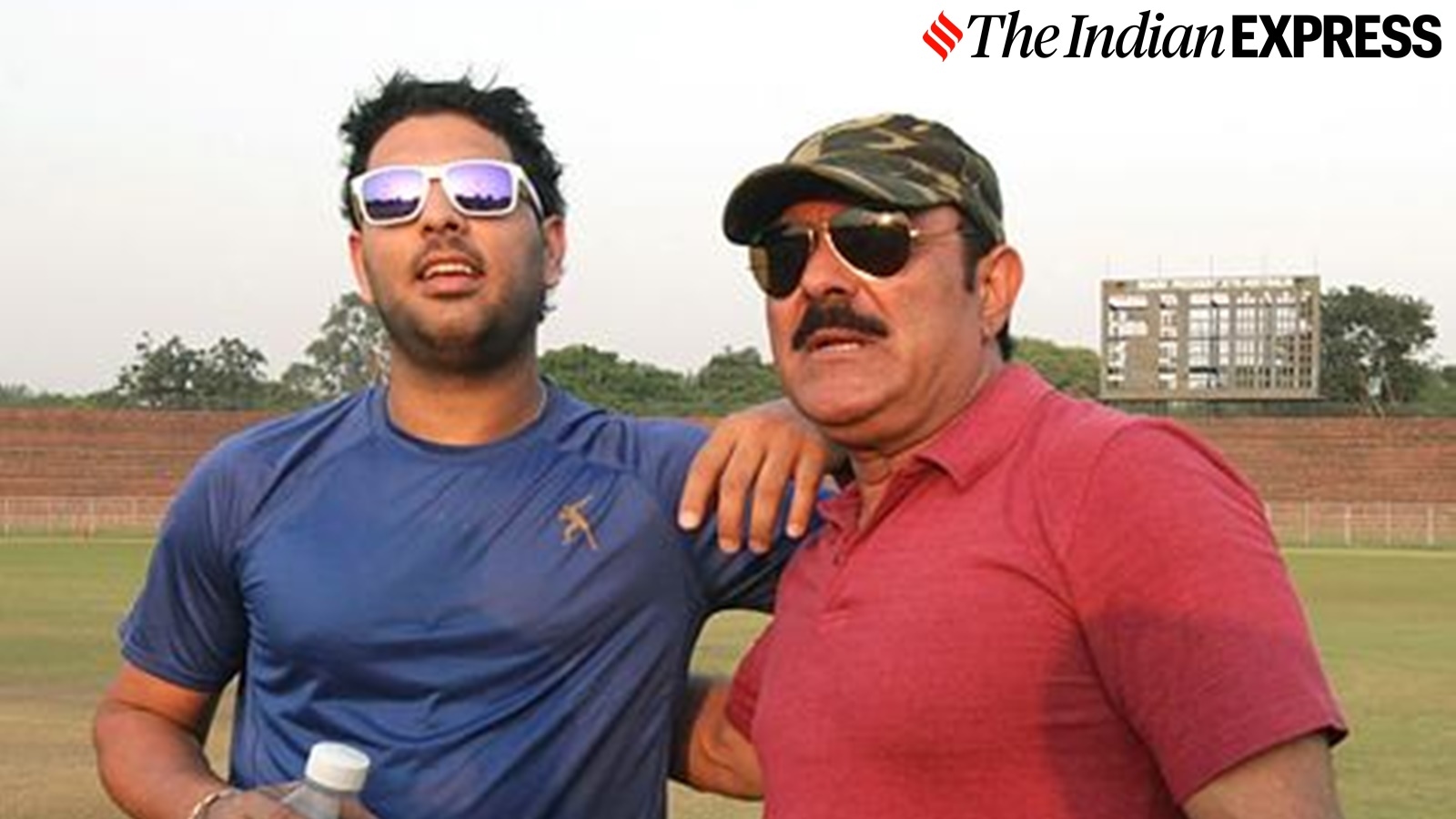
 Yuvraj Singh with his father, Yograj Singh, in the picture. (FILE)
If one asks me which of his six sixes against Stuart Broad are my favourite, my answer would be the flick from middle stump to hit the 90-metre six between fine leg and square leg. The kind of elegance as well the almost effortless feel to it made it easy to watch, but only Yuvraj and I knew how much training it took for him to achieve that perfection.
Story continues below this ad
Against Australia in the semi-final too, Yuvi hit a six through flick over the deep backward square on a ball pitched full on middle stump by Brett Lee and was in his destructive mode right from the start of his knock of 70 runs.
My only advice or warning to him for the T20 format was ‘Adhe-tedhe shot de nal out nahi hona’ (Don’t get out through slogging). When you have the natural ability to hit any ball on your will for six or boundary, you don’t need to play that kind of shots. And he showed that. He would hit bowlers like Broad for a six down on one knee, hit pacers leaning back for sixes or hitting sixes through flicks from leg.
I remember early in his career, Yuvi would face problems in sweep shots and avoid it. Yuvi told me Sachin sir told him to try to sweep. I told Yuvi to first master the reverse sweep and then try. He spent hours in nets practising that and mastering that shot and it meant that he could reverse sweep pacers too (laughs).
I have never told Yuvi ‘well played’. I have told him that ‘well done, son’. To make use of his ability and training is what carried him for long and made him a treat to watch in any format. And that’s what I told him when he won the T20 World Cup for India. I was glad that he could show the world his natural batting in the newest format too and win India a World Cup years before he again won the World Cup, this time in the form of the 2011 World Cup.
Story continues below this ad
And now when I see Abhishek Sharma hit the ball with such ease, I am reminded of Yuvraj’s hitting. He came close to bettering Yuvraj’s record of fastest fifty in T20Is recently. Even though I advise Abhishek to rely on singles and doubles too, I enjoy his fearless batting.
But then as per the famous Punjabi saying goes, “Jeho ji koko, oho jehe ohde bache” (As is the crow, so are its chicks”. ). Abhishek would only follow his coach Yuvraj (laughs). While both Yuvraj and Abhishek have their own style, the kind of backfoot punch Abhishek plays, I am reminded of Yuvraj’s shots. Like Yuvi, Abhishek too hits sixes and fours on his own will. My favourite shots of Abhishek are his sixes against pacers towards long on, long off and mid-wicket. The way Abhishek targets the first ball of his innings, it sets the tone as well makes the opponent fear his batting.
So my advice to Abhishek is again to play fearless cricket and get India the T20 World Cup.
— Yograj Singh played one Test and six ODIs for India, and is father and coach of Indian all-rounder Yuvraj Singh. He spoke with Nitin Sharma