Synopsis: Rothschild & Co, adviser to NSE’s upcoming IPO, traces its origins to a 19th-century banking dynasty that financed wars, governments and global industrial giants. Once central to world finance, the firm today operates as a global advisory house, with the NSE mandate marking its latest high-profile engagement.
The National Stock Exchange of India Ltd. has appointed Rothschild & Co as an independent adviser to oversee its long-awaited initial public offering. The firm will lead the process of selecting lead bankers, legal counsels and other intermediaries, according to the exchange’s response to Bloomberg queries. The move signals fresh momentum for what could become one of India’s biggest listings.
After being stalled for several years due to regulatory and legal hurdles, NSE’s board last week approved the IPO proposal. The world’s busiest derivatives bourse is planning a fully offer-for-sale issue, with existing shareholders likely to divest 4 to 4.5 percent of equity. The IPO could raise about 2.5 billion dollars based on the current trading price in the unlisted market.
But this appointment raises a larger question. Who exactly is Rothschild & Co, the firm that once bailed out governments, helped the British government buy a stake in the Suez Canal, financed wars and railway expansions across countries, and played a role in founding De Beers, which at one point controlled 80 to 85 percent of the world’s rough diamond distribution? The adviser to India’s largest exchange today is the same banking name that once stood at the centre of global finance.
Who Were The Rothschilds?
The family’s rise to global prominence began in 1744 with the birth of Mayer Amschel Rothschild in Frankfurt am Main, Germany. Born in the Judengasse, the city’s Jewish ghetto, Mayer built a finance house and laid the foundation of a banking empire.
Mayer’s strategy was simple but powerful. He placed each of his five sons in five major European financial centres, creating interconnected banking houses across the continent. The Rothschild coat of arms reflects this structure: it features a clenched fist holding five arrows, symbolising the five dynasties established by his sons. The design references Psalm 127, and beneath the shield appears the family motto: Concordia, Integritas, Industria, meaning “Unity, Integrity, Industry.” Unlike earlier court financiers who often lost their wealth due to political upheaval or royal seizure, the Rothschilds built an international banking system whose assets were held in financial instruments such as stocks, bonds and debts. This structure made their wealth more secure and less vulnerable to local threats.
An important part of Mayer Rothschild’s long-term plan was to keep control of the banks strictly within the family. By maintaining ownership among brothers and close relatives, they preserved secrecy and control over their growing fortune. Around the late nineteenth and early twentieth centuries, it was noted that their model of establishing branches across key financial centres was widely copied by other financiers. Through integrity and financial skill, the Rothschilds earned trust not only within Jewish financial circles but across the broader banking world. Carefully arranged family marriages also helped ensure that the fortune remained consolidated, allowing the Rothschild name to remain at the centre of international finance for generations.
Mayer Amschel Rothschild strengthened his empire by sending each of his five sons to a key financial centre in Europe. Amschel Mayer Rothschild remained in Frankfurt, although he died childless and his fortune later passed to the sons of Salomon and Kalman. Salomon Mayer Rothschild established the Vienna branch, while Nathan Mayer Rothschild built the powerful London house that would become especially influential. Kalman Mayer Rothschild set up operations in Naples, and Jakob Mayer Rothschild founded the Paris branch. Together, these five centres formed a tightly connected European banking network controlled entirely by the Rothschild family.
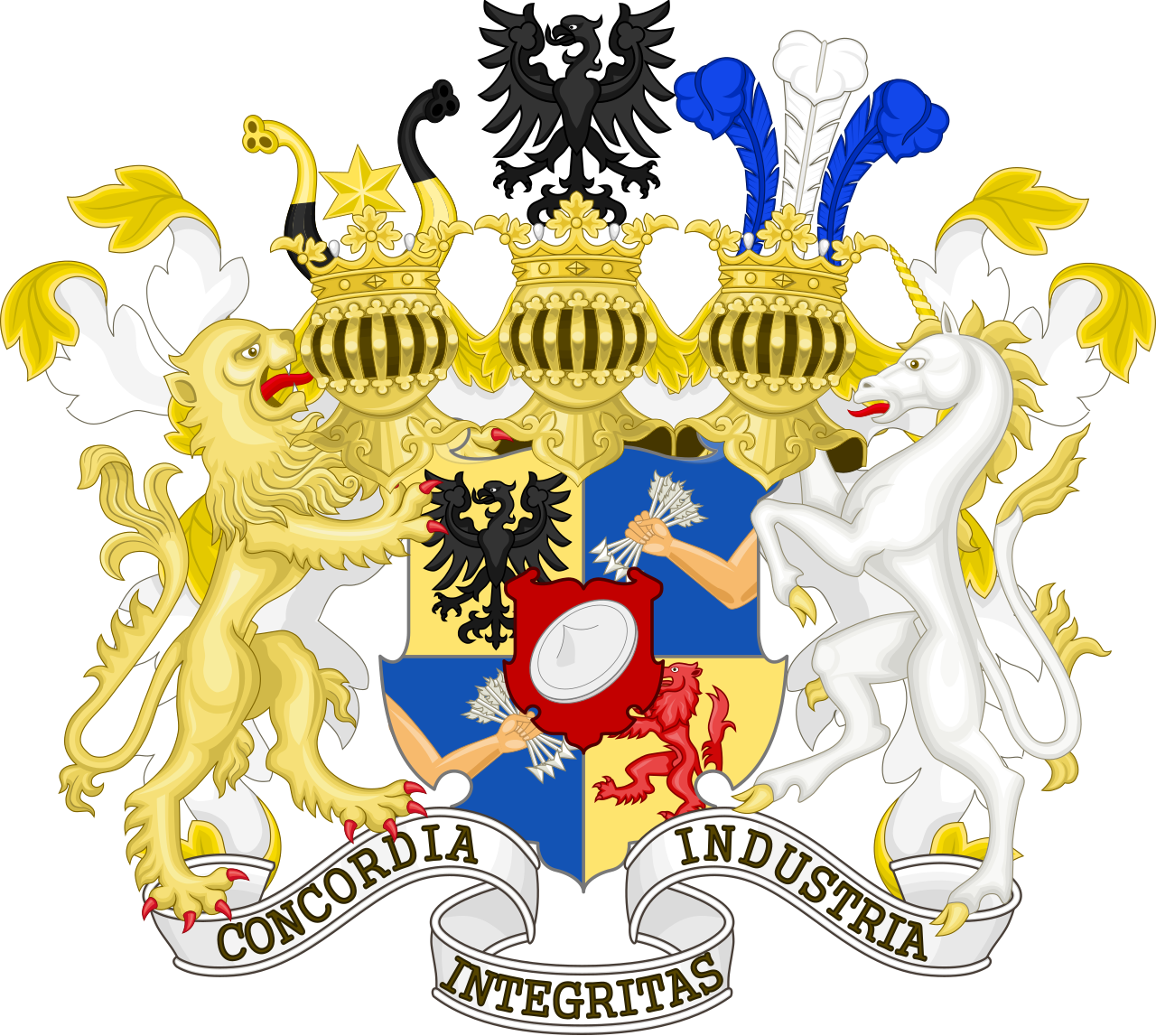
Rothschild Court of Arms
How Powerful Were The Rothschilds?
Financing Wars And Governments
By the time the Napoleonic Wars began in 1803, the Rothschild family was already wealthy and dominant in the bullion trade. From London between 1813 and 1815, Nathan Mayer Rothschild played a key role in financing Britain’s war effort. He organised the shipment of gold and funds to support the Duke of Wellington’s armies across Europe and arranged financial subsidies for Britain’s continental allies. In 1815 alone, the Rothschilds provided GBP 9.8 million in subsidy loans, an amount equivalent to about GBP 850 million in 2023 terms.
The family built a powerful network of agents, shippers and couriers who transported gold safely across war-torn Europe. This network also gave Nathan access to political and financial information ahead of competitors, strengthening the family’s position in financial markets and making them invaluable to the British government.
Pioneers Of International Finance
The Rothschild banking houses helped shape modern international finance during Europe’s industrialisation. They financed railway systems across countries and arranged complex government funding deals, including projects such as the Suez Canal. Between 1895 and 1907, they loaned nearly 450 million US dollars to European governments, which would equal about 15.2 billion dollars in 2024 terms.
Their influence extended beyond finance into property and prestige. During the 19th century, the family bought a large portion of property in Mayfair, London. By the end of the century, they owned or had built at least 41 grand palaces, a scale of wealth that rivalled even royal families. In 1909, British Chancellor of the Exchequer David Lloyd George reportedly described Nathan, Lord Rothschild, as the most powerful man in Britain.
Backing Nations And Independence
The family was also involved in major political and national developments. In the early 19th century, they played a direct role in financing Brazil’s independence from Portugal. As part of the agreement for recognition, Brazil agreed to pay two million pounds sterling to Portugal. N M Rothschild & Sons raised this capital in London in 1825, and had earlier helped arrange a one-million-pound tranche in 1824. Brazil also took over repayment of a GBP 1.5 million loan that had been made to Portugal in 1823 by the Rothschild bank.
Later, during the Russo-Japanese War, the Japanese government approached the London and Paris branches of the Rothschild family for funding. The London consortium issued Japanese war bonds totalling GBP 11.5 million, a very large sum for that period.
Building Global Businesses
Rothschild capital was behind some of the most important industrial companies of the 19th century. In 1873, de Rothschild Frères in France and N M Rothschild & Sons in London joined other investors to acquire the Rio Tinto copper mines from the Spanish government. The mines were restructured and turned profitable, and by 1905 the Rothschild interest in Rio Tinto exceeded 30 percent. From the late 1880s onwards, the family took full control of the company.
They were also involved in founding and financing major businesses such as Eramet and Imerys in 1880, and De Beers in 1888. In 1887, the French and British Rothschild banking houses invested in and loaned money to the De Beers diamond mines in South Africa, becoming its largest shareholders. At one point, De Beers controlled the majority of the world’s rough diamond distribution.
Preventing A US Default
Their influence was not limited to Europe. During the financial crisis that followed the Panic of 1893, the United States was close to running out of gold reserves and faced the risk of default. President Grover Cleveland turned to Nathaniel Mayer Rothschild, who worked with J. P. Morgan to arrange an emergency rescue. Using a Civil War-era provision, the US government issued 30-year bonds in exchange for 3.5 million ounces of gold from the Morgan–Rothschild syndicate. The deal restored confidence, strengthened US gold reserves and prevented what would have been America’s first sovereign default.
From financing wars and national independence to backing industrial giants and stabilising governments, the Rothschild family was not just wealthy — it was central to the functioning of global finance in the 19th and early 20th centuries.
Where Are They Now?
Over the past two centuries, the vast Rothschild fortune has been divided among many branches of the family. Rather than functioning as one unified banking empire, the wealth today is spread across different descendants involved in investments, private banking, business ventures and philanthropy. The Rothschild name is still frequently linked to conspiracy theories that exaggerate its power and control. In reality, while the family remains wealthy and influential, it is far from being the richest on the planet.
In recent years, two of the most prominent figures from the French and English branches passed away. Baron Benjamin de Rothschild from the French branch died in January 2021 and was estimated to have a net worth of around USD 1.1 billion in 2020, roughly USD 1.3 billion in today’s terms. From the British branch, Jacob Rothschild, 4th Baron Rothschild, was regarded as its leading financial figure until his death earlier this year, with an estimated net worth of about USD 1 billion. His daughter, Hannah Rothschild, has established her own profile as a filmmaker, author and chair of the board of trustees of the National Gallery in London.
Other members of the dynasty continue to remain active across different fields. James Rothschild, who is married to Nicky Hilton, is estimated to have wealth of around USD 1.3 billion. David Mayer de Rothschild, known as a film producer and adventurer, has been reported by some online sources to have a significantly larger personal fortune. Meanwhile, Olivia de Rothschild, the daughter of the late Benjamin de Rothschild, is expected to play a meaningful role in the family’s future business interests. Today, the Rothschild story is less about a single dominant banking house and more about a globally dispersed family connected by legacy, capital and influence.
Rothschild & Co advising NSE’s IPO is not an isolated headline in its modern history. The firm has advised governments, central banks, sovereign wealth funds and some of the world’s largest corporations on mergers, restructurings, capital raises and landmark transactions across continents. From Europe to the United States and Asia, it continues to operate as a global financial advisory house, far removed from the old image of a single dominant family bank.
What makes the NSE mandate significant is not that Rothschild is stepping back into relevance, but that one of India’s most important capital market institutions has chosen a firm with centuries of advisory experience to guide a complex and closely watched listing. The Rothschild story today is less about empires and more about expertise. From financing wars in the 19th century to advising multibillion-dollar transactions in the 21st, the name has evolved with global finance, and the NSE IPO is simply the latest chapter in that long trajectory.
Disclaimer: The views and investment tips expressed by investment experts/broking houses/rating agencies on tradebrains.in are their own, and not that of the website or its management. Investing in equities poses a risk of financial losses. Investors must therefore exercise due caution while investing or trading in stocks. Trade Brains Technologies Private Limited or the author are not liable for any losses caused as a result of the decision based on this article. Please consult your investment advisor before investing.