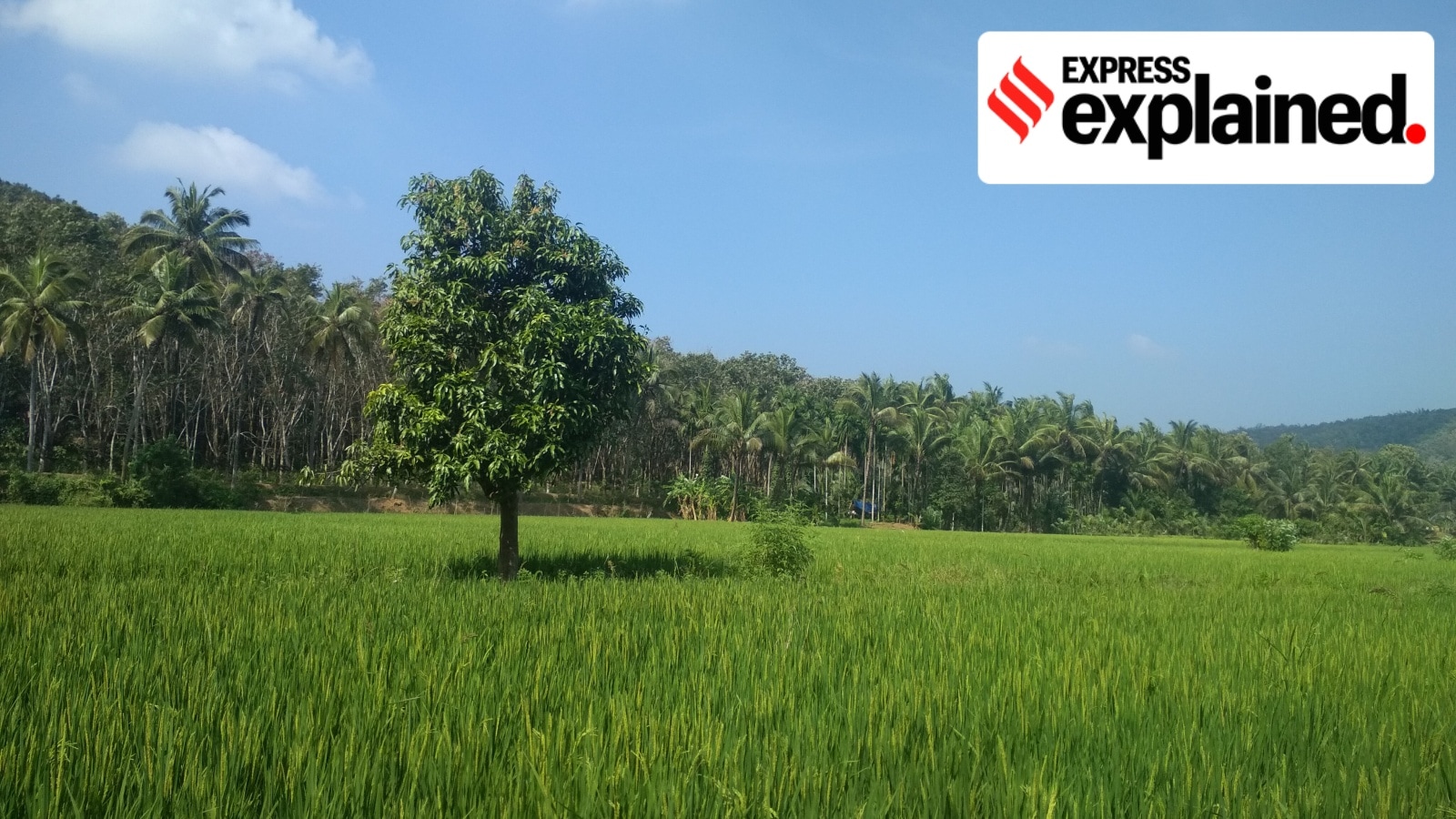
A Union Finance Ministry directive asking states to consider discontinuing the practice of giving a bonus over and above the minimum support price (MSP) for paddy has brought together two opposing poles in Kerala — the ruling CPM and the state BJP unit.
The Kerala government heavily incentivises paddy production, perhaps more than any other state. This is because paddy cultivation has been steadily declining despite rice being the state’s staple food.
Here is a look at how the state gives incentives for growing paddy, and the new procurement system it has now introduced.
The MSP-plus-bonus structure for paddy
According to the Commission for Agricultural Costs and Prices (CACP) under the Union government, the national average cost of paddy production is Rs 15.79 per kg, and the MSP has been fixed at Rs 23.69 per kg. In Kerala, however, the cost of production is higher, at Rs 21.46 per kg, as per the CACP.
As a result, paddy in Kerala is procured at Rs 30 per kg through a combination of the MSP and a state incentive. At present, the MSP is Rs 23.69 per kg, while the state bonus is Rs 6.31 per kg.
The other incentives for paddy cultivation
Rice is the staple food in Kerala, but the area under paddy has been shrinking. To arrest this decline, the state has introduced a range of benefits and financial assistance schemes, unmatched by most other states.
Story continues below this ad
Apart from the MSP and the bonus, farmers receive Rs 5,000 per hectare towards seeds, fertilizers and pesticides. Paddy field owners are paid Rs 3,000 per hectare as a royalty for maintaining their land as paddy fields. Another Rs 5,400 per hectare is given for maintaining soil health.
For cultivating paddy on fallow land, landowners receive a one-time sum of Rs 35,000 per hectare, while farmers are paid Rs 5,000. Those cultivating special seed varieties are given Rs 10,000 per hectare.
Apart from these incentives, local civic bodies, too, run schemes to encourage paddy cultivation, with assistance of up to Rs 25,000 per hectare.
Why paddy production is dwindling
Rising input costs have made paddy cultivation less lucrative. Consequently, large tracts of paddy and wetland have been reclaimed for residential, commercial and non-paddy plantation purposes.
Story continues below this ad
Data from the state’s Department of Economics and Statistics shows a sharp fall in the area under paddy. In 1979-80, Kerala had 7.93 lakh hectares under paddy cultivation. This fell to 2.05 lakh hectares in 2020-21 and to 1.80 lakh hectares in 2023-24.
Productivity has also declined, from 3,091 kg per hectare in 2020-21 to 2,958 kg in 2023-24. The State Economic Review 2025 notes that paddy accounted for only 7.01% of the total cropped area in the state in the last financial year.
The procurement system before 2026
Until last month, the State Civil Supplies Corporation, or Supplyco, procured paddy from farmers and handed it over to private mills for conversion into rice for the public distribution system (PDS). This process took about six months, and farmers received the MSP only after that.
To prevent this delay, the state government introduced a system in 2015 under which banks would give loans to farmers once they produced a paddy receipt sheet (PRS), a document showing that Supplyco had lifted paddy from them. Banks would credit the amount to the farmers’ accounts, and Supplyco would later repay the banks with interest once MSP funds came from the Centre.
Story continues below this ad
However, delays in the Centre’s MSP payments meant that farmers were shown as debtors in the interim. This affected their credit scores and their ability to access other loans. The state scrapped the system last month.
Co-operative sector roped in for procurement
In January 2026, the Kerala government introduced a new two-tier procurement system using primary agricultural cooperative societies, with Supplyco as the nodal agency.
Under the new system, primary cooperative societies procure paddy directly from farmers and pay them for the produce. At the district and taluk levels, nodal cooperative societies will be formed with stakes held by primary societies and farmer groups.
These nodal societies can store paddy and process it into rice at private or rented mills. The rice will then be supplied to the state-run PDS. The societies can levy a processing charge and retain by-products such as broken rice, husk, and bran, which would otherwise go to private mills.
Story continues below this ad
Kerala Bank, a conglomeration of district cooperative banks, will fund the cooperative societies engaged in procurement if required. The prompt procurement is expected to reduce crop damage and enable farmers to swiftly receive payments.