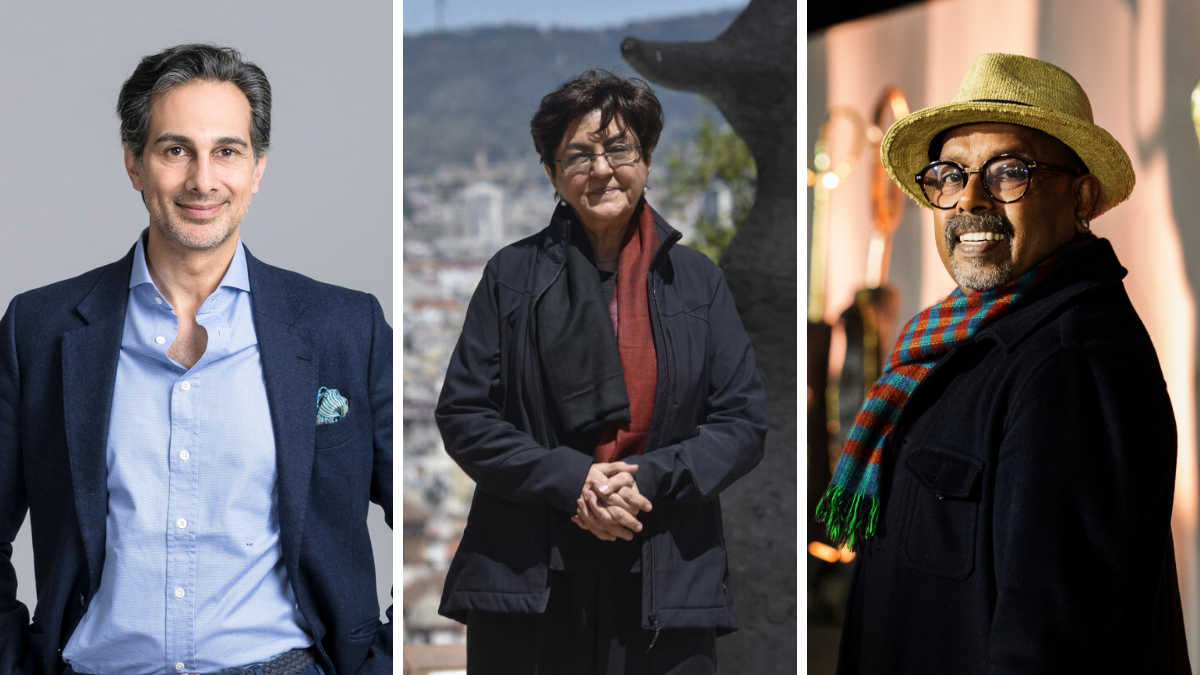
On May 8, the Kochi-Muziris Biennale president Jitish Kallat will make an announcement of the curator for its seventh edition. Prior to that, on May 6, India arrived in Venice not with a single story — but as a chorus.
With a focus on the ideas of home, memory, and belonging and their shifting registers, the India Pavilion presents the exhibition Geographies of Distance: Remembering Home at the 61st Venice Biennale. The festival starts on May 9, with previews from May 6-8. Presented by the National Gallery of Modern Art and Ministry of Culture, curated by Amin Jaffer, five artists will be showcased: Alwar Balasubramaniam, Ranjani Shettar, Sumakshi Singh, Skarma Sonam Tashi, and Asim Waqif. The Pavilion exhibit is being supported by Isha Ambani, chairperson of the Nita Mukesh Ambani Cultural Centre, and Sunil Munjal, founder of Serendipity Arts Foundation.
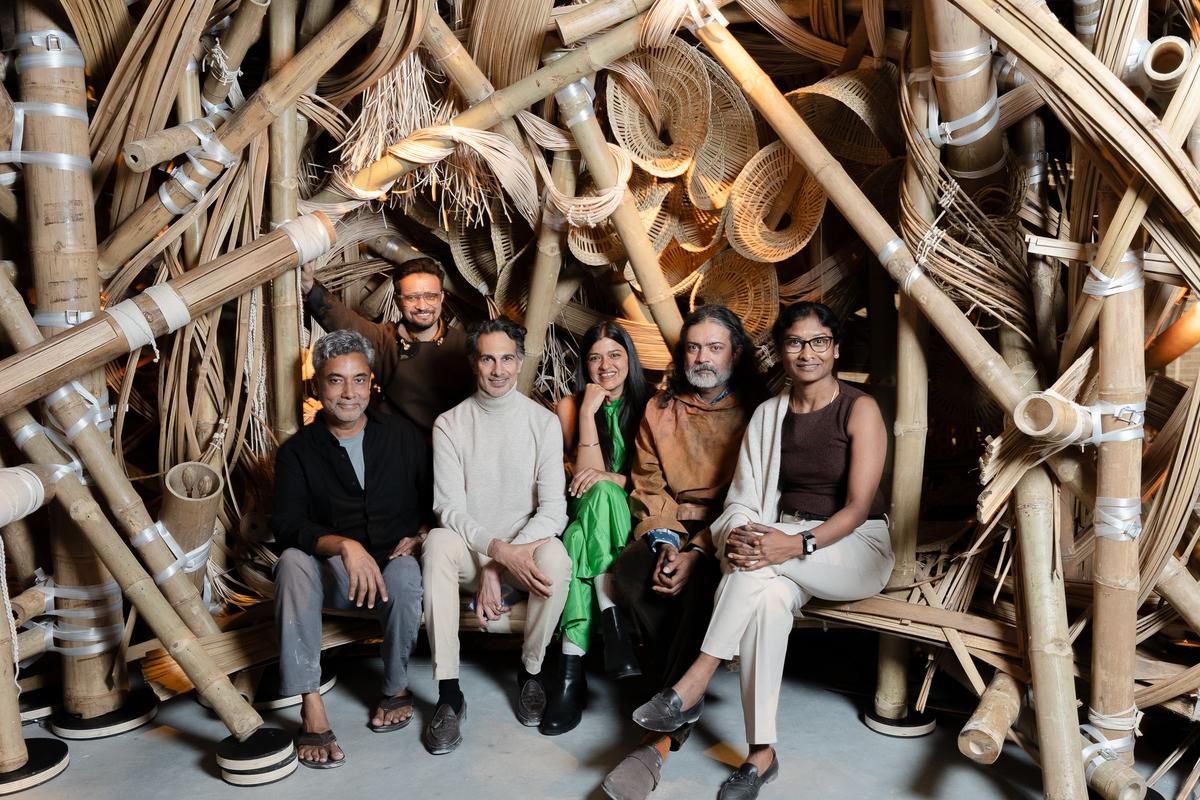
(L-R) Alwar Balasubramaniam, Skarma Sonam Tashi, Amin Jaffer (curator), Sumakshi Singh, Asim Waqif, and Ranjani Shettar
| Photo Credit:
Joe Habben
Jaffer’s curatorial note states that each of “the five artists evoke home through material and making. Working with soil and thread, bamboo, natural fibre, and papier-mâché, their practices are rooted in India’s material traditions that span millennia, yet their questions are urgently contemporary: as time passes, what of our home remains? What disappears? What do we actively sustain?”

If Balasubramanian goes back to the soil, ‘humus’ in Latin, from which derives the word ‘human’, recording everything outdoors, from fallen leaves to animal footsteps, Singh crafts from delicate white thread, thinner than hair, as gossamer-like architectural membranes suspended in air, reminiscent of memories drawn from the ether.
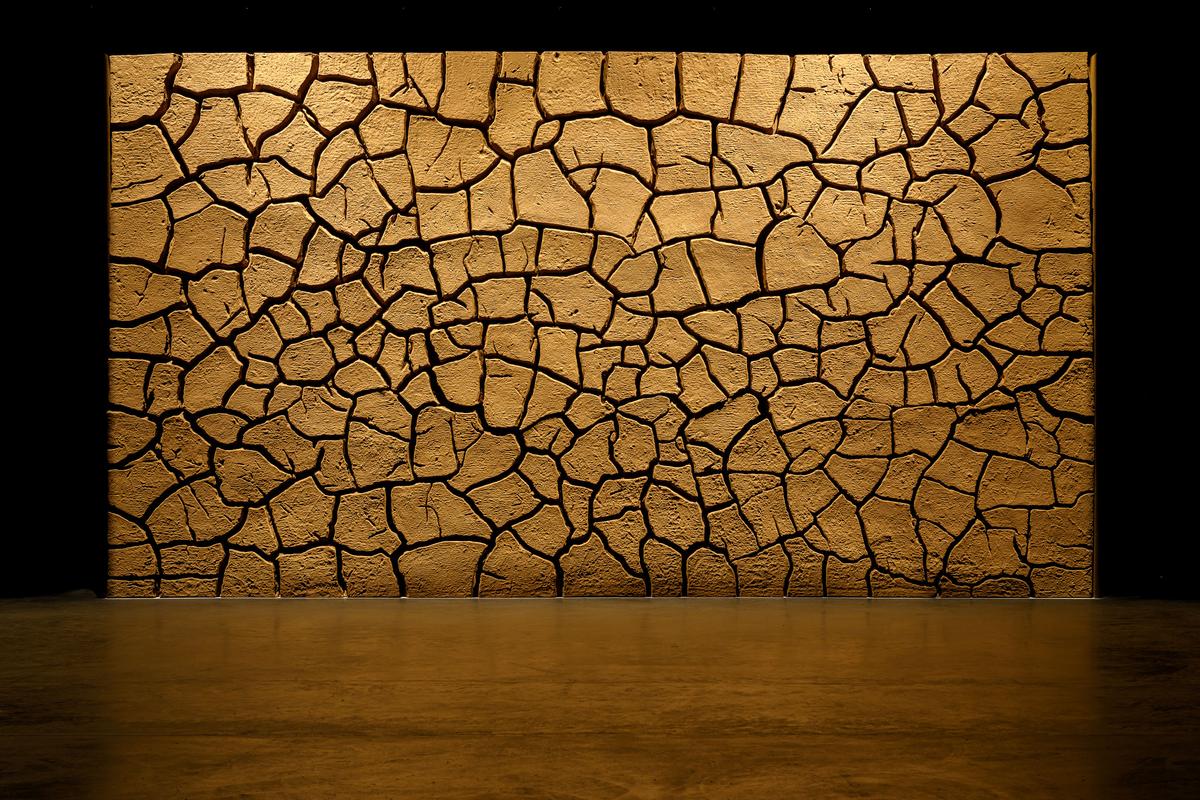
Alwar Balasubramaniam’s Not Just for Us
| Photo Credit:
Andrea Avezzù
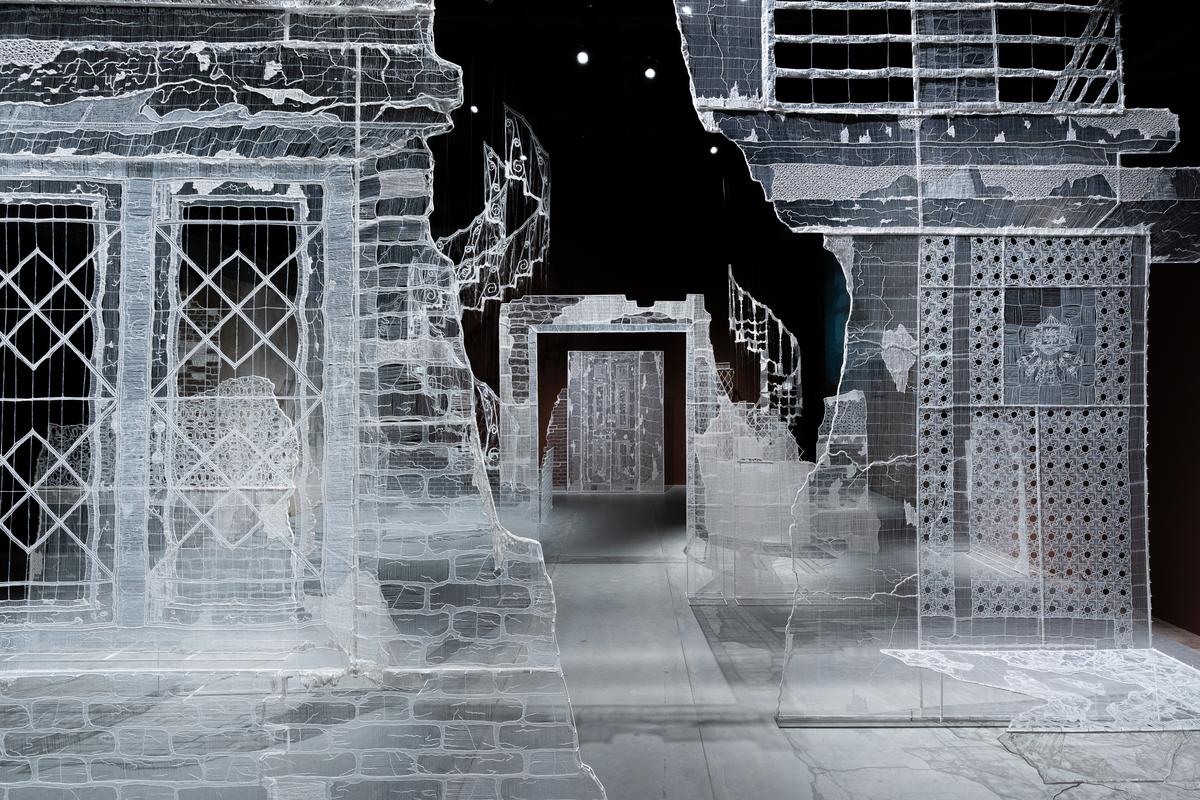
Sumakshi Singh’s thread installation, Permanent Address
| Photo Credit:
Joe Habben
Then there is Shettiar’s handwoven flora and nature, with cotton and lacquer, in a musical choreography; Tashi’s Echoes of Home, which uses recycled cardboard, papier-mâché, and clay, to reflect on his relationship with his homeland, Ladakh. And Waqif, who has been working with bamboo for almost 30 years, reflects on the broader shift towards standardised (pakka) construction models and diminishing visibility of traditional architectural methods.
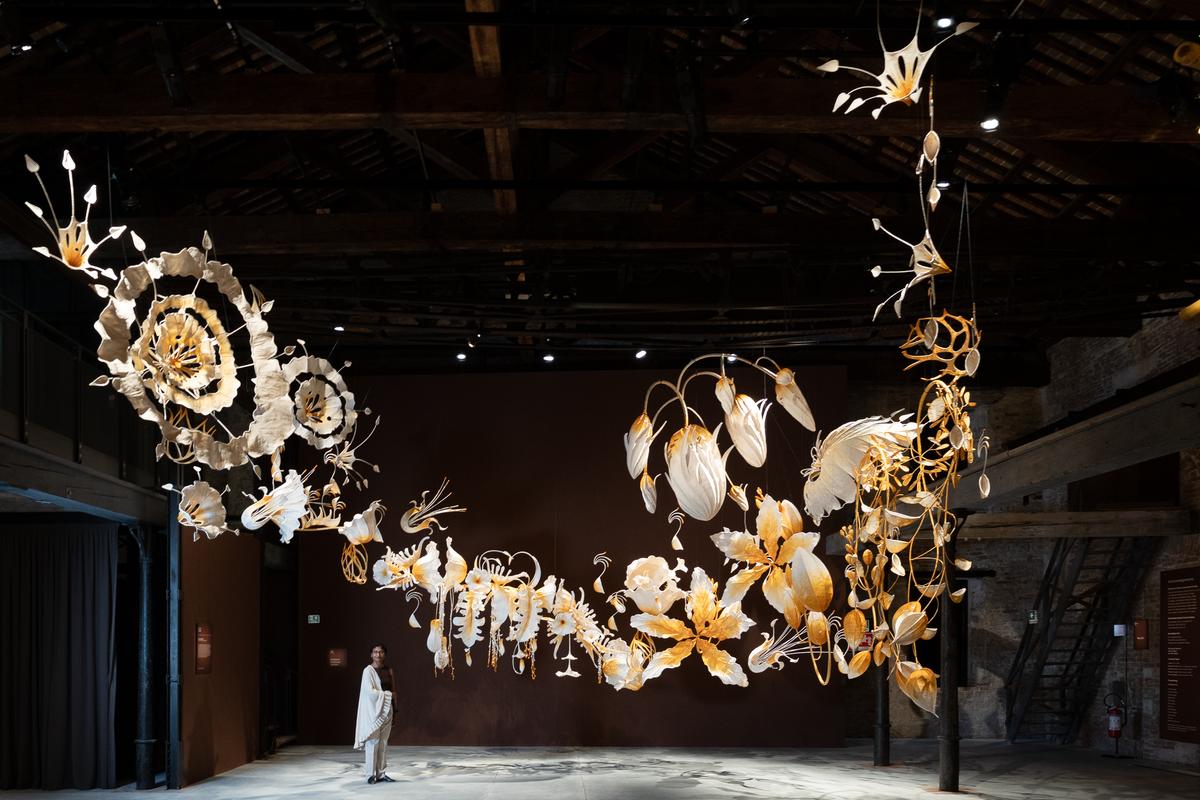
Ranjani Shettar’s handwoven floral installation
| Photo Credit:
Joe Habben
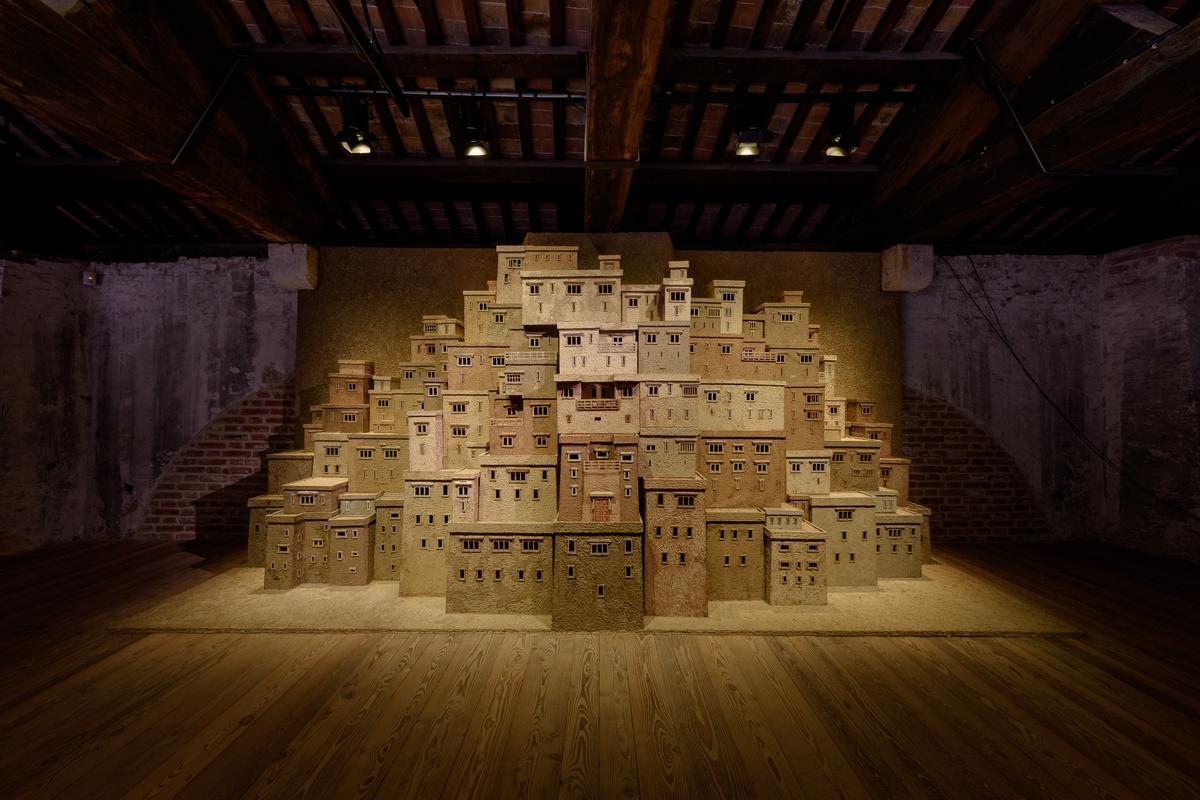
Skarma Sonam Tashi’s Echoes of Home
| Photo Credit:
Andrea Avezzù
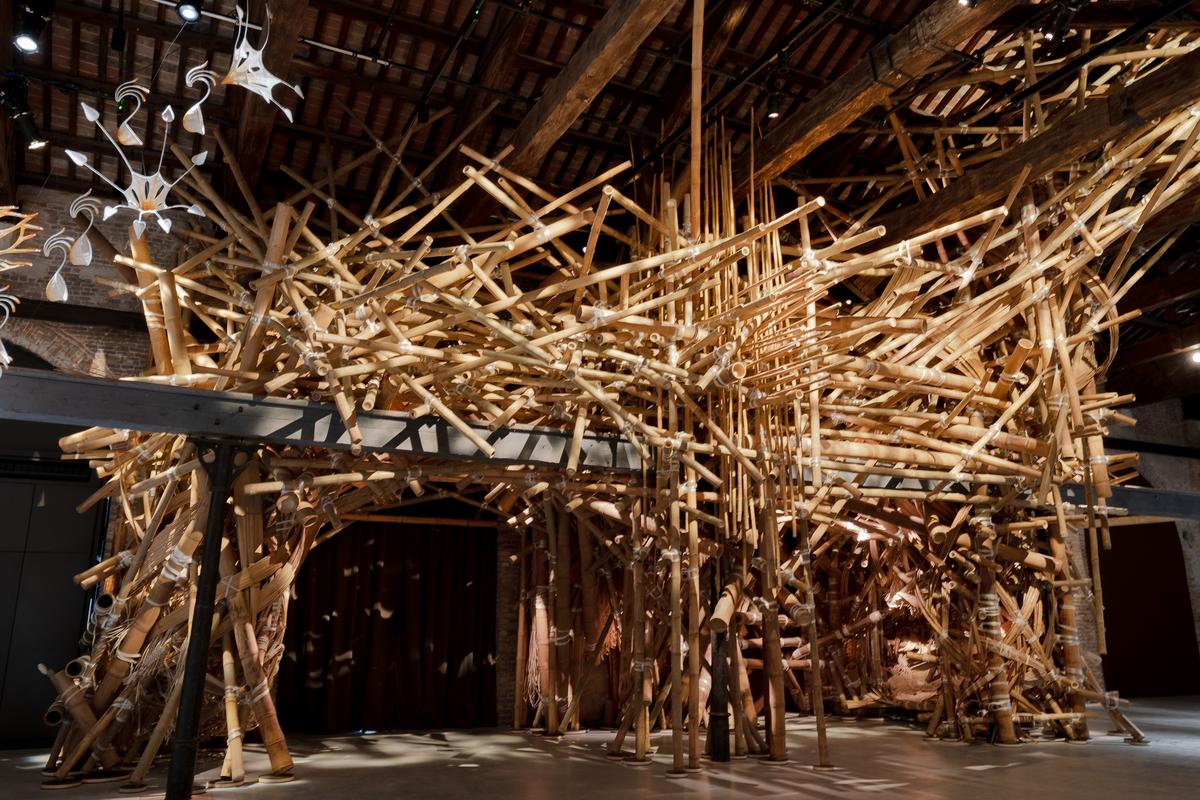
Asim Waqif’s Chaal
| Photo Credit:
Joe Habben
A feminist telling by Nalini Malani
But India’s presence expands far beyond the pavilion walls. In one of the Biennale’s most powerful collateral exhibitions, Kiran Nadar Museum of Art brings Nalini Malani’s Of Woman Bornto Venice. Magazzini del Sale, a 15th-century salt warehouse within the Venice Biennale’s exhibition circuit, turns into a darkened, immersive animation chamber.
Nalini Malani’s Of Woman Born at Magazzini del Sale
| Video Credit:
Courtesy: KNMA
The work draws from ancient narratives and feminist thought, turning the viewer into a witness, surrounded by stories that refuse to settle into a single frame. Composed of 30,000 iPad drawings, Of Woman Born is inspired by the Greek myth of Orestes, who murdered his mother and her lover to avenge their slaying of his father. If the Pavilion explores how we construct home, Malani reveals what lingers when it is fractured or lost.

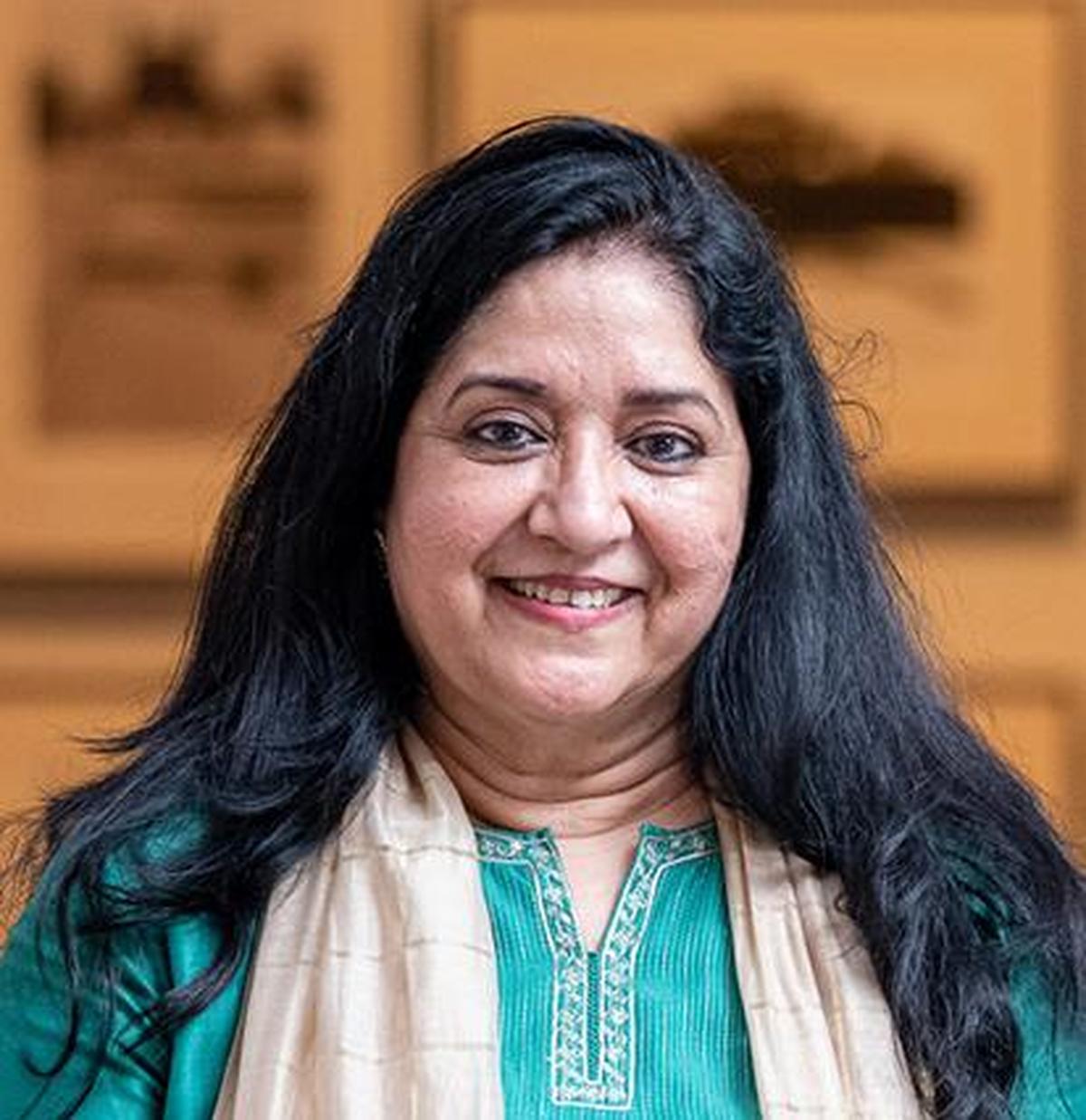
Roobina Karode, artistic director and chief curator, Kiran Nadar Museum of Art
| Photo Credit:
Mohammed Roshan
“We have walked alongside Nalini’s practice for decades, and what strikes you is how the world keeps catching up to what she has always known. Of Woman Born is not a response to this moment — it is a reckoning with every moment that brought us here. Venice felt like the only right stage for that,” says Roobina Karode, artistic director and chief curator, Kiran Nadar Museum of Art.
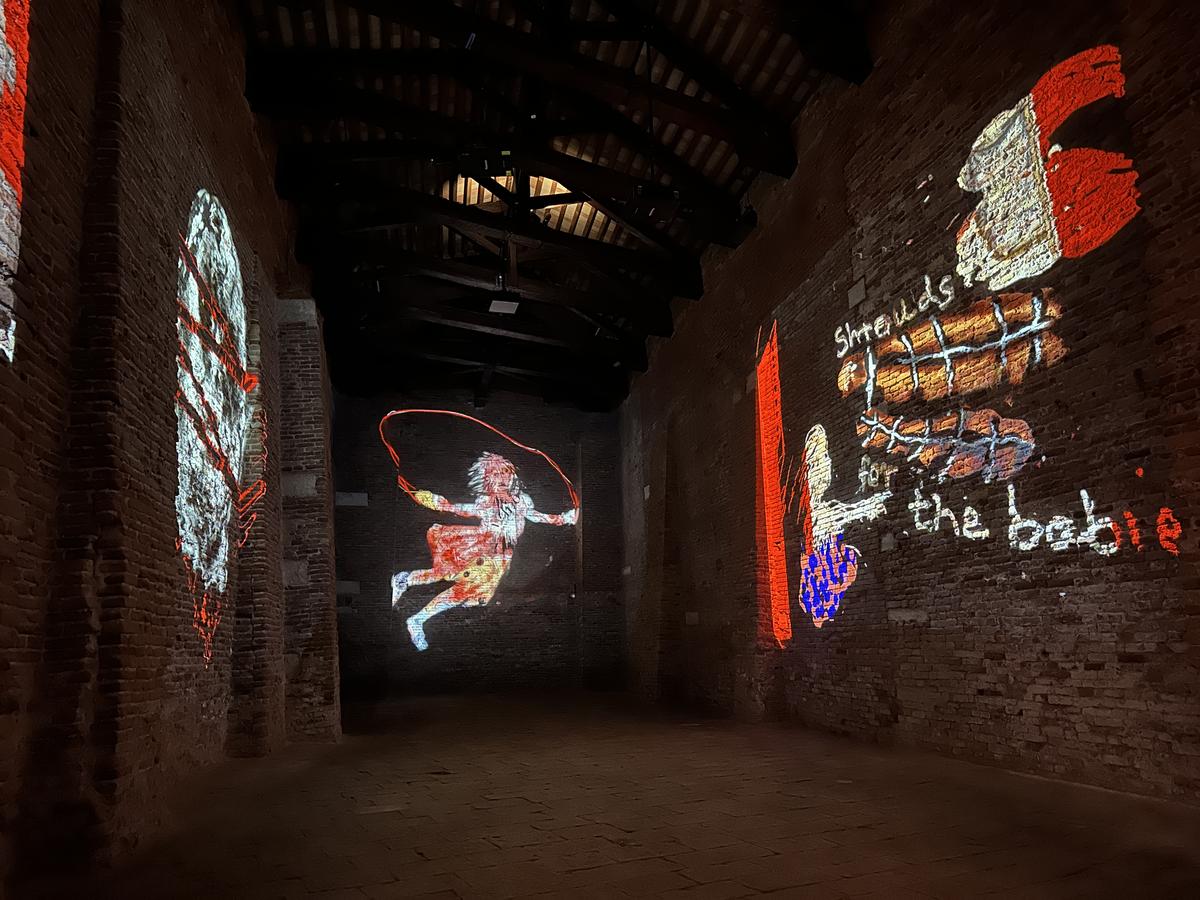
Nalini Malani’s Of Woman Born
| Photo Credit:
Courtesy KNMA
Parallel shows
Elsewhere, Paresh Maity brings a different energy to Venice — one of colour, movement, and emotional immediacy; of India not as a fixed geography, but as a feeling carried across places. Maity, usually known for his paintings, will be exhibiting a 3-D brass-and-metal sculpture, Equilibrium, at Marinaressa Gardens, Riva dei Sette Martiri, Giardini, Venice, presented by Art Alive Gallery. His display is part of the collateral exhibition Personal Structures – Confluences and continues his showcase from the last Biennale.
Paresh Maity’s Equilibrium
| Video Credit:
The Hindu
Maity says, “This is the second time the ECC (European Cultural Council) has selected my sculpture to exhibit during Venice Biennale. It will be in a garden called Marinaressa Gardens. I’m really excited and I feel very happy and honoured to see my sculpture Equilibrium along with the works of artists from around 50 other countries. And, this will be seen by each and everyone because this is outside the garden. Whoever is walking, passing by the waterfront from San Marco to Giardini or Arsenale, they will be able to see this. The culture concept for Equilibrium is based on directions: east, west, north, south and Ishaan, Agni, Nairitya, and Vayu.”
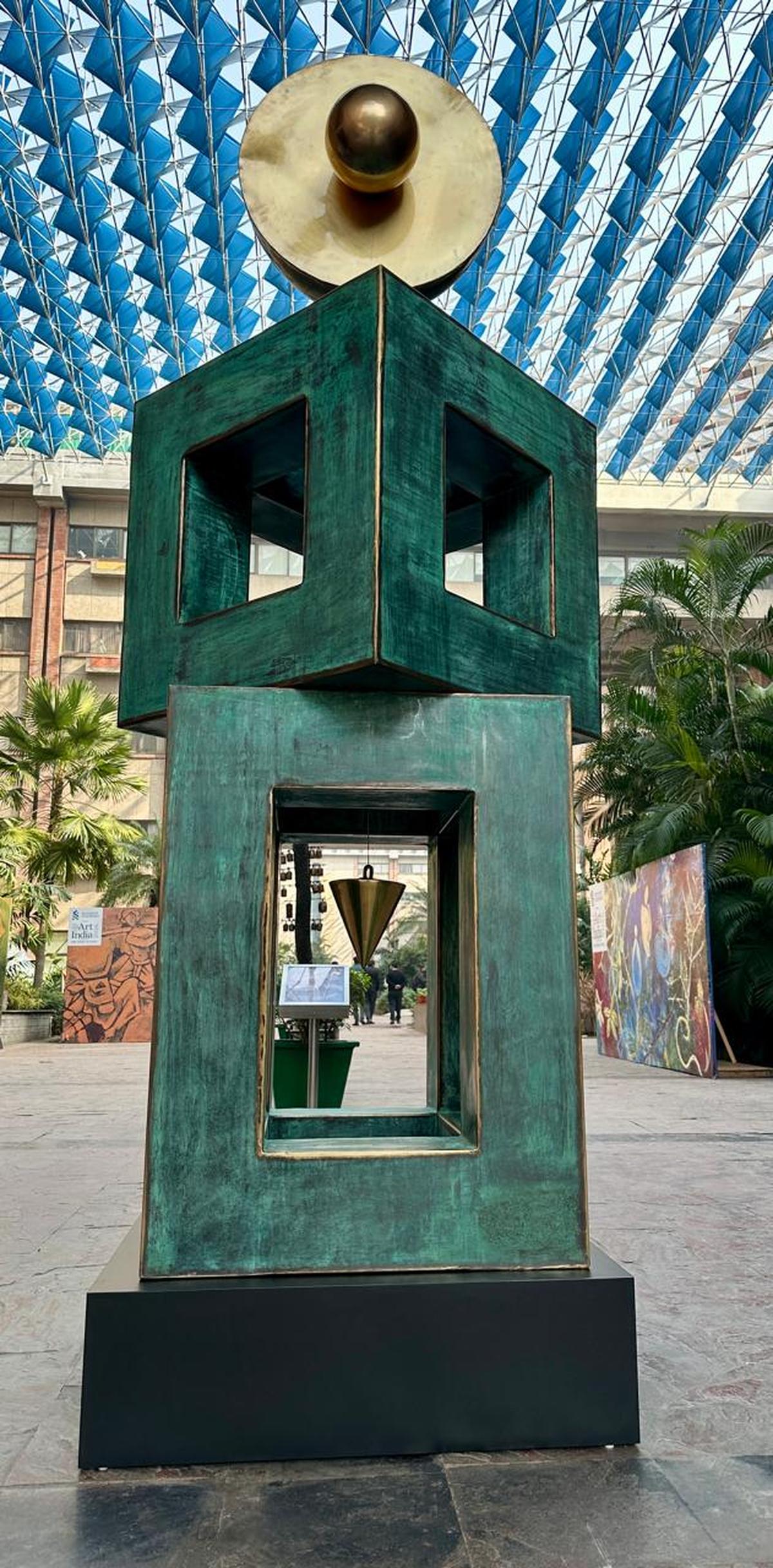
Paresh Maity’s sculpture Equilibrium
| Photo Credit:
Special arrangement
“Last Biennale, in 2024,” Maity adds, “they had selected another sculpture of mine, called Genesis, which was appreciated in a big way. They are giving me a very premium spot and a space to exhibit the sculpture, which is already installed. I feel very honoured to be a part of the world’s biggest art exhibition, Personal Structures: Confluences 2026.”
The jury resigns
Meanwhile, just days before the opening, the entire five-member international jury, led by Brazilian curator Solange Farkas, of the 2026 Venice Biennale has resigned. The jury announced it would refuse to award prizes to artists from countries whose leaders face International Criminal Court (ICC) charges — a not-so-subtle reference to Russia and Israel.
This marks the return of Russia for the first time since the full-scale invasion of Ukraine. In 2022, after Russia went to war against Ukraine, the curator and artists involved in the Russian pavilion withdrew in protest against Vladimir Putin and his invasion, leaving the pavilion empty. In 2024, Russia handed the space over to Bolivia. Amid European governments’ protests, the Russian pavilion at the 2026 Venice Biennale will remain closed to the general public and will be accessible only during professional preview days, according to news reports.
The Biennale organisers postponed the Golden Lion awards and replaced them with public voting by visitors.
And then there are quieter, scattered presences. Artists like Dayanita Singh continue to reshape how archives and images function, turning photography into something sculptural and alive. Coinciding with the Biennale, Singh’s key presentation is a large solo exhibition titled “Archivio” at the State Archives of Venice, currently on till July 31.
India at Venice Biennale 2026, which runs till November 22, resists definition. It does not attempt to represent a nation in its entirety, but contributes to a larger dialogue about belonging in a world in a constant state of flux.
The India Pavilion exhibit is being supported by Isha Ambani, chairperson of the Nita Mukesh Ambani Cultural Centre, and Sunil Munjal, founder of Serendipity Arts Foundation.