Mains Examination: General Studies-III: Challenges to internal security through communication networks, role of media and social networking sites in internal security challenges, basics of cyber security; money-laundering and its prevention.
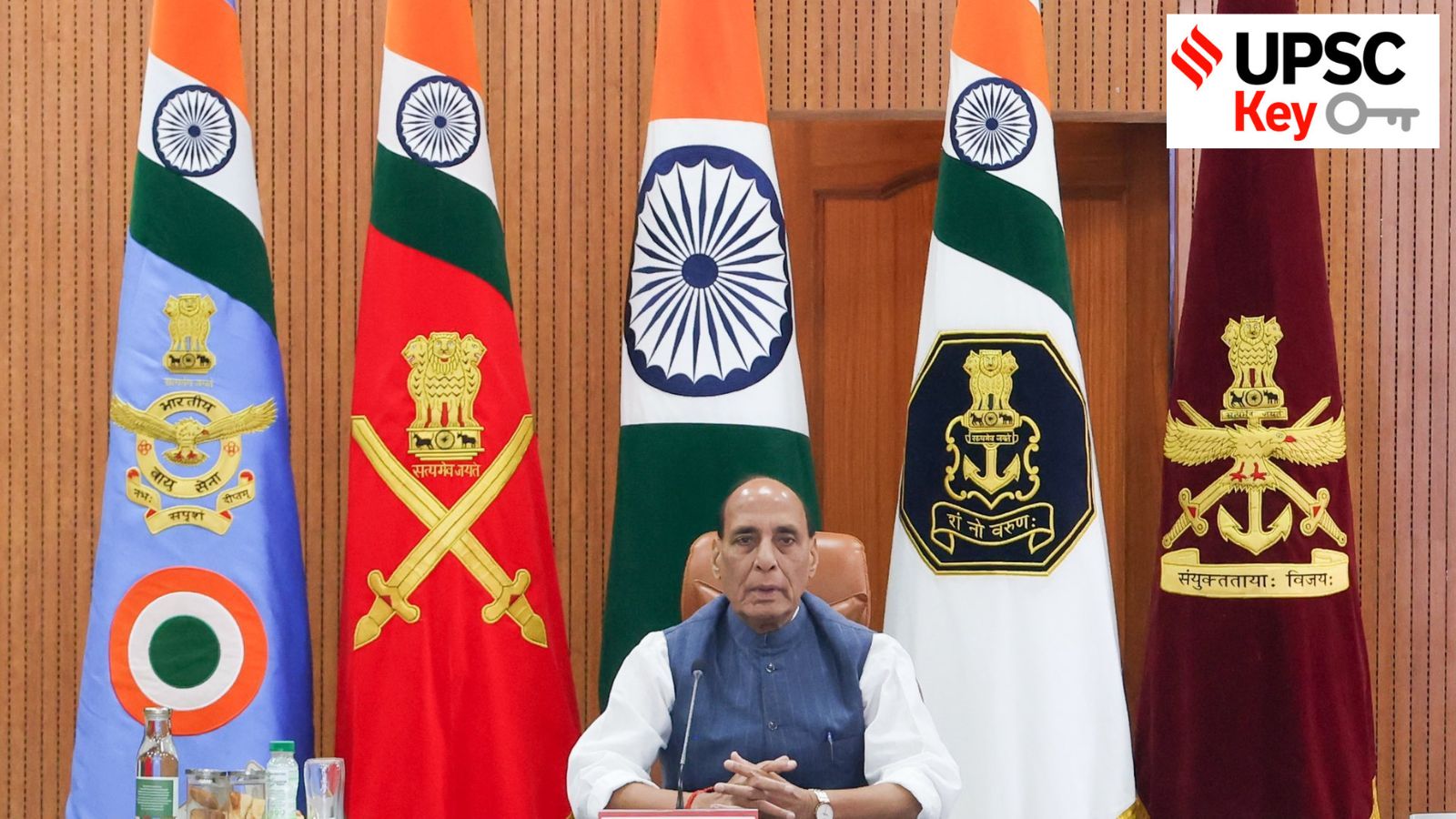
What’s the ongoing story: Defence Minister Rajnath Singh on Friday described Operation Sindoor as a “short-duration, deep-penetration, high-intensity, and high-impact operation” which showcased India’s ability to compel its adversary to surrender.
— How has modern warfare changed?
— What are the challenges of modern warfare?
— What are unified theatre commands?
— What is the need of the unified theatre commands?
— What is India’s expenditure on the defence sector?
— What is the main objective of formulating the National Military Strategy?
Key Takeaways:
— Addressing the second edition of Joint Commanders’ Conference in Jaipur a year after the operation, he said it was a demonstration of India’s growing capabilities and a symbol of its collective resolve and new military ethos.
— He also released a documentary film on Operation Sindoor and the Joint Doctrine for Integrated Communication Architecture, aimed at strengthening doctrinal clarity, interoperability and integrated communications across the Armed Forces in future multidomain operations.
— According to the statement, the conference, themed ‘Military Capability in New Domains’, brought together the top leadership of the Ministry of Defence and the Indian Armed Forces to deliberate on emerging security challenges and future readiness.
Story continues below this ad
FROM NATION PAGE: Armed Forces set new goals for 2047, draw insights from Sindoor, conflicts
— Drawing insights from Operation Sindoor and the recent global conflicts, the Indian Armed Forces have set strategic goals and priorities that they aim to reach by 2047, The Indian Express has learnt.
— These goals include achieving an edge in combat readiness and scaling capability development and strengthening military diplomacy, among others.
— These goals are beyond the various measures being undertaken by the Indian military over the last year, including a large-scale construction of underground infrastructure, boosting air defence, prioritising procurement of modern weapons and technology through the emergency route.
— According to officials privy to the matter, the goals call for the formulation of a National Military Strategy, modernising and procuring the latest technologies and platforms, including autonomous, while bolstering the development of indigenous technologies under the Atmanirbharta initiative.
Story continues below this ad
—- As part of the vision, the military is looking to strengthen deterrence through the procurement of intelligent platforms, combat assets, and force multipliers, create robust border infrastructure as well as coastal surveillance, and design national strategies for possible threats.
— There will likely be an emphasis on air domain awareness in maritime zones, while also expanding Underwater Domain Awareness (UDA).
— Additionally, there will be an overall enhancement of space-based Intelligence, Surveillance and Reconnaissance (ISR) capabilities, along with the development of robust cyber defence networks, among the strategic priorities of the forces, oficials told The Indian Express.
— There are also long-term goals to establish a Defence Geospatial Agency, a Drone Force and a force for cognitive warfare, aside from a full-fledged Space Command, and Cyber Command.
Do You Know:
Story continues below this ad
— SIPRI ranks India as the second-largest arms importer, accounting for 8.3 per cent of global imports in 2020–24. India’s $86.1 billion defence spending places it among the top five globally, but more importantly, it highlights a steady – not aggressive – expansion compared to China’s far larger outlay.
— India is steadily increasing its capabilities across land, air and sea, while also paying attention to cyber and space domains. Military spending has risen gradually, but it remains around 1.9–2 per cent of GDP, which indicates limits in fiscal space.
— SIPRI data noted that while India’s defence imports remain high, there is a gradual shift towards domestic production. Delhi’s defence strategy combines immediate security requirements with long-term goals of self-reliance, evident in its strategies like diversification and Defence Vision 2047.
Other Important Articles Covering the same topic:
📍India’s defence strategy in the time of rising global conflicts
Previous year UPSC Mains Question Covering similar theme:
Story continues below this ad
The use of unmanned aerial vehicles (UAVs) by our adversaries across the borders. to ferry arms/ammunitions, drugs, etc., is a serious threat to internal security. Comment on the measures being taken to tackle this threat. (UPSC CSE 2023)
EXPLAINED
How the charkha came to embody Gandhi and Tagore’s deepest disagreements
Syllabus:
Preliminary Examination: History of India and Indian National Movement
Mains Examination: General Studies-I: Modern Indian history from about the middle of the eighteenth century until the present – significant events, personalities, issues.
What’s the ongoing story: In September 1921, during Mahatma Gandhi’s visit to Calcutta, Rabindranath Tagore told him: “Poems I can spin, Gandhiji, songs and plays I can spin, but of your precious cotton what a mess I would make!”
Key Points to Ponder:
— What is Rabindranath Tagore’s idea of Nationalism?
Story continues below this ad
— What is the significance of Charkha in India’s independence movement? (culture, swadeshi, economy, village economy)
— In what ways did Tagore and Gandhi agree and differ in their approach to India’s anticolonial movements?
— How does the current global wave of nationalism echo the tendencies Rabindranath Tagore warned about?
— Know about the difference in ideology, nationalism,and modernity between Tagore and Gandhi
Story continues below this ad
— What is the cultural significance of Tagore’s in India’s national movement?
— Know about Tagore’s contribution in education, novels, poetry, novels, and songs
Key Takeaways:
— Gandhi and Tagore shared an enduring friendship that lasted from 1914-15 till the latter’s death in 1941. But they also shared profound disagreements about political, social and economic matters.
— And perhaps no object symbolised their deepest philosophical differences more than the charkha. Tagore recoiled from Gandhi’s insistence that every true Indian must spin, while Gandhi remained unwavering in his belief that spinning carried deep moral and symbolic significance.
Story continues below this ad
— Jawaharlal Nehru once observed: “No two persons could probably differ so much as Gandhi and Tagore!”
— The conflict between them, despite a deep friendship rooted in respect, was probably inevitable. The first signs appeared in 1915, when Gandhi visited Shantiniketan after returning from South Africa. They disagreed on a range of topics — from nationalism to education and politics.
— The gap grew after the Amritsar Massacre, when Gandhi initiated movements such as Non-Cooperation. Tagore worried these movements would lead to blind nationalism. Instead, he renounced his knighthood in protest.
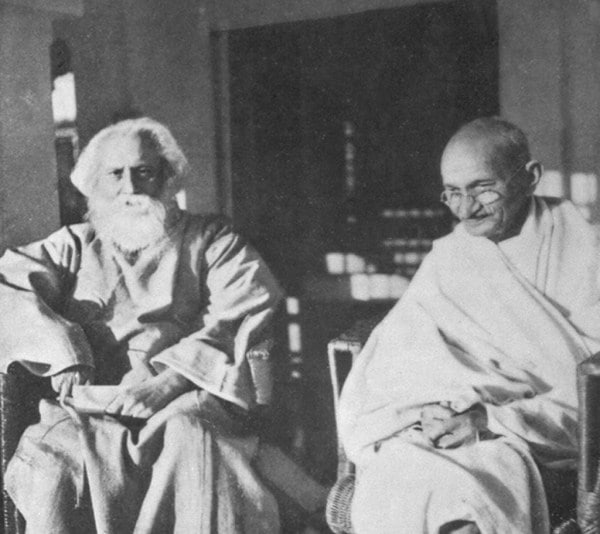 Rabindranath Tagore and Mahatma Gandhi in 1940. Wikimedia Commons
— In the aftermath of a devastating earthquake in Bihar in 1934, Gandhi called the calamity a “divine chastisement for the great sin we [upper castes] have committed against… Harijans”. Tagore did not agree.
— “If we associate ethical principles with cosmic phenomena, we shall have to admit that human nature is morally superior to Providence…,” he wrote to Gandhi (and later published) in protest.
— Tagore was deeply unsettled by what he saw as the moral tyranny embedded in the spinning movement — the cult of the charkha and the Congress directive mandating khadi, or hand-spun cloth.
— In November 1924, Gandhi and other Congress leaders resolved that all Congress members must wear khadi while attending political or Congress functions, and contribute 2,000 yards of evenly spun yarn every month. Gandhi believed this would not only make India self-reliant in clothing, but also morally transform Congress workers themselves.
— Tagore disagreed sharply. He dismissed the directive as “censure in printer’s ink” and responded with the essay The Cult of the Charkha in The Modern Review.
— He also believed the original purpose of the charkha — enabling the poor to meet a basic need for clothing, was being undermined as spinning turned into ritual. The repetitive labour it demanded, he argued, engaged “the muscles and not the mind”.
— Tagore also rejected the idea that India could isolate itself from the modern world. Withdrawal from science and technology, he believed, would impoverish rather than strengthen the country.
— Gandhi answered these criticisms in The Poet and the Charkha in November 1925. Acknowledging the unease generated by Tagore’s essay, he defended the spinning wheel: “The fact is that the Poet’s criticism is a poetic licence and he who takes it literally is in danger of finding himself in an awkward corner.”
— He also accused Tagore of inhabiting an ivory tower, remarking: “If the Poet span half an hour daily, his poetry would gain in richness. For it would then represent the poor man’s wants and woes in a more forcible manner than now.”
— For Gandhi, machinery had its place, but “it must not be allowed to displace the necessary human labour”. The charkha, in his view, cultivated dignity in physical work, encouraged cooperation, and carried both economic and ethical significance.
— Tagore was not opposed to the charkha as a means of meeting a basic human need. What troubled him was the excessive importance it had acquired in Gandhi’s political and moral programme.
Do You Know:
— It was an unease with this violence that Rabindranath Tagore shared with Mahatma Gandhi. The relationship between Tagore and Gandhi was one of the most important and, for the Indian Freedom Movement, consequential intellectual associations of the last century.
— The two men held each other in the highest regard and their ties were marked by both alignment and contention. While Gandhi advocated the boycott of foreign goods, Tagore was wary of such approaches dominating the anticolonial struggle.
— On the other hand, Gandhi, like Tagore, wished for India to remain true to its spirit and refrain from “imitating the West”. A militant response to colonialism, the two also agreed, would adversely affect those in whose name it was being carried out. Victory under such circumstances meant little.
— Once violence became the accepted means through which a society addressed its problems, the logic underpinning it risked becoming embedded in common sense, sustaining itself well into the post-colonial future.
— Born on May 7, 1861, Rabindranath Tagore remains the only Indian to have won the Nobel Prize in Literature.
— Although he was knighted by the British in 1915, Tagore renounced the honour in protest against the Jallianwala Bagh massacre, a powerful political statement.
— Tagore is credited with writing the national anthems of both India (Jana Gana Mana) and Bangladesh (Amar Sonar Bangla), an extraordinary legacy across nations.
Other Important Articles Covering the same topic:
📍Rabindranath Tagore: I will never allow patriotism to triumph over humanity
📍Five timeless films that bring Rabindranath Tagore’s stories to life
Previous year UPSC Prelims Question Covering similar theme:
(1) With reference to Madanapalle of Andhra Pradesh, which one of the following statements is correct? (UPSC CSE 2021)
(a) Pingali Venkayya designed the tricolour Indian National Flag here.
(b) Pattabhi Sitaramaiah led the Quit India Movement of Andhra region from here.
(c) Rabindranath Tagore translated the National Anthem from Bengali to English here.
(d) Madame Blavatsky and Colonel Olcott set up headquarters of Theosophical Society first here.
Previous year UPSC Mains Question Covering similar theme:
What was the difference between Mahatma Gandhi and Rabindranath Tagore in their approach towards education and nationalism? (UPSC CSE 2023)
Why 2023 law to appoint CEC came about, the legal challenge it faces
Syllabus:
Preliminary Examination: Current events of national and international importance.
Mains Examination: General Studies-II: Appointment to various Constitutional posts, powers, functions and responsibilities of various Constitutional Bodies.
What’s the ongoing story: The Supreme Court on Thursday (May 7) described Parliament’s decades-long delay in enacting a law for appointments to the Election Commission, until it was directed to do so in 2023, as “tyranny of the elected”.
Key Points to Ponder:
— Know the constitutional provisions related to the Election Commission of India.
— What is the process of selection of CEC?
— How is the CEC different from the other Election Commissioner?
— What do you understand by ‘tyranny of the unelected’ and ‘tyranny of the elected’?
— EC is like a “guardian of democracy”. Elaborate.
— What are the challenges faced by the Election Commission of India (ECI)?
— What are the recent initiatives taken by the ECI to strengthen voting system in India?
— What are the concerns related to the ECI?
Key Takeaways:
— A bench of Justices Dipankar Datta and Satish Chandra Sharma was hearing challenges to the Chief Election Commissioner and Other Election Commissioners (Appointment, Conditions of Service and Term of Office) Act, 2023.
— This law, introduced to address the legislative gap, came under legal challenge in 2024 as it removed the Chief Justice of India (CJI) from the selection panel for Election Commissioners, replacing the CJI with a Union Cabinet minister appointed by the Prime Minister.
— Article 324(2) of the Constitution states that Election Commissioners should be appointed in a manner “subject to the provisions of any law made in that behalf by Parliament.”
— While the Election Commission (Conditions of Service of Election Commissioners and Transaction of Business) Act, 1991, regulated salaries, tenure and the commission’s functioning, it did not cover appointments.
— In the absence of such a law, appointments remained under the executive’s domain. The Union Law Ministry would prepare a panel, suggesting names to the PM, whose recommendation would go to the President. Over time, ECs were almost always drawn from the bureaucracy, and the senior-most EC would usually become the CEC.
— In its March 2023 ruling in Anoop Baranwal vs Union of India, the Supreme Court laid down an interim process for appointing Election Commissioners until Parliament enacted a law on the issue.
— It said that the President shall make CEC and EC appointments on the advice of a three-member committee “consisting of the Prime Minister, the Leader of the Opposition in the — Lok Sabha, and in case no leader of the Opposition is available, the leader of the largest opposition party in the Lok Sabha in terms of numerical strength and the Chief Justice of India.”
— The decision was rooted in the need to ensure that elections are conducted fairly and legally, with an independent body essential to insulate the democratic process from executive interference.
— The Anoop Baranwal judgment also expanded the understanding of voting rights. The bench held that the right to vote flows from the Constitution and that casting a vote is a part of freedom of expression guaranteed under Article 19(1)(a).
— The court then made what it called a “fervent appeal” to Parliament to strengthen the Election Commission institutionally and financially.
— After the Anoop Baranwal judgment, Parliament enacted the Chief Election Commissioner and Other Election Commissioners (Appointment, Conditions of Service and Term of Office) Act in 2023.
— In 2024, petitioners such as the NGO Association for Democratic Reforms (ADR) challenged this law. The plea argues that the law restores the executive’s power and dominance over appointments and defeats the principle held in Anoop Baranwal — that the EC must be insulated from executive interference.
— Justice Datta said he is “reminded of a parliamentarian saying tyranny of the unelected” and added, “This should be equated with tyranny of the elected.”
— During the hearing, Justice Datta also said: “But was there a proper debate in the Parliament about the Anoop Baranwal judgment? Is the ethos voiced in the judgment reflected in the Parliamentary debates… That is not clear.
— Senior Advocate Shadan Farasat responded that there had been no proper debate in Parliament. And Bhushan said: “There was virtually no debate because a number of MPs were suspended.”
Do You Know:
— The Part XV of Constitution of India deals with Elections. It has the following articles (Articles 324–329) to empower the Election Commission and provide insight into the potential roles and functions of the commission.
— Article 324: The superintendence, direction and control of the preparation of the electoral rolls for, and the conduct of, all elections to Parliament and the Legislature of every state and of elections to the offices of President and Vice-President.
— Article 325: No individual to be excluded from electoral rolls on the basis of religion, race, caste, sex or any of them.
— Article 326: Adult suffrage shall be the basis for elections to the House of the People and to the Legislative Assemblies of States.
— Article 327: Parliament may, according to the provisions of this Constitution, from time to time enact laws with respect to all matters relating to elections to Parliament and Legislative Assemblies of States.
— Article 328: A state’s Legislature may from time to time by law make provision with respect to all matters relating to, or in connection with, the elections to the House or either House of the Legislature.
— Article 329: The article prohibits the courts from becoming involved in electoral matters.
Other Important Articles Covering the same topic:
📍Amid controversies over ‘vote chori’ and SIR, let’s revisit EC’s power and duties
📍Election Commission of India: Composition, powers and functions
Previous year UPSC Prelims Question Covering similar theme:
(2) Consider the following statements: (UPSC CSE 2017)
1. The Election Commission of India is a five-member body.
2. Union Ministry of Home Affairs decides the election schedule for the conduct of both general elections and bye-elections.
3. Election Commission resolves the disputes relating to splits/mergers of recognised political parties.
Which of the statements given above is/are correct?
(a) 1 and 2 only
(b) 2 only
(c) 2 and 3 only
(d) 3 only
Previous year UPSC Mains Question Covering similar theme:
Discuss the role of the Election Commission of India in the light of the evolution of the Model Code of Conduct. (UPSC CSE 2022)
The war in West Asia has hit the poor more than the rich
Syllabus:
Preliminary Examination: Current events of national and international importance
Mains Examination: General Studies-III: Indian Economy and issues relating to planning, mobilisation of resources, growth, development and employment.
What’s the ongoing story: As the conflict in West Asia continues to strangle fuel and fertiliser supplies across the world, pushing up prices and the cost of living, a familiar question has resurfaced: Who gets hurt the most?
Key Points to Ponder:
— What is K-shaped economic recovery?
— How is it different from V-shaped recovery?
— Understand different types of economy recovery – V, U, W, and L
— How has the West Asia crisis impacted the fuel and fertilizer sector in India?
— How does the global crisis impact different classes of society?
Key Takeaways:
— In other words, often such crises create a K-shaped economy. This is a phenomenon where the economic divisions and inequalities widen with one (often small) segment of the economy tending to consume heavily while another (often large) segment struggles to even consume the staples.
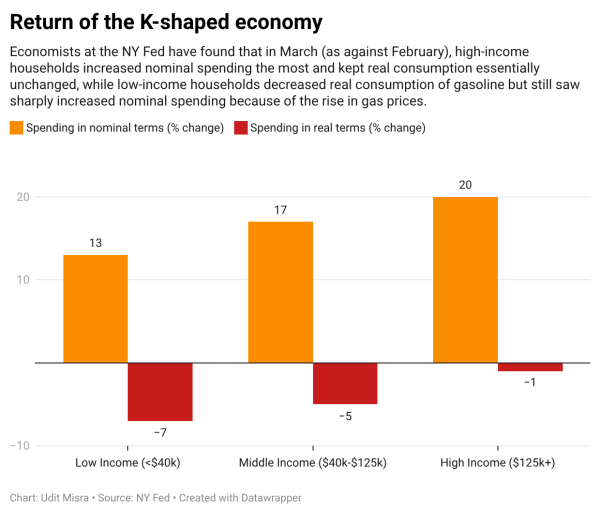
— The war in Iran is already beginning to reveal a K-shaped pattern. Economists at the Federal Reserve Bank of New York recently analysed the way US consumers spent on fuel as pump prices started increasing.
— They found the following: “In March, high-income households increased nominal spending the most and kept real consumption essentially unchanged, while low-income households decreased real consumption of gasoline but still saw sharply increased nominal spending because of the rise in gas prices.”
 K-shaped economy
— The chart alongside shows what happened to consumer consumption in March, compared to February. The poorest — US consumers earning less than $40,000 a year — spent 13.33% more on fuel prices but this “nominal” increase in spending does not capture the “real” decline of almost 7% in spending.
— In other words, while the poorest spent 13% more money to buy fuel, they ended up buying 7% less actual fuel.
— The middle-income earners — those earning between $40,000 to $125,000 a year — spent 17% more on fuel but managed to buy 5% less actual fuel.
— The richest consumers managed to increase their spending by over 20% and thus ensured that their actual consumption of fuel barely changed.
— The broader point is: As oil prices stay elevated, the poor will struggle to consume the same amount even after spending more while the rich will spend more to maintain the same level of real consumption.
— Only looking at nominal spending patterns hides the deepening economic divide that happens during such crises.
— This economic divide was best captured by the following quote (often attributed to poet Damian Barr) that became popular during the Covid-induced economic recession in 2020: “We are all in the same storm but not in the same boat”.
— Richer consumers in any country (and by the same logic, richer countries, say, Japan or South Korea) will be able to spend more in order to take a smaller hit on their actual consumption while the poor (and poorer countries such as Bangladesh or India) may end up being forced to consume less even if they spend more.
Do You Know:
— A K-shaped recovery happens when different sections of an economy recover at starkly different rates.
— If the economic disruption was just for a small period wherein more than people’s incomes, it was their ability to spend that was restricted, it is possible to imagine a “Z”-shaped recovery.
— But what will happen if this recovery is slower and takes more time because the economic disruption resulted in several jobs being lost and people losing incomes, drawing down on their savings etc.?
— Then the economy will follow a “U”-shaped path. In such a scenario, after the initial fall, the recovery is gradual before regaining its momentum. If this process is more-long drawn than it throws up the “elongated U” shape.
Other Important Articles Covering the same topic:
📍Explained: What is a K-shaped economic recovery, and what are its implications?
📍ExplainSpeaking: When and how will Indian economy recover, what the shape of its recovery will be?
Previous year UPSC Mains Question Covering similar theme:
Do you agree that the Indian economy has recently experienced V-shaped recovery? Give reasons in support of your answer. (UPSC CSE 2021)
FRONT
Freeze on petrol and diesel prices cost oil marketing firms Rs 30,000 crore a month
Syllabus:
Preliminary Examination: Current events of national and international importance
Mains Examination: General Studies-III: Indian Economy and issues relating to planning, mobilisation of resources, growth, development and employment.
What’s the ongoing story: STATE-OWNED oil marketing companies (OMCs) Indian Oil, Bharat Petroleum and Hindustan Petroleum are estimated to be piling up under-recoveries — the difference between the retail price and the import price — of about Rs 30,000 crore a month on petrol, diesel and cooking gas, according to a senior government official.
Key Points to Ponder:
— How are market prices of petrol and diesel determined in India?
— How is the ongoing crisis in West Asia impacting oil prices across the country?
— Are petrol and diesel under the GST framework?
— Know about India’s dependence on the Strait of Hormouz
— What do you understand about energy security?
— What are the major petroleum reserves in India?
Key Takeaways:
— OMCs have been facing severe stress as they have kept retail prices of fuel products unchanged despite a surge in global prices amid the West Asia crisis, said Sujata Sharma, Joint Secretary, Petroleum Ministry.
— Besides the three fuel products, OMCs are also losing money on sale of aviation turbine fuel, or jet fuel, for domestic flights. Estimated losses on jet fuel sales were not immediately available.
— With no plans to compensate the OMCs for their losses on sale of petrol, diesel, and jet fuel below market prices, sources said the comments on ballooning under-recoveries indicates a price hike is imminent. The OMCs too have been pushing for a price increased, they said.
— In the case of LPG, the government had stepped in to cushion the impact on OMCs in recent years, and such an intervention can’t be ruled out even this time around, sources indicated.
— With an effective halt in vessel movements through the Strait of Hormuz-from where one-fifth of global oil and natural gas flows usually transited-global energy supplies have been hit and prices have skyrocketed.
— India depends heavily on oil and gas imports to meet its energy needs, and fuel prices in the country are not linked to global oil and fuel price benchmarks.
— The crisis has led to retail fuel price surges in a number of countries, with some even forced to ration fuel supplies. There has been no rationing of petrol and diesel in India, although it was done for commercial and industrial LPG to prioritise cooking gas supplies to households.
— Petrol and diesel prices have not been hiked for over four years now in India. Moreover, the timing of the current global surge in prices, which clashed with Assembly elections in some states, made it politically fraught for the prices to be hiked.
— With the elections now over, a hike in prices of fuels like petrol, diesel, and the domestic LPG could be in the offing in the coming days or weeks, according to highly placed sources in the government. Throughout March and April, the Petroleum Ministry assured consumers that there was no proposal to hike fuel prices.
Do You Know:
— India depends on imports to meet over 88% of its crude oil needs, 40% of which depend on the Strait of Hormuz. As for natural gas, India’s import dependency is about 50%, and 55-60% of India’s liquefied natural gas (LNG) imports come via the Strait.
— In the case of liquefied petroleum gas (LPG), India’s reliance on imports is 60%, and a whopping 90% of those come through the critical waterway.
— The supply disruption forced reduction in natural gas and LPG supplies to certain industries in India as the government was forced to prioritise the requirements of households and priority sectors.
— Before 2010, India followed the Administered Pricing Mechanism, under which the government fixed fuel prices. These prices had little connection with global crude oil markets. State-owned firms such as Indian Oil, Bharat Petroleum, and Hindustan Petroleum sold fuel at controlled prices, often below cost.
— The government later compensated them through subsidies, upstream support, and oil bonds. While this system protected consumers, it distorted price signals and burdened public finances.
— Reforms began on June 25, 2010, following the Kirit Parikh Committee’s recommendations. Petrol prices were deregulated. Diesel followed in 2014, and daily price revisions were introduced in 2017. On paper, India shifted to market-based pricing.
— But in reality, India never fully let go of the controls. Today’s system is best described as managed deregulation. Prices are linked to global prices and exchange rates, but government policy — especially taxes — determines the outcome.
— When crude prices fall, taxes rise, and oil companies retain higher margins, while consumers continue to pay the same high price. When crude prices rise, oil companies absorb losses as they delay price increases under government pressure.
Other Important Articles Covering the same topic:
📍India needs a clear, rules-based framework for fixing petrol prices
Previous year UPSC Prelims Question Covering similar theme:
(3) In the context of global oil prices, “Brent crude oil” is frequently referred to in the news. What does this term imply? (UPSC CSE 2011)
1. It is a major classification of crude oil.
2. It is sourced from the north sea.
3. It does not contain sulphur.
Which of the statements given above is/are correct?
(a) 2 only
(b) 1 and 2 only
(c) 1 and 3 only
(d) 1,2, and 3
THE IDEAS PAGE
In AI world, future belongs to students who can think beyond the machine
Syllabus:
Preliminary Examination: Current events of national and international importance
Mains Examination: General Studies II: Government policies and interventions for development in various sectors and issues arising out of their design and implementation.
What’s the ongoing story: Ashish Dhawan and Pramath Raj Sinha wrote: What should I really study? Will the degree I am pursuing matter in five years? Ten years? These questions on the careers best suited for students today are being asked in classrooms, families, and counselling sessions. They are not new. But they are pressing harder.
Key Points to Ponder:
— How is AI changing the education system?
— Know about AI applications in the field of health, education, and governance
— How can India leverage its demographic dividend to become the AI hub of the world?
— What necessary changes need to be made in the education system to adapt to AI?
— What is Bodhan AI?
Key Takeaways:
— The unease is one of pressure, of too much changing at once. AI deepens that unease, but the question underneath is older. It is about education itself, and what students need to carry into a working life none of us can fully predict.
— AI is now a fact of daily life, including at the workplace. Job roles are being reorganised, tasks and workflows redistributed among teams and tools. Turnaround times are getting shorter, and expectations of productivity rising.
— Think of AI as a huge, tireless brain holding answers to almost any question. But what to ask, within which constraints, and what to look for in the answer, is the part only the human can direct.
— Framing the right problem requires giving AI the right history and concerns. The quality of the answer is, in the end, governed by the quality of asking. For curious minds, that is an ever-present opportunity: To expand learning, go deeper across topics, and follow an idea further than was ever possible before.
— The questions a student today should be asking are not simplistic or even easy. What change do I want to see in my community, my city, my country? How do I want to contribute? And why? These shape the interests and passions of our young people, who, motivated by the mission they want to be part of, will go on to build India and its future.
— The adjustment Indian universities now need to make is in how they teach, what they assess, and how they prepare students for a market that will keep changing. Treating AI as one more elective is not the answer. Nor is narrowing education to what seems immediately rewarding.
— India today has one of the largest and youngest workforces in the world. That is a unique advantage if our students can collaborate with technology to meaningful effect, while continuing to relentlessly enhance their fundamental human thinking: Seeing which problems are worth solving, holding the line on quality, bringing other people along, and the vision to grow.
— A good education has always asked exactly this of its students. AI does not change that ambition. It raises the stakes of meeting it.
Do You Know:
— Education Minister Dharmendra Pradhan said the Centre will integrate AI tools in teaching from the next academic session at all levels, from pre-primary to higher education.
— The effort is propelled by the launch of a not-for-profit company, Bodhan AI, at the Centre of Excellence in AI for Education. IIT Madras hosts this Centre of Excellence, which was a Budget announcement last year, with an allocation of Rs 500 crore.
— Bodhan AI will work on research to build AI capabilities for Indian languages, and develop assets like automatic speech recognition and speech synthesis. Applications will then be built, with the aim of taking them to schools and other institutions through collaborations with state governments.
Other Important Articles Covering the same topic:
📍AI is not killing education — it’s exposing a deep-rooted crisis in how we learn
📍Govt to bring in AI tools in teaching: What is the plan, how it will work
Previous year UPSC Prelims Question Covering similar theme:
(4) With the present state of development, Artificial Intelligence can effectively do which of the following? (UPSC CSE, 2020)
1. Bring down electricity consumption in industrial units
2. Create meaningful short stories and songs
3. Disease diagnosis
4. Text-to-Speech Conversion
5. Wireless transmission of electrical energy
Select the correct answer using the code given below:
(a) 1, 2, 3 and 5 only
(b) 1, 3 and 4 only
(c) 2, 4 and 5 only
(d) 1, 2, 3, 4 and 5
Previous year UPSC main Question Covering similar theme:
📍Introduce the concept of Artificial Intelligence (AI). How does AI help clinical diagnosis? Do you perceive any threat to privacy of the individual in the use of AI in healthcare? (UPSC CSE 2023)
| PRELIMS ANSWER KEY |
| 1. (c) 2. (d) 3. (b) 4. (b) |
Subscribe to our UPSC newsletter. Stay updated with the latest UPSC articles by joining our Telegram channel – IndianExpress UPSC Hub, and follow us on Instagram and X.
🚨 Click Here to read the UPSC Essentials magazine for April 2026. Share your views and suggestions in the comment box or at manas.srivastava@indianexpress.com🚨