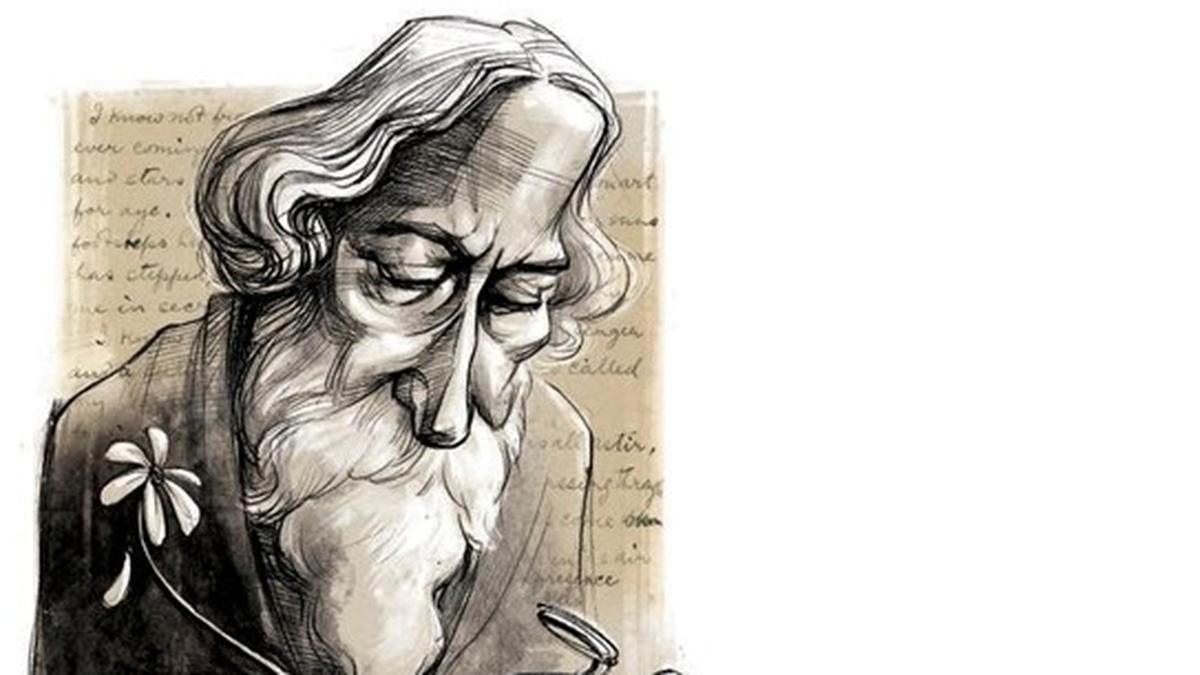
Addressing a tutorial on the English romantics, a professor concluded: “Read Tagore, I implore you, to understand how unlike poets such as Shelley and Keats, he did not struggle to reconcile imagination and reality. This tip stayed with those students of Jadavpur University, one of whom I borrow the anecdote from to embark on this eminently rewarding but daunting endeavour to celebrate the poet-laureate’s musical oeuvre on his 165th birth anniversary, which was celebrated last week.
Bengalis raised in Kolkata will readily profess how Rabindranath Tagore has been central to their formative years. He has been omnipresent in school texts, music on the radio and records at home, not to forget the compulsive desire in each of us to sing, recite and enact his offerings with aplomb — often without concern for glaring individual limitations of craft and performance.
One of my earliest memories of Rabindra Sangeet is Hemanta Mukhopadhyay’s rendition of ‘Ogo nodi apon bege’, a song of the river as a willing chronicler of life’s many turns across meadows and landscapes. Later on, songs of ‘Chandalika’, the dance-drama about love pitted against social ostracism, would play on loop, gradually leading to timeless anthems such as ‘Dhono dhannay’, ‘More bina uthe kon shure baje’ in school and college. These experiences are by no means exclusive. If anything, they are stereotypically ‘Bangalee’. Yet, these have been essential, a rite of passage that paves the way towards serious cultural and intellectual exploration of Tagore songs. For the invested music lover, it is a work in progress that opens doors, at times a whole new horizon, at each hearing.
Wherein lies the essence of Tagore’s music? Rabindra Sangeet offers the ultimate synthesis of words, tones and melody, explains Reba Som in her exemplary book, The Singer and His Song. Unbelievable as it may sound, Tagore has songs for every emotion. There is a song for every season; he’s able to tell the story of sunshine and rain, spring blooms and winter fog. And in doing so, he unveils ideas of love, faith, devotion and surrender, introducing us to elevated thoughts, at times with disarming simplicity.
Wherein lies the essence of Tagore’s music? Rabindra Sangeet offers the ultimate synthesis of words, tones and melody, explains Reba Som in her exemplary book, The Singer and His Song. Unbelievable as it may sound, Tagore has songs for every emotion. There is a song for every season; he’s able to tell the story of sunshine and rain, spring blooms and winter fog. And in doing so, he unveils ideas of love, faith, devotion and surrender, introducing us to elevated thoughts, at times with disarming simplicity.
“I know no man in my time who has done anything in the English language to equal these lyrics,” said Irish poet W.B. Yeats, while introducing some of Tagore’s own translations of his songs to a gathering of English intellectuals circa 1912. Events that followed are well-known. Gitanjali is published in England the same year. Tagore wins the Nobel in 1913 and is knighted two years later. By then, the western world has taken note of the eponymous genre of Rabindra Sangeet and his genius of setting over 2,200 songs to his own music in the storied tradition of the ‘lieder’ that encompasses poetic expression in an enduring musical form to create a staggering ensemble of narratives, feelings and timeless commentary.
Debabrata ‘George’ Biswas, with his splendid baritone, articulates the cosmic wonder of existence in ‘Aakash bhora surjo tara’. Kanika Bandopadhyay brings serenity through ‘Anandadhara bohichhe bhubane’, a song of universal truths, while Ritu Guha offers solace in ‘Eki labonye purno pran’, her tribute to the ‘Lord of Life.’
Suchitra Mitra celebrates freedom that lies in the light of the skies beyond the limitations of the body and mind in ‘Amar mukti aloye aloye’. Sagar Sen’s intimate ‘Aj jyotsnarate shobai gechhe bone’ captures the quiet of a moonlit night when “all have left and I chose to stay.” And Santideb Ghosh, with his ‘kirtani’ storytelling of Krishnakoli, evokes the image of the dark village girl who comes to life in the plaintive relief of a flute.
Appreciation of Tagore may be rooted in the Bengali language, but he is by no means the sole preserve of Bengal. For, his music is a well-spring of good thought, embodying all that is life. Filmmaker Ritwik Ghatak spoke of it with remarkable candour: “I cannot speak without Tagore… I have nothing new to say… in the final analysis, you will find he has the last word.”
And if you are one of those still engaging with the question, ‘How have we forsaken who we were to become who we are now?, you may want to turn to ‘Klanti amar khoma koro prabhu’ (Forgive me my weariness, oh Lord) and then perhaps, embrace continuum in the finality of, ‘Achhe dukkho, achhe mrityu (there is sorrow, there is death) particularly, Srikanta Acharya’s rendition, Reba Som’s translation of which goes like this:
There is sorrow, there is death…
Yet laugh the sun, moon and stars
Spring arrives in the bower in varied colours
Waves merge into rising waves
Flowers scatter to blossom again
There is no erosion, there is no end
There is no trace of being impoverished,
It is at the feet of that plenitude
That my mind begs for space.
Published – May 15, 2026 10:49 am IST