
The government is actively evaluating a revamped framework for Press Note 3 (PN3)—the foreign investment rule issued in 2020 that mandates prior approval for FDI from neighbouring countries, including China. The move comes as ministries weigh the need to balance national security considerations with capital requirements across emerging sectors.
According to sources, the proposed framework may introduce a three‑tier structure, creating clearer pathways for investments based on size and strategic importance.
Speaking to NDTV Profit, Moin Ladha, Partner at Khaitan & Co, said the introduction of a clear threshold for beneficial ownership could be transformative for businesses waiting indefinitely for approvals. “If the de minimis threshold… is prescribed, this by itself will facilitate a lot of minority investment across sectors,” he noted, pointing out that current approval timelines stretch to “almost about 12 months in certain situations.”
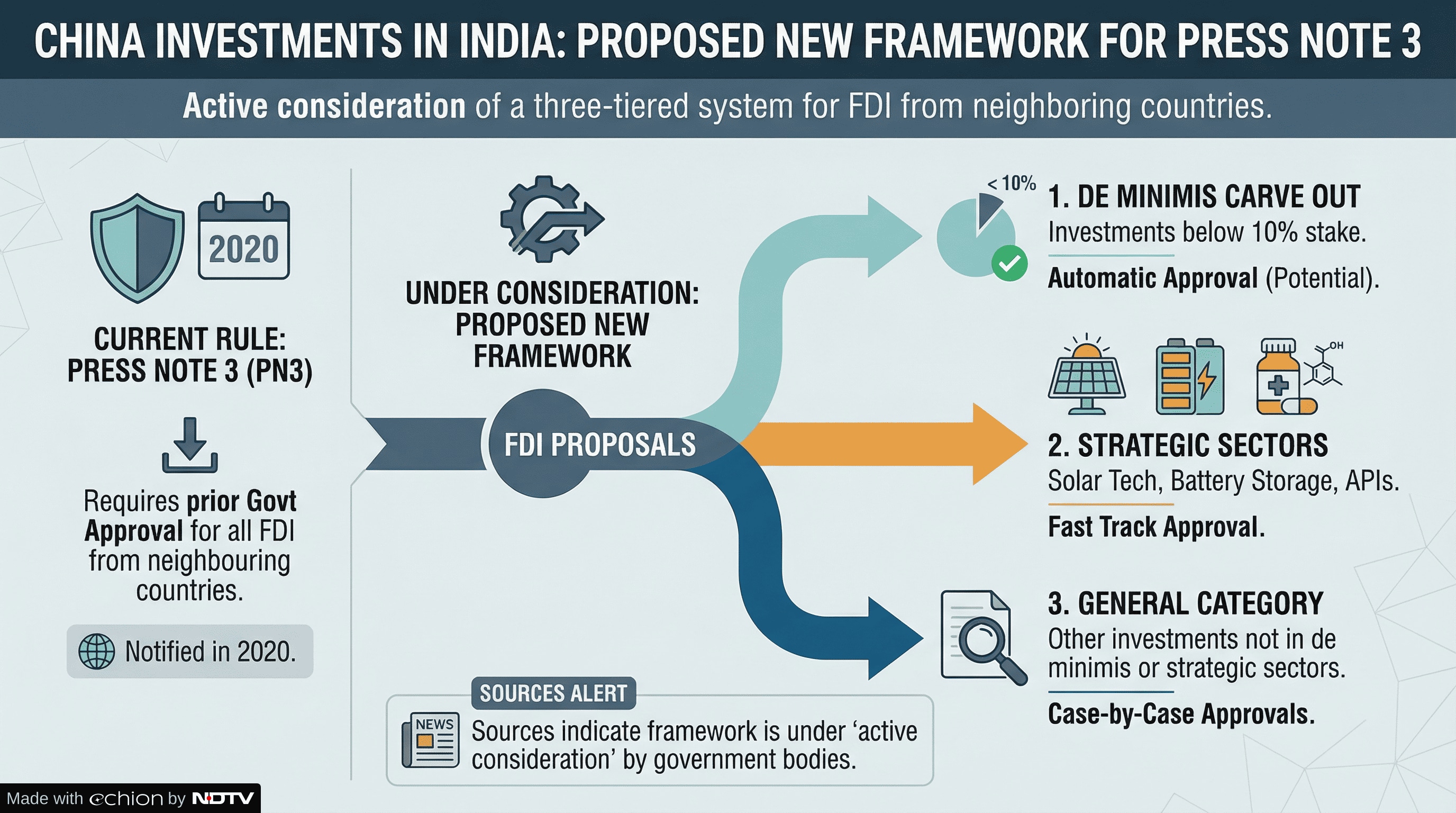
A key proposal under discussion is a de minimis carve‑out, which could allow automatic approval for investments involving a stake below 10%, provided the sector is considered low‑risk. This mechanism is expected to benefit startups and smaller enterprises that rely on global funds with indirect Chinese exposure.
However, Ladha cautioned that several unanswered questions remain. “How will we aggregate this 10%?… What about existing Chinese investments?” he asked, noting that entities with pre‑2020 joint ventures or wholly‑owned subsidiaries need clear direction. He added that even within the 10% window, rights embedded in shareholder agreements could complicate interpretations: “What if this 10% comes with control rights or other rights?”
In sectors deemed strategic—such as solar technologies, battery storage and active pharmaceutical ingredients (APIs)—the government may enable fast‑track clearances to accelerate domestic capacity building. These sectors are critical to India’s energy transition and pharmaceutical supply‑chain resilience.
All other sectors would fall under a general category, where investments from PN3‑notified countries would continue to be examined on a case‑by‑case basis. The deliberations mark the first major rethink of PN3 since its introduction, signalling calibrated easing without compromising security review mechanisms.
ALSO READ: Nifty Q3 Scorecard: SBI, TechM Power Ahead As Reliance, Tata Motors PV Slip
Essential Business Intelligence,
Continuous LIVE TV,
Sharp Market Insights,
Practical Personal Finance Advice and
Latest Stories — On NDTV Profit.