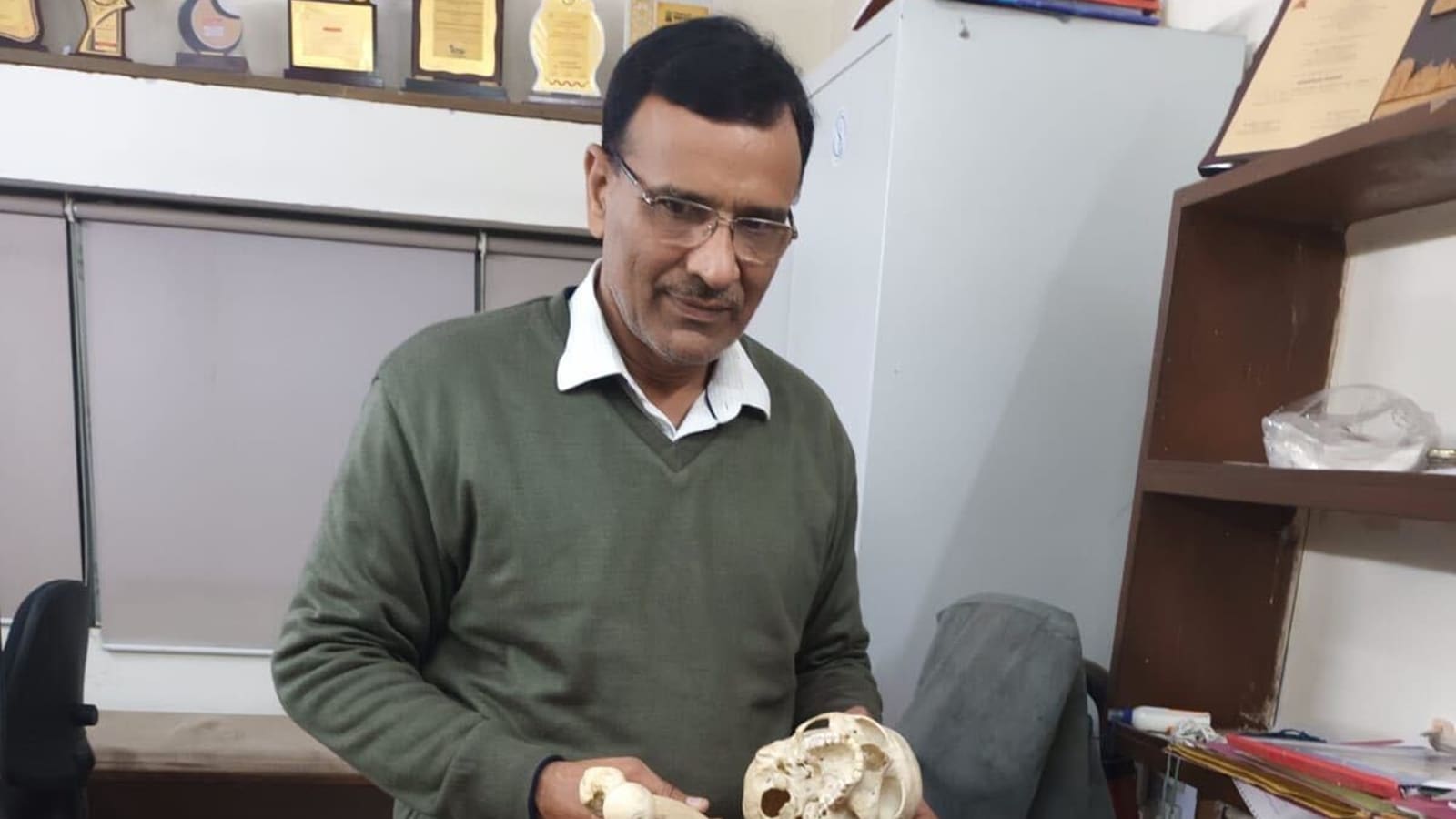
Teeth powder sent to a Hungarian lab. Mitochondrial DNA from teeth, jaw fragments, and bones dispatched to Hyderabad. Oxygen isotope studied to determine food habits; strontium isotope to decide origins. Further tests at Memorial University, Canada, and California State University. A dental health status comparison made with other remains worldwide. And lastly, access to a skull spirited away as a war trophy to Britain.
This is the way a picture was put together of how — and when — 280-plus bodies landed up in a well in Ajnala, Amritsar.
Eleven years after the bodies were discovered in 2014, and a decade on from when he started putting the dots together, J S Sehrawat, 53, was honoured with the position of Fellow by the American Academy of Forensic Sciences (AAFS), at its just-concluded Annual Scientific Conference in New Orleans, US.
The recognition, the AAFS said, was for Sehrawat’s “continued contributions to the field of forensic science”, and his “dedication to… promoting forensic science through integrity and justice for all”.
In his 23‑year career as a forensic anthropologist — he now heads the Department of Anthropology at Panjab University, Chandigarh — Sehrawat has been part of several key investigations involving human remains. The Ajnala project has been the most significant.
What set off the Ajnala mystery was the discovery of a book at a London museum detailing how 282 “rebel Indian soldiers” were captured in 1857, executed, and buried in a well and a religious structure built over the site. The book was written by an officer who had served as Deputy Commissioner of Amritsar in 1858.
The book’s claims led to relocation of the religious structure in 2014, and the discovery of skeletons — as it had talked about — underneath. Two theories now swirled about the skeletons — one aligned with the book’s version, but another group of historians contested that the bodies belonged to victims of the 1947 Partition violence.
Story continues below this ad
In 2017-18, the Central government sanctioned nearly Rs 40 lakh for a project to do biological profiling of the recovered remains. Sehrawat was appointed principal investigator, supported by a co‑investigator (who passed away later) and a research fellow.
One of the first clues investigators found were medals and coins issued in 1796, 1814, and 1840, and no later than 1856, at the site, along with the bodies. Sehrawat says the soldiers are believed to have carried these items as proof of their service, in the hope of a fair trial over the 1857 Mutiny. However, they are believed to have been executed the day after they were captured.
In 2018, teeth that were in powdered form were dispatched to a Hungarian lab for radiocarbon dating. It concluded in 2019 that the teeth belonged to individuals who had died between 1856 and 1858.
Then, teeth, jaw fragments and bones were analysed for mitochondrial DNA under the guidance of Dr K Thangaraj (recently awarded the Padma Shri) and Dr Neeraj Rai at Hyderabad’s Centre for Cellular and Molecular Biology – in the hope of narrowing down the places of origin of the 282 bodies.
Story continues below this ad
Oxygen isotope analysis was done of 85 samples. It is a method that measures ratios of different oxygen isotopes to determine exposure to past climates, water sources, geological processes etc.
Strontium isotope analysis, which measures the ratio of naturally occurring strontium isotopes to trace geographic origin, geological processes, diet, and migration, confirmed that the individuals concerned came from the Indo-Gangetic plains of Eastern Uttar Pradesh, West Bengal, Bihar and coastal Odisha – rather than areas around Ajnala.
Says Sehrawat: “What we eat or drink, their chemical signatures get imprinted in our bones and teeth for centuries. These signatures, based on food habits, reveal where a person lived. The samples from the skeletons were further matched with water, foodgrains, and rocks from the relevant regions.”
Dental health status, examined and compared with similar remains from other sites worldwide, was another clue. The anterior teeth of the skeletons were found notched, while posterior teeth showed minimal decay. “This pointed to a practice of cutting cartridge threads with teeth, while the sound dental health was something to be expected of soldiers,” notes Sehrawat.
Story continues below this ad
The skull that was accessed belonged to Alum Beg, a revolutionary soldier known to have been martyred in Ajnala in 1857. “He was arrested months after the 282 soldiers were killed and was executed with a cannon. His skull was then taken by a British officer as a war trophy, and carried to England, where it eventually came into the possession of a British family,” says Sehrawat.
Born into a farmer’s family in Kila Zaffargarh village of Haryana’s Jind district, Sehrawat studied at a government primary school before moving to Rohtak’s Jat High School for secondary education. He completed his post‑graduation from Maharishi Dayanand University, Rohtak.
After nearly a decade as a forensic anthropologist at Chandigarh’s Government Medical College and Hospital, he joined Panjab University in 2012 as an assistant professor.
Some of the Archaeological Survey of India (ASI) projects Sehrawat has worked on include examination of remains found in Ladakh caves to determine tribal affiliations in 2022. “We confirmed they had died over 2,000 years ago, during a period of foreign invasions,” he says.
Story continues below this ad
Panjab University Vice Chancellor Prof Renu Vig said it was a matter of pride and happiness to see faculty members being recognised globally. “Such honour reflects the university’s continued academic excellence and commitment to quality scholarship,” Vig said.
Sehrawat sees his work as undone, though, till they can trace as many of the forgotten martyrs as possible to their place of origin.
“We know Alum Beg was from Kanpur, but the native places of the 282 soldiers remain unknown,” Sehrawat says. “Our work continues.”