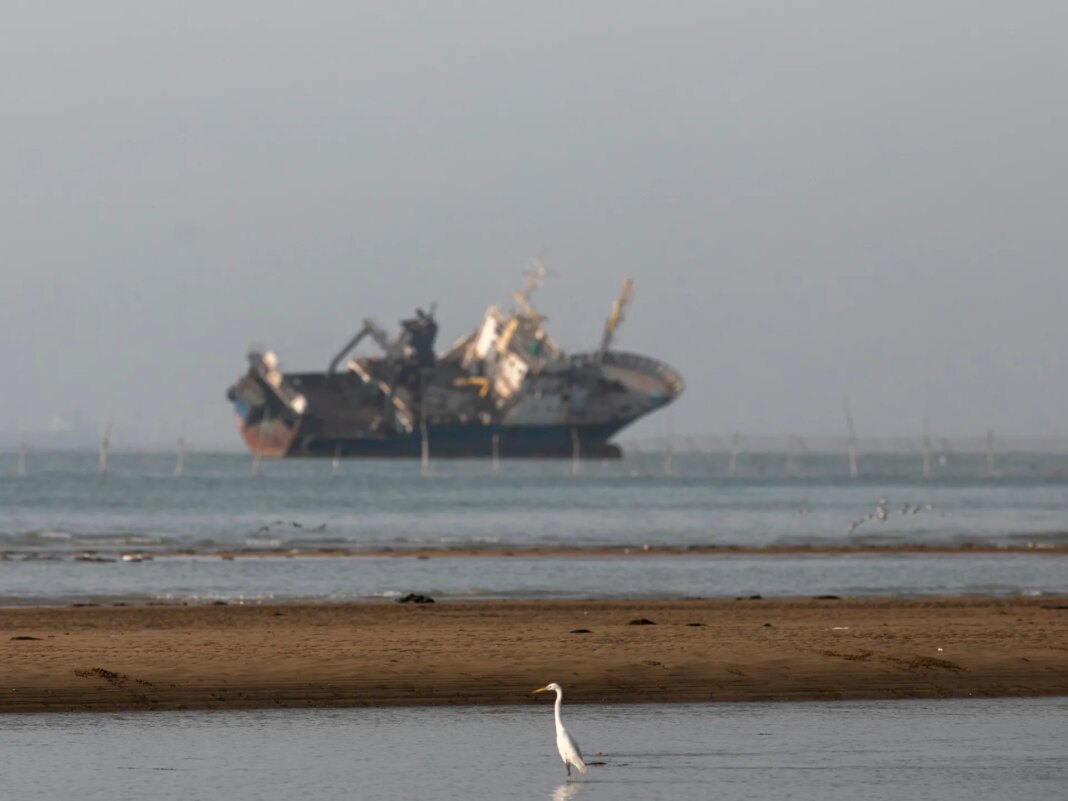
The United States has carried out strikes near Bandar Abbas, the second attack in less than a week on Iran’s strategically important port city, escalating tensions around the Strait of Hormuz despite a fragile ceasefire that has been in place between Washington and Tehran since April 8.
Reuters and The Associated Press, quoting unnamed US officials, reported that US forces shot down four Iranian drones and struck a ground control station for drones on Wednesday in Bandar Abbas.
Recommended Stories
list of 4 itemsend of list
The strikes followed explosions in Bandar Abbas on Tuesday. Iran’s Ministry of Foreign Affairs accused Washington of violating the ceasefire through “aggressive acts” in Hormozgan province, where the port city is located.
The semiofficial Iranian news agency Tasnim also reported that Iranian forces had fired on an “American airbase” in the region in response to a US attack near Bandar Abbas.
The escalation came after US President Donald Trump said during a cabinet meeting in Washington, DC, on Wednesday that “nobody’s going to control” the Strait of Hormuz as he spoke about ongoing negotiations between Tehran and Washington.
Bandar Abbas, home to key Iranian naval forces, occupies one of the most strategically sensitive positions in the Gulf. Its location on the Strait of Hormuz has made it central to both Iran’s military position and the wider confrontation with the US. Here is what we know:
Where is Bandar Abbas?
Bandar Abbas lies on Iran’s southern coast, on the northern side of the Strait of Hormuz, the narrow waterway linking the Gulf to the Gulf of Oman and Arabian Sea.
The city, which had a population of more than 526,000 people at the time of Iran’s 2016 census, sits roughly 60km to 70km (35 to 45 miles) north of the strait’s narrowest point.
Its position gives Iran oversight of one of the world’s most important shipping lanes. About one-fifth of global oil and gas supplies transit through the Strait of Hormuz during peacetime.
Since the ceasefire was announced on April 8, Iran has continued to control shipping through the Strait of Hormuz while US forces have imposed a blockade on Iranian ports.

What is the military significance of Bandar Abbas?
Bandar Abbas is the headquarters of both Iran’s conventional navy and the naval arm of the Islamic Revolutionary Guard Corps (IRGC).
The conventional navy has used it as its base since 1977 when Iran moved much of its fleet from Khorramshahr at the western edge of Iran’s Gulf coastline, to Bandar Abbas, transforming the city into the country’s main southern naval command centre.
According to the Middle East Institute, the IRGC navy later relocated its headquarters from Tehran to Bandar Abbas to improve operational control along the Strait of Hormuz.
Although Trump and Israeli officials claimed Iran’s naval capabilities have been heavily damaged in their recent attacks, Tehran still maintains a fleet of fast attack boats operated by the IRGC navy.
The vessels are designed for “swarm” tactics and are being used against commercial ships that do not have authorisation from Iran to sail through the narrow Strait of Hormuz. They were used recently against two Indian ships and two foreign container vessels, the Panama-flagged MSC Francesca and the Liberian-flagged Epaminondas, which Iran said had not been given approval to transit the waterway.

Why is Bandar Abbas important to Iran’s economy?
The Strait of Hormuz is not just a military chokepoint but also an economic lifeline.
Analysts estimated that more than 90 percent of Iranian crude shipments transit through the strait.
That makes Bandar Abbas and nearby Gulf infrastructure critical to government revenues, including the trade networks that help Iran circumvent sanctions, particularly by exporting oil to China.
Why are the US attacks significant?
Samir Puri, a visiting lecturer in war studies at King’s College London, told Al Jazeera the ceasefire has not yet formally collapsed despite these latest exchanges of fire.
He described those incidents as “limited” compared with strikes carried out before April 8. These attacks can be characterised as “tit-for-tat military-to-military engagements rather than attacks on infrastructure or widespread destruction en masse”, he said.
“What the US military is attempting to do is explore whether it can physically deny the IRGC and Iran the ability to control the Strait of Hormuz,” he said.
“Iran, of course, wants to show it cannot be denied that capability.”
What does this mean for peace negotiations?
Diplomatic and military operations are unfolding simultaneously as Iran and the US have exchanged a volley of proposals and counterproposals for peace since the ceasefire began.
“This is unfolding on parallel tracks. There is a military track and a negotiating track all unfolding at the same time,” Puri said. These limited strikes are, therefore, ultimately being launched as part of the negotiations, he said.
“The negotiators can only present the leverage they have from the field of battle. Is the US going to put itself into a position in which it can say to Iranian negotiators that they do not control the Strait of Hormuz? Because if you try to amass forces around Bandar Abbas and launch attacks from that coastal area, we can strike back.
“But Iran will not want to be pushed into that position and will want to say it retains the ability to strike shipping and US bases hosted by Gulf allies and partners. So that’s the duality that’s unfolding right now.”
Puri said both Washington and Tehran still appeared to have incentives to continue mediation but the two sides are approaching negotiations with very different objectives.
“Trump and the US administration want to impose a victor’s peace on Iran. Iran’s reading of the same script that they’re being handed is very different, and Iran probably wants to stretch out these negotiations for as long as possible without conceding.”
“So again, you end up in a situation that wars elsewhere have seen – negotiations without an endpoint or even the promise of an endpoint but still an incentive for both parties to participate, for now.”