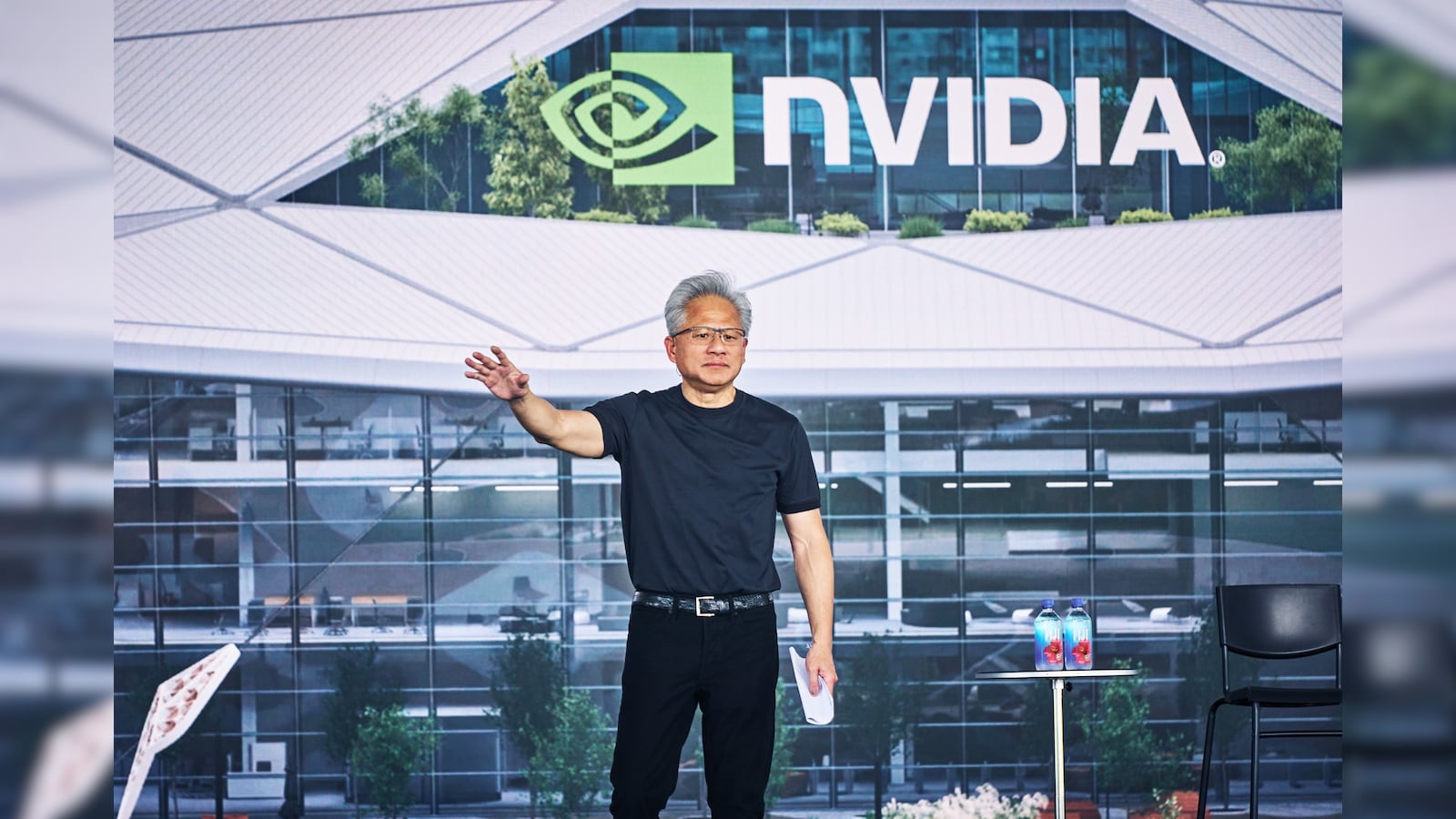
At least seven Chinese universities that support the country’s armed forces and defense industry are seeking access to Nvidia Corp.’s H200 chips, the most powerful artificial intelligence processors ever allowed by the US to be sold in China, according to a review of procurement records.
Two of the institutions that have expressed interest in the H200 chips – Beihang University and Northwestern Polytechnical University – rank among China’s “Seven Sons of National Defense,” an elite group dedicated to aiding the People’s Liberation Army. Both schools have been blacklisted by the US Commerce Department owing to their work advancing China’s military.
Records reviewed by Bloomberg News show that Beihang’s School of Cyber Science and Technology, which says it has “national defense characteristics and aerospace advantages,” is pursuing a lease to use the Nvidia chips. NWPU’s School of Cyberspace Security is also seeking to rent access to H200s, according to the records. The school says it carries out important national cyber tasks, has a national defense innovation team, and that many graduates go on to serve in military units.
Bloomberg also identified more than 25 Chinese universities and labs that collaborate with the country’s military and defense industry that are either already using or seeking to obtain older generation Nvidia chips, according to records dating back to 2011. Six of the universities are on the Commerce Department’s blacklist due to an agency determination that their work with the PLA – including developing missiles and nuclear technology – threatens US national security.
Several blacklisted entities say on their websites that they are already using the older generation Nvidia chips. It’s unclear whether any of the schools succeeded in obtaining access to the newer H200 chips or what specifically they would do with them if they did. The Bloomberg review didn’t turn up any evidence of wrongdoing, such as violations of US export controls, or indications the universities were seeking to access large numbers of chips.
Authorities in China so far have blocked the country’s AI companies from buying H200s, owing in part to concerns that a flood of American-designed AI chips would hinder the government’s long-held goal of developing an indigenous chip industry. Bloomberg’s findings show that hasn’t stopped China’s military-linked institutions from exploring ways to use Nvidia’s products anyway, signaling the chips’ advanced features hold enduring appeal.
The data also highlight concerns by US lawmakers that Nvidia’s technology – which has powered the AI boom and made it the world’s most valuable company – could end up potentially benefiting China’s armed forces as well, a prospect the company has repeatedly dismissed.
An Nvidia spokesperson said it would be “silly” to think that the Chinese military would rely on “a few dozen second-hand GPUs.”
“China has more than enough domestic chips for all of its military applications, with millions to spare,” the Nvidia spokesperson said. “Just like it would be nonsensical for the American military to use Chinese technology, it makes no sense for the Chinese military to depend on American technology.”
A spokesperson for the Chinese Embassy in Washington said that “China’s position regarding US chip exports to China has been consistent: we advocate that China and the United States achieve mutual benefit and win-win outcomes through cooperation, and we oppose the politicisation, instrumentalisation, and weaponisation of technological and economic issues.”
The Chinese universities referenced in this article didn’t respond to requests for comment. Neither the White House nor the Commerce Department commented.
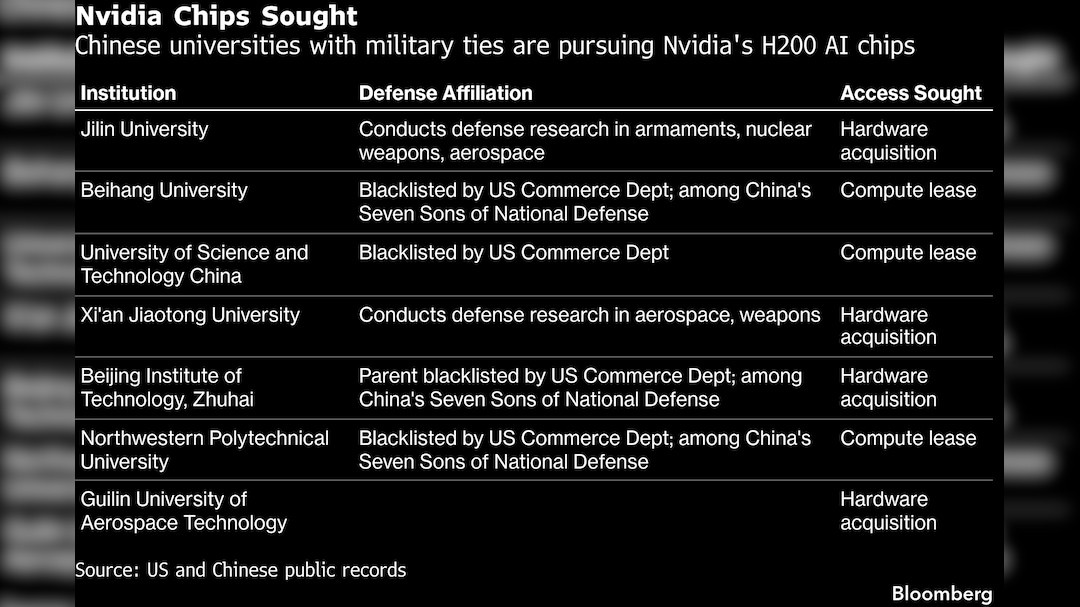
Chinese universities with military ties are pursuing Nvidia’s H200 AI chips
Photo Credit: (Photo: Bloomberg)
The institutions linked to China’s armed forces pursued Nvidia chips in a variety of ways, according to the documents reviewed by Bloomberg. In some cases, they’ve tried to buy them through third-party brokers. In others, they’ve sought contracts to rent the chips’ computing power. The earliest documentation Bloomberg was able to identify showing a Chinese military-linked university seeking access to H200 chips was dated June 2025, with the efforts continuing this year, the records show.
In many cases, the universities and labs sought access to relatively small quantities of chips such as a single server with eight Nvidia graphics processing units – the high-speed processors used in AI. Those amounts are better suited for academic work and a fraction of what top Chinese AI companies like Alibaba Group Holding Ltd. or Baidu Inc. would need for commercial purposes.
“That’s research lab-scale, and much smaller than what hyperscalers buy and use for training the most advanced frontier AI models,” said Michael Deng, a technology analyst at Bloomberg Economics.
“But a server like that is enough to take one of China’s leading open-weight AI models and adapt it for military applications like autonomous weapons development or cyber operations,” Deng said. “That work would run significantly faster on H200s compared to domestic Chinese chips.”
Efforts by PLA-tied entities to access Nvidia’s sought-after chips underscore the pressure the US will face in keeping sophisticated American technology away from China’s military following President Donald Trump’s decision to allow H200 sales to vetted Chinese customers. The move, carried out after an extensive lobbying campaign by Nvidia Chief Executive Officer Jensen Huang, marked a significant easing of US export restrictions aimed at reining in Beijing’s AI ambitions.
Huang has long rejected warnings from US lawmakers and advocates in Washington of a tougher stance toward China that the company’s chips could end up aiding the Chinese military.
“There’s a belief that somehow if we provided American chips to foreign countries and specifically China that the Chinese military would be building their military and building airplanes and aircraft carriers using American chips,” Huang said in a Time interview last year. “They have plenty of their own chips, and their companies are formidable. The idea that China does not have a technology industry we now know is lunacy.”
Even so, top Chinese chipmakers such as Huawei Technologies Co. and Semiconductor Manufacturing International Corp. lag behind their US counterparts in both quality and volume of AI chips produced. “The question is not whether the PLA wants to depend on Nvidia, but whether it realistically has any choice in the matter,” said Ryan Fedasiuk, a fellow at the American Enterprise Institute and a former State Department official. “For now, the answer is no.”
“They are requesting these chips both because nobody can beat Nvidia on quality, and because there are not a sufficient number of Huawei-designed alternatives in production for them to bid on,” said Fedasiuk, who has published research documenting Chinese military use of US technology.
As part of its review, Bloomberg examined a variety of public data, including Chinese procurement announcements as well as the websites of university labs and professors detailing their computing resources. Sunny Cheung, who studies China and emerging technology as a fellow with the Jamestown Foundation, helped develop the criteria and evidence for determining whether Chinese universities or labs should be considered direct collaborators with China’s military or defense sector.
The assessment included Seven Sons institutions, those placed under Commerce Department restrictions, those that signed memorandums of understanding, undertook joint research or academic programs, or participated in direct technology transfer with the PLA or China’s defense sector. Universities whose engagement did not exceed activities such as hosting campus visits by the People’s Liberation Army or participating in military recruitment were excluded from the analysis.
“We are actively empowering this ecosystem,” Cheung concluded after reviewing the data.
Nvidia’s H200 hails from the company’s Hopper line of processors used for training and running AI models. It was the most powerful AI chip on the market – with superior memory capacity and bandwidth – until the introduction of the company’s next generation Blackwell models in late 2024. A Council on Foreign Relations report last year estimated the H200’s processing power at more than six times stronger than the H20, which was previously the most advanced chip approved for sale to China.
In January, the Commerce Department issued a rule formalizing Trump’s H200 decision that limited sales to verified Chinese buyers. The regulation specifically requires companies seeking US export licenses for the chips to confirm that the technology won’t go to a Chinese military purpose or end user, including for nuclear, missile, chemical or biological weapons.
The type of AI processor Nvidia sells would be used as part of a computer to develop weapons, rather than be installed as a component of a missile. Both the US and China would deploy cutting-edge chips to boost the computing power of military systems, significantly bolstering their capability, according to Isaac Harris, executive director of the Frontier Security Institute.
“Nobody is talking about putting a GPU into a weapons system – that’d be a complete waste of money and of a GPU,” said Harris, whose group advises national security officials on deploying AI. “The militaries of each country would use the chips to accelerate their own research and development of future capabilities as well as operating the complex systems that require large amounts of compute such as targeting and data management.”
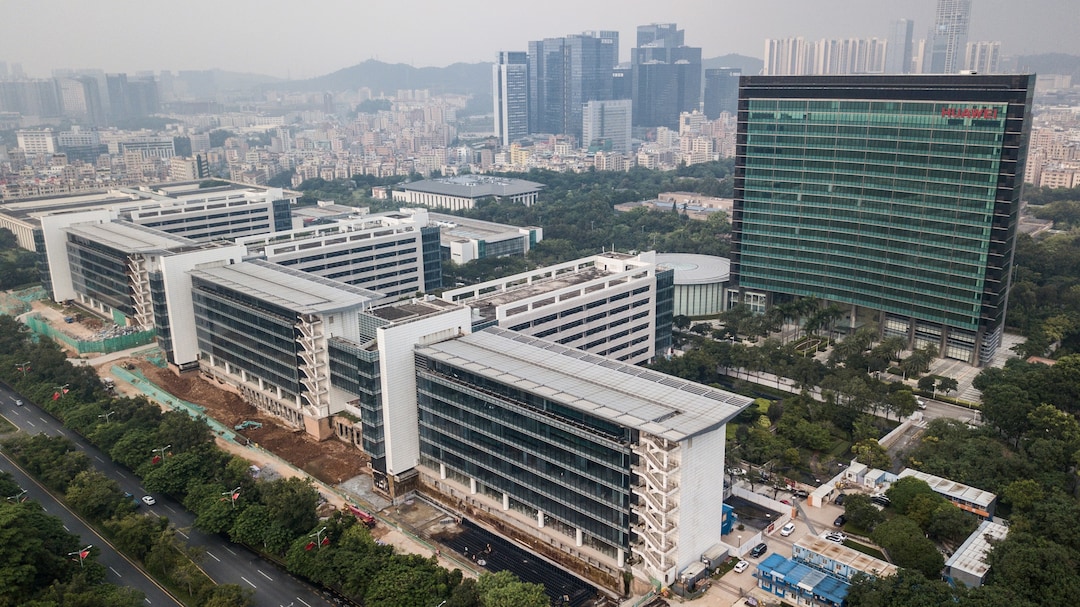
The Huawei Technologies Co. headquarters in Shenzhen.
Photo Credit: (Photo: Bloomberg)
Those seeking leases to use the newer H200 model as opposed to buying the chips outright are taking advantage of what some national security officials consider to be a massive flaw in US regulations: If the chips are hosted outside China and the university is paying for remote access, the hardware technically wouldn’t cross a border and therefore wouldn’t be considered an “export.”
Such a transaction wouldn’t violate export controls even if the US has already blacklisted the university in question and prosecuted people for exporting tech to it, as is the case with both Beihang and NWPU, which are both seeking H200 compute leases.
Several entities identified in the Bloomberg review have already been using older generation Nvidia chips including the A100, A800 and H20. Those models were legally allowed to be sold to customers in China at various points under US export rules.
At the Beijing University of Posts and Telecommunications, a supercomputing center is powered by 144 of Nvidia’s A800 chipsets, according to a webpage detailing its hardware resources. The school was blacklisted by the Commerce Department in 2020 after US officials concluded it “directly participates in the research and development, and production, of advanced weapons and advanced weapons systems in support of People’s Liberation Army modernisation.”
Then there’s Harbin Institute of Technology, which the US blacklisted in 2020 after determining it had “sought to use US technology for Chinese missile programs.” It has already put Nvidia’s H100 chips to use, according to a university webpage, and last year submitted a bid to obtain its H20 model, according to records reviewed by Bloomberg. The university is one of China’s Seven Sons of National Defense.
Another institution, the University of Science and Technology of China, which was blacklisted for its role in advancing China’s quantum technology and nuclear capabilities, says on its website that one of its supercomputing systems is powered by 200 of Nvidia’s A100 chipsets.
For US lawmakers who favor tougher restrictions to keep advanced technology out of China’s hands, a core issue is ensuring that AI chips like those made by Nvidia don’t get used by the Chinese armed forces. “We know for a fact we don’t want them to touch Chinese military end users,” Representative Brian Mast, the Republican chair of the House Foreign Affairs Committee, said at an event last month in Washington.
“If it was just kids playing video games, I could care less,” added Mast, whose panel has jurisdiction over US export control programs. “But when it’s touching real weapons systems, real military, real casualties, Congress is going to pay attention.”
(This story has not been edited by NDTV staff and is auto-generated from a syndicated feed.)
Essential Business Intelligence,
Continuous LIVE TV,
Sharp Market Insights,
Practical Personal Finance Advice and
Latest Stories — On NDTV Profit.