Sports may not be the first subject that comes to mind when preparing for UPSC, but the examination has repeatedly featured questions from this domain. In fact, UPSC CSE Prelims 2026 featured a question on Grand Slam tennis tournaments—an area many aspirants tend to overlook.
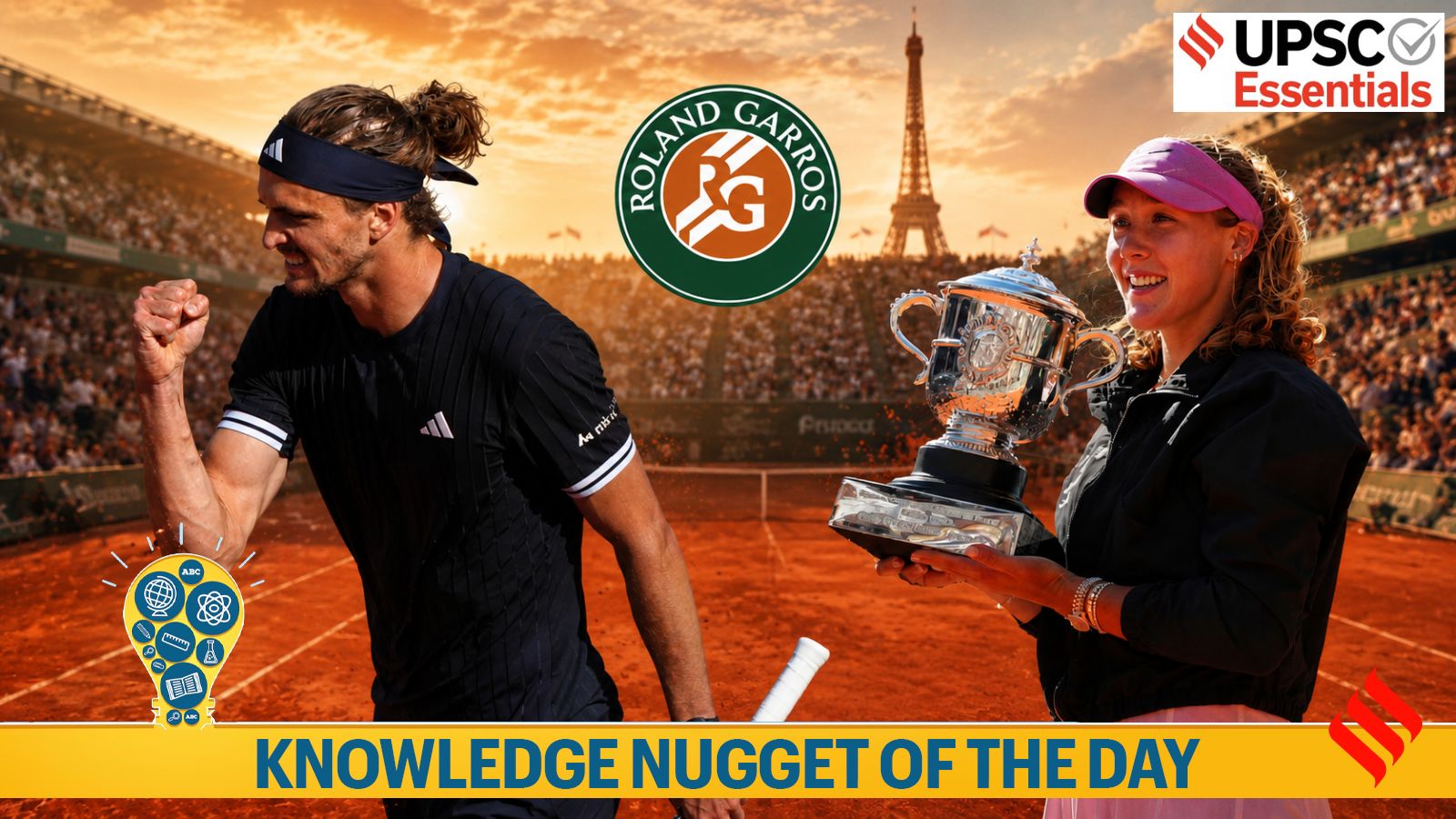
The French Open 2026 concluded on Sunday (7th June) with Alexander Zverev of Germany defeating Italy’s Flavio Cobolli in a five-set thriller to win the French Open 2026 men’s singles title. In the Women’s Singles title, Mirra Andreeva, 19 years old, from Russia, became the youngest player to win the women’s singles title since Monica Seles in 1992.
At the start of the tournament, players have repeatedly said Roland Garros is playing faster than usual. The reason is not a change in balls or court construction alone — it is the weather. Let’s understand this through this article.
Key takeaways:
1. The French Open is officially called Roland Garros. It is the only Grand Slam played on a clay surface. This year, as Paris experiences an unusually intense early-summer heatwave, with temperatures exceeding 35°C during the opening week of the tournament, the players felt the heat.
World No. 1 Aryna Sabalenka said the conditions were “boiling hot” and that “balls are flying, everything is much faster.”
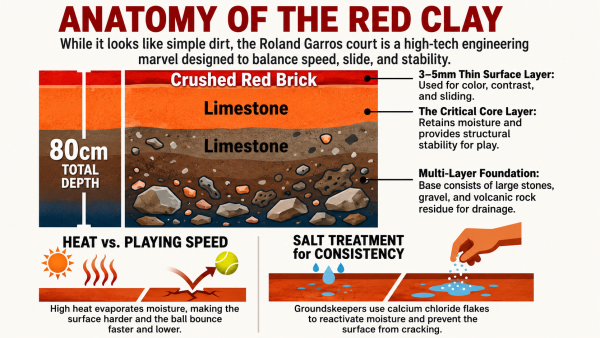
2. The court at Roland Garros is actually a complex five-layer structure nearly 80 centimetres deep. They are built using large foundation stones, gravel, volcanic rock residue, compacted limestone, and finally a thin layer of crushed red brick.
3. The crushed brick layer is 3 to 5 millimetres thick. It is mainly there for colour and as a material that provides some sliding ability and an important visual contrast, since the limestone is almost white.
Story continues below this ad
 AI-generated infographics
4. According to Philippe Vaillant, head of court maintenance at Roland Garros, the limestone layer is the most critical component because it retains moisture and provides structural stability. The red brick layer is mainly cosmetic and helps players slide. If the limestone dries out excessively, the court can crack. More importantly, the surface becomes dangerously slippery.
5. The clay courts being moisture-dependent is different from hard courts. Here, the playing characteristics are directly tied to the amount of water retained beneath the top layer of crushed brick.
6. When temperatures rise sharply, moisture evaporates faster. The surface becomes drier and harder, which changes the speed and bounce of the ball. Traditionally, clay slows the ball down because moisture creates more friction between the surface and the ball. But dry clay reduces that resistance. The bounce becomes quicker and lower, favouring aggressive baseline hitting over attritional rallying.
7. To combat the heat, tournament staff used calcium chloride, a salt compound spread across the courts in flake form each morning. The compound slows evaporation and helps the courts retain consistency through long matches played in direct sun. Groundskeepers say the substance effectively “reactivates” moisture in the crushed brick layer during the day.
Winners of the French Open 2026
| Category | Winners | Runner up |
| Women’s Singles | Mirra Andreeva (Russia) | Maja Chwalinska (Poland) |
| Men’s Singles | Alexander Zverev (Germany) | Flavio Cobolli (Italy) |
| Women’s Doubles | Katerina Siniakova and Taylor Townsend | Anna Danilina and Aleksandra Krunic |
| Men’s Doubles | Marcel Granollers and Horacio Zeballos | Harri Heliovaara and Henry Patten |
| Mixed Doubles | Sara Errani and Andrea Vavassori | Gabriela Dabrowski and Evan King |
What are Grand Slam tennis tournaments?
8. Wimbledon, French Open, US Open, and Australian Open are the most prestigious events on the annual tennis calendar, bestowed with the moniker of “Grand Slam”, a term that has been in use for almost a century.
9. Through a shared governance structure, Grand Slam Tennis is the partnership between the four Grand Slam tournaments, forming the opportunity to lead a shared vision for advancing the game of tennis at all levels while acting as custodians of the sport’s history and traditions.
Story continues below this ad
10. According to the website of Australia Open, the term ‘Grand Slam’ dates back to 1933 when Australia’s Jack Crawford won the Australian, French and Wimbledon Championships and reached the final of the US Championships against the British player Fred Perry.
| Grand Slams | Host Country | Court surface |
| Australia Open | Australia | Hard court |
| Roland Garros | France | Clay court |
| Wimbledon | United Kingdom | Grass court |
| US Open | United Sates | Hard court |
How are Grand Slam Tournaments governed?
1. In 1989, the Grand Slams joined forces for the first time to form the Grand Slam Committee, which, among other responsibilities, administers the Grand Slam rules. Grand slam tennis is managed through a Board comprising the four Grand Slam Chairs supported by their CEOs.
Seven separate bodies are in charge of administering and growing tennis: each of the four Slams operating separately, the two players’ associations (ATP and WTA) and the International Tennis Federation (ITF).
2. According to the official Grand Slam Rule Book 2026, the four Grand Slam Tournaments (GST) are open for entry to all internationally ranked tennis players with a ranking of 500 or better based on merit and without discrimination. Minors under the age of fourteen are ineligible for the tournament.
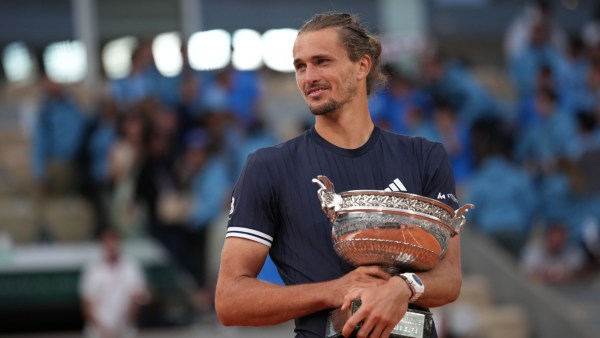 Alexander Zverev defeated Italy’s Flavio Cobolli in French Open final to win maiden Grand Slam. (AP)
3. The Rule Book mentions that there shall be no limitation as to the number of Wild Cards a player may receive to compete in the Grand Slam Tournaments. There are no entry fees for players in the Grand Slams.
Story continues below this ad
4. The Grand Slam tournament matches follow the rules of Tennis and Duties and Procedures for Officials published by the International Tennis Federation (ITF), unless otherwise specified by GST.
BEYOND THE NUGGET: International Tennis Federation (ITF)
1. ITF is the world governing body of tennis. With over 200 member nations, it’s one of the largest federations in world sport. It oversees the five areas of the game: Administration and regulation, Organising international competition, Structuring the game, Developing the game, and Promoting the game.
2. The ITF controls the major international team events for all age groups and for Wheelchair Tennis, including the world’s two largest annual international team competitions in sport, Davis Cup for men and the Billie Jean King Cup by BNP Paribas for women. The four Grand Slams are all official championships of the ITF.
3. India has not won either the Davis Cup or the Billie Jean King Cup. In 2025, Italy were crowned as World champions of the Davis Cup after defeating Spain. The Billie Jean King Cup 2025 was also won by Italy after defeating the United States.
Story continues below this ad
Post Read Question
Which of the following statements with regard to the Grand Slam Tennis Tournaments is/are correct? (UPSC CSE 2026)
1. The tournaments have a shared governance structure establishing the partnership among the four Grand Slam tournaments.
2. They are open for entry to all internationally ranked tennis players above the age of 14.
3. There is a limitation on the number of ‘Wild Cards’ a player may receive to compete in a Grand Slam Tournament.
Select the answer using the code given below:
(a) 1 and 2 only
(b) 2 and 3 only
(c) 1 only
(d) 1, 2 and 3
Story continues below this ad
(Sources: Why Roland Garros groundskeepers are turning to salt to save clay from heatwave, 2026 Official Grand Slam Rule book)
Subscribe to our UPSC newsletter. Stay updated with the latest UPSC articles by joining our Telegram channel – IndianExpress UPSC Hub, and follow us on Instagram and X.
🚨 Click Here to read the UPSC Essentials magazine for May 2026. Share your views and suggestions in the comment box or at manas.srivastava@indianexpress.com🚨