

6 min readNew DelhiFeb 20, 2026 10:32 AM IST
Allahabad High Court news: The Allahabad High Court has pulled up the Uttar Pradesh government for its continuing failure to curb the manufacture, sale and use of deadly synthetic kite strings, popularly known as “Chinese manjha”, observing that authorities seem to act only after deaths and serious injuries make headlines.
A bench of Justices Rajan Roy and Abdhesh Kumar Chaudhary was hearing a Public Interest Litigation (PIL) filed in 2018 by petitioner-in-person Moti Lal Yadav, along with a connected PIL filed by Rajjan Khan, and said that if the menace continues, the court may be compelled to direct the state to pay compensation to victims.

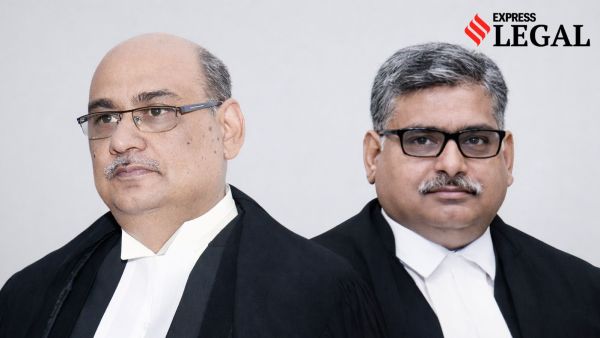 Justices Rajan Roy and Abdhesh Kumar Chaudhary heard the PIL on February 11.
“If such sale and use of so-called Chinese manjha continues, then, we may be compelled to consider ordering payment of compensation by the State to victims, in addition to the cost of treatment etc,” the court said on February 11.
The matter has been listed for further hearing on March 11, 2026.
Action only after deaths
- It appears that only when such injuries/deaths take place due to the use of such manjha and these incidents hog the headlines in newspapers that state functionaries wake up and start taking some action, the court observed.
- A permanent mechanism involving a regular and continuous exercise for the prevention of manufacture, sale and the use of such manjha is required to be put in place.
- This must be done with suitable and effective provisions in law to curb the said practice and to make those indulging in such practices liable for their actions.
- Let the state authorities file a fresh counter-affidavit in the matter, keeping in mind the aforesaid.
- The affidavit must contain the measures which they propose to take by making suitable provisions in law, unless already existing, for preventing the manufacture, sale and use of such manjha.
- The affidavit must also have details for making such persons, who violate the law, accountable and liable.
- The accountability aspect should not only be with regard to those indulging in the manufacture, sale and use of manjha, but also with respect to those who fail to discharge their duty of preventing the same.
- A proper mechanism should be put in place.
- In the case of Anurag Mishra (another PIL), it was directed that effective steps for spreading awareness among the general public about the fallout of the use of such manjha, especially parents of juveniles, should be undertaken so that there may be a general consensus in society against the manufacture, sale, purchase and use of such manjha.
Recurring public safety concern
- Synthetic manjha, typically made of nylon or metallic yarn and coated with crushed glass or metal dust, is known for its razor-sharp edge.
- While it gives kite flyers a competitive advantage, it has repeatedly caused grievous neck injuries to motorcyclists and pedestrians, besides posing serious risks to birds.
- The high court has clarified in earlier judgments that it does not seek to ban kite flying as a sport.
- The issue, it has consistently maintained, is the use of hazardous materials that endanger human life and wildlife.
PIL filed in 2018
- The lead petition was filed in 2018, nearly eight years ago, seeking a ban on the import of “Chinese manjha” and other injurious products.
- The PIL also sought a strict prohibition on its sale and use across Uttar Pradesh.
- It urged the court to direct the state to issue enforceable and punitive orders to prevent its circulation.
- Over the years, the state has repeatedly placed on record a series of government orders, dating back to 2016, 2017 and 2018, issued under various statutory provisions, including powers under the Environment (Protection) Act, 1986.
- On September 3, 2024, the high court had specifically asked the departments of home and environment to explain the mechanism in place to implement these orders and to produce action-taken reports from districts.
- A counter-affidavit was subsequently filed in January 2025 detailing district-level actions.
- Yet, as the court noted this week, the ground reality appears unchanged.
10 incidents of injuries, deaths in February
- During the hearing, petitioner Moti Lal Yadav placed before the court several newspaper reports from February 2026 documenting as many as 10 injuries and fatalities allegedly caused by razor-sharp synthetic manjha.
- These included incidents where two-wheeler riders suffered deep neck cuts and cases where the string proved fatal.
- The court recorded that similar tragedies have been repeatedly reported in past years.
Government orders won’t suffice
- Chief standing counsel Shailendra Kumar Singh informed the court that the term “Chinese manjha” is a misnomer and creates the impression that the string is necessarily imported from China.
- He clarified that the expression is commonly used to refer to synthetic, nylon or lead-coated manjha, which may also be manufactured domestically.
- He further submitted that fresh government orders were issued on February 9 and 10, 2026, to effectively curb the use of such strings.
- The court said that repeated circulars and prohibitory notifications mean little if they are not backed by sustained ground-level enforcement.

© IE Online Media Services Pvt Ltd