

5 min readMumbaiUpdated: Mar 1, 2026 12:47 PM IST
Long before he rose to become Iran’s most powerful figure in 1989, Ayatollah Ali Hosseini Khamenei had travelled through parts of India, visiting Karnataka and Kashmir in 1980-81 as a 41-year-old cleric, in the early years of the Islamic Republic.
Decades later, he would recall that journey while hosting Indian leaders in Tehran, speaking admiringly of Mahatma Gandhi, Jawaharlal Nehru, Maulana Abul Kalam Azad and India’s religious diversity, showcasing an unusual personal linkage between the Iranian Supreme Leader and India.

Documentation from Iranian archives shows that at the age of 41, two years after the Iranian Revolution and shortly before he assumed the presidency of Iran in October 1981, Khamenei visited India as part of the outreach efforts initiated by the government of Ruhollah Khomeini, which came to power after the 1979 revolution.
According to archival references and later accounts, Khamenei first travelled to Bengaluru and then to Alipur, a town located about 75 kilometres from the Karnataka capital. Alipur stands out for its distinct character, with a predominantly Shia Muslim population and longstanding religious and educational links with Iran.
Photographs published on Khamenei’s official website show him being welcomed by crowds in Bengaluru and Alipur in 1981. The captions explicitly describe Indian people greeting him during that visit, offering rare primary visual confirmation of his presence in the country at the time. Local accounts state that he visited the village in 1981 to 82 to inaugurate a hospital built in collaboration with the Iranian government.
For Alipur, the visit marked the high point of its ties with Iran. Even today, dozens of youths from the village pursue religious studies in Iranian seminaries or attend universities in cities such as Tehran and Mashhad, reflecting a relationship that predates and outlasts that early 1980s trip.
Iranian accounts and memoir literature also recall a visit to Kashmir in late 1980 or early 1981, where Khamenei reportedly addressed gatherings in Srinagar. Recollections attributed to Kashmiri activist Qalbi Hussain Rizvi describe the visit as taking place at a time of sectarian tension in the Valley. In his memoirs, Rizvi writes that Khamenei joined Friday prayers at a Sunni mosque, praying while “standing before Mir Vaez Maulawi Farouq,” the Mirwaiz of Kashmir, and delivered a 15 minute speech.
Story continues below this ad
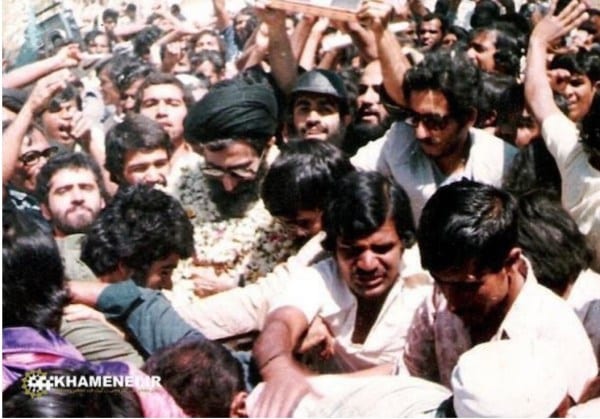 Ayatollah Ali Hosseini Khamenei mobbed by public during his visit to Karnataka in 1980. Photo: Iranian Government Archives
“Until that day, Shias and Sunnis had intense discords; if a Shia visited a Sunni mosque, they would even cleanse the mosque, saying that a heretic had entered and thus defiled the mosque. But after the Leader’s speech, it was common for Shias to pray at Sunni mosques and would pray before Sunni prayer leaders with no fear. Sunnis would pray at Shia mosques, too. This unity was an outcome of that 15 minute speech made by Ayatollah Khamenei,” the memoir states.
Three decades later, during Prime Minister Manmohan Singh’s visit to Tehran in August 2012, Khamenei himself referred to his India trip. According to the Ministry of External Affairs record of the meeting, “He recalled his own readings of Indian history, his appreciation for Gandhiji’s struggle, and his belief that Nehru was in fact the founder of the Non Aligned Movement.”
In the same interaction, he shared his experience of visiting India and lauded its religious diversity. The MEA transcript records him stating, “He mentioned that he had been on a street called Ali Kabir Street here; he had seen members of the Sikh community who live in this country and who run businesses here. He had gone into one of those shops, this was many years ago, and he had been presented some books. So, he had some idea about the Sikh religion and the diversity of religions in India. He had in 1981 visited India and seen some of this for himself. He said that he believed that religious diversity was important and should not harm India’s national unity; sectarian feuds should be avoided; and there is a need for harmony among all groups.”
Since assuming Iran’s highest office in 1989, Khamenei did not undertake a formal state visit to India. Subsequent engagements with Indian leaders took place in Tehran or on the sidelines of multilateral summits.
Story continues below this ad
In his speeches and writings, Khamenei also lauded pre-Partition Indian leaders such as Maulana Abul Kalam Azad and poet Muhammad Iqbal, reflecting his engagement with South Asian intellectual history.
At the same time, his tenure also saw moments of friction. Khamenei’s public remarks on Kashmir in recent years drew strong diplomatic responses from New Delhi. The Ministry of External Affairs summoned Iranian envoys and reiterated that Jammu and Kashmir is an integral part of India, terming such comments interference in internal affairs. While these statements caused temporary diplomatic strain, they did not derail broader India Iran ties, which continued to be shaped by civilisational links, energy cooperation and strategic engagement.

© The Indian Express Pvt Ltd