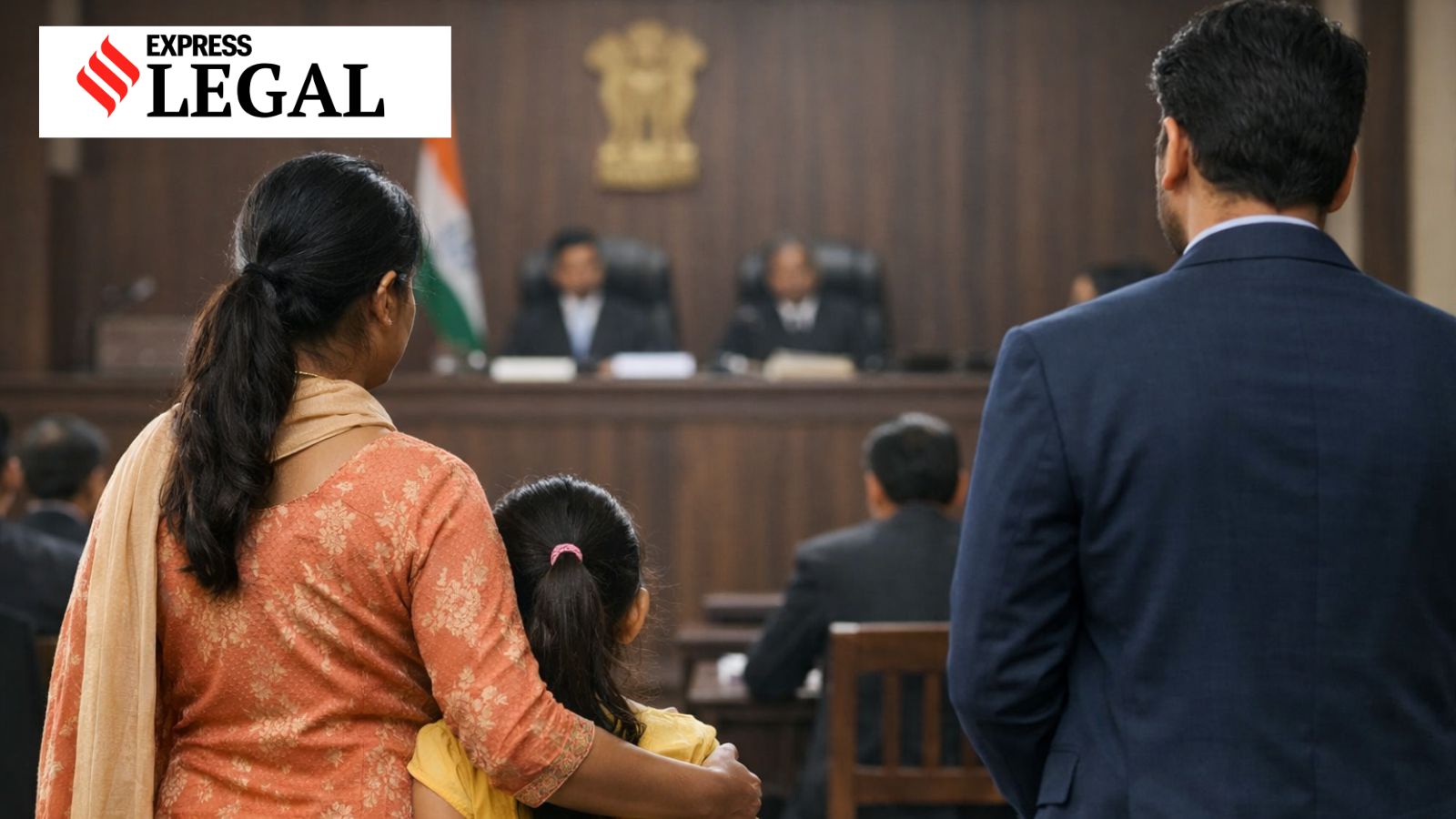
Andhra Pradesh High Court news: Observing that the language used in the order imprints a “fostered culture of subordination” and embraces a “colonial mindset”, the Andhra Pradesh High Court recently declined to enforce a UK family court order granting custody of a minor daughter to her England-based father, and allowed the child to be in India with her mother.
Justices Cheekati Manavendranath Roy and Tuhin Kumar Gedela clarified that such a colonial legacy cannot be permitted to be revived or superimposed upon the independence of the Indian judiciary.
“This imprints a fostered culture of subordination and embraces speak of a colonial mindset. As a subsidium sine qua non (support all the way), this colonial legacy cannot be permitted to be revived or superimposed upon the independence of the Indian Judicial,” the Andhra Pradesh High Court said in its April 2 order.
The Andhra Pradesh High Court was hearing the plea of a UK-based man who was seeking directions to produce his minor daughter before the court and hand her over to him.
The high court further highlighted that certain biological and emotional needs of a growing girl child cannot be adequately addressed by a father living alone abroad, noting that at this stage, the child requires the care and attention of her mother, particularly in matters concerning puberty, privacy, and overall development.
Children a nation’s asset
The Andhra Pradesh High Court emphasised the importance of child welfare, observing that children are not merely the future but individuals whose present well-being must be protected. It was noted that children are the supreme assets of the nation and must be treated as “people of today and not people of tomorrow.”
The court pointed out that the law governing the custody of the child is entirely different and stands on a different footing, and the citizenship or nationality will be secondary, and the paramount consideration and welfare of the child need to be addressed.
Story continues below this ad
The Andhra Pradesh High Court clarified that the legalistic view is already settled that the laws in India should be considered as long as the child stays in India. Highlighting the sensitivity of children at a tender age, the bench observed that they are often reticent yet emotionally perceptive, making their immediate environment crucial to their well-being, care, and emotional security.
In the present case, the court noted that the proceedings were initiated against the child’s mother, who is the biological parent, and therefore, the child’s custody with her cannot be termed unlawful. It observed that the child had been left with the maternal grandparents with the father’s consent during his visit to India, and hence, such custody could not be characterised as illegal.
The Andhra Pradesh High Court further took note of the fact that the father himself had earlier emphasised before the UK family court the importance of a family environment, particularly with the grandparents, and had accordingly placed the child in their care during the visit.
While acknowledging that the father’s efforts to seek custody reflect his concern and affection, the court observed that its primary duty is to act as a guardian of the child’s welfare, which must remain the overriding consideration.
Story continues below this ad
Referring to the international dimension of the dispute, it observed that although principles such as those under the Hague Convention may be relevant, they cannot override the paramount consideration of the child’s welfare, especially where the child has developed familiarity and emotional bonds within her present environment in India, including with her maternal family.
‘Custody to mother, but father has rights’
- The Andhra Pradesh High Court asked both parents to build a “child-parent” bond gradually through patience and empathy.
- It further advised the parents to ensure effective communication and avoid letting past disputes affect the child, stating that maintaining the relationship with both parents is crucial even when they live apart.
- The court also drew attention to the fact that the child’s emotional, mental and physical well-being should always be a priority, and when such issues arise, the central question is not who is right or wrong between the parents, but what arrangements will best serve the child.
- The Andhra Pradesh High Court also clarified that the father, as a natural guardian, has every right to interact with the child, and this court permits the father to interact on video calls every day and the mother should ensure the same by allowing him to talk with the child.
- Lastly, the court highlighted that this latest order giving custody to the mother, does not eclipse or impeach the right of the father to agitate his claims in the United Kingdom against his estranged wife.
- It was also clarified that this order of custody to the mother remains till the child attains majority or is subject to the option exercised by her as per her wish, according to her age and capability of thinking.
- The Andhra Pradesh High Court allowed the petitioner to travel to England along with the child yearly once till she attained majority, to meet the ends of justice.
‘Estranged wife, harassment’
The couple got married at Tirupati in November 2017. It was placed on record that the man is a British citizen, and before his marriage, he resided in the UK due to his job, and later, the estranged wife joined him in March 2018 to lead their marital life.
Their daughter was born in the UK and is a British citizen, presently aged about 5 years 11 months. The petitioner contended that after a few months of marriage, disputes arose due to the attitude and behaviour of his wife, who exhibited cruelty and harassment towards the petitioner and his family members.
He also claimed that the estranged wife’s attitude did not change even after the intervention of the elders of both sides. The man further added that due to his interest in his child and family, he was benevolent with the hope that she could change.
Story continues below this ad
It was placed on record that in 2023, the estranged wife decided to move to Saudi Arabia for a job, leaving behind the daughter and the petitioner in the UK. The wife later joined the marital home in November 2024 in the UK, and since then, there has been no change in her attitude, and she has shown spasmodic harassment. Subsequently, the petitioner filed an application for divorce in January 2025 in the UK family court, which is yet to be decided and is pending.
It was further noted that during a visit to India pursuant to permission granted by a UK court, the father had handed over the child to the maternal grandparents for a short stay, after which a dispute arose when the child was not returned to him.
Subsequently, the father approached the Andhra Pradesh High Court by filing the present habeas corpus petition alleging illegal custody.