

The jhumka is in the news! However, this time, not for its extravagant mentions in Bollywood songs, or in the backdrop of those thousands of Instagram reels which you can’t escape. Ralph Lauren models were seen wearing jhumkas at the Paris Fashion Week 2026. And this time, the global fashion brand has labelled it as “authentic vintage accessory” with no credits to Indian craftsmanship — a perfunctory nod to heritage and cultural misappropriation. From Prada’s Kolhapuri chappals, to Gucci’s kaftan top inspired by our kurti, brands have poached a cultural legacy without collaborating or recognising local artisans even in the past. However, in this case, one thing remains clear: It doesn’t matter whether you pick it up from Bareilly bazaar, Delhi’s Janpath, or silver jewellers of Jaipur, the jhumka will always be Indian.
With that, let’s move on to the top stories from today’s edition:
- LPG shortage in India’s big cities
- Inside IIT Madras’s Brain Centre
- Shivam Dube’s train journey
🚨 Big Story
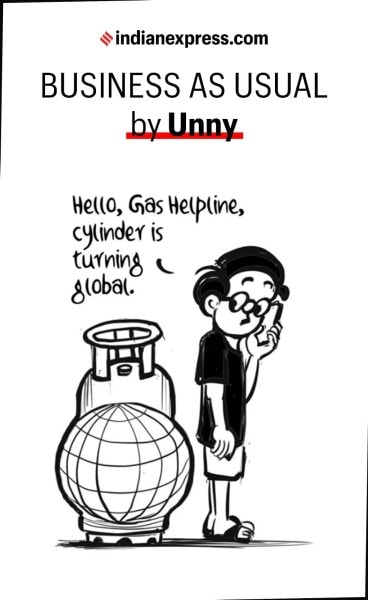
As the conflict in West Asia leads to a shortage of liquefied petroleum gas (LPG), commercial LPG users, including restaurants, food sellers, autorickshaw drivers and laundry services, have reported disruptions to their operations in several Indian cities. Triggered by the US and Israel’s attacks on Iran, the West Asia conflict has halted the movement of ships through the crucial Strait of Hormuz. Over 80% of India’s LPG imports pass through this narrow waterway. In response, the Indian government has invoked emergency powers to direct refiners to maximise LPG production and ensure that all the gas is supplied solely to domestic LPG consumers. Here’s how Indian cities are tackling the crisis.
In view of the crisis, the Indian government has invoked the Essential Commodities Act to divert natural gas to “priority sectors” that are dependent on the fuel. Segments that directly impact millions of common consumers—piped natural gas (PNG) for households, compressed natural gas (CNG) for vehicles, and LPG production—will have precedence over other natural gas-consuming sectors. While natural gas supplies to refineries have been cut to 65% of their average consumption of the past six months. Read here about the steps taken so far.
With the conflict pushing up energy prices, its ripple effects are beginning to spread far beyond oil and gas, with sectors such as textiles, mining and steelmaking in India starting to feel the pressure. The severe impact is emerging through a chain of second- and third-order effects linked to fuel costs, petrochemicals, feedstock, chemicals, and disruptions in global shipping routes along the Strait of Hormuz. And India is among the most exposed.
⚡ Only in Express
Story continues below this ad
“At IIT Madras, I could see the entire brain on my computer, every part of it, in great detail, down to the level of a cell. Brain atlases have been made earlier, but never with this kind of detail and this degree of sophistication…”
Neuropathologist Rebecca Folkerth has been observing human brains all her life. And yet, when she visited the Sudha Gopalakrishnan Brain Centre (SGBC) at IIT Madras for the first time in 2023, she was amazed by what she saw. At the research lab in Chennai, scientists are working to capture high-resolution cell-level details of the entire brain, allowing one to zoom into any section and look at individual cells. My colleague Amitabh Sinha travels to the SGBC, that is on an ambitious mission – mapping hundreds of human brains, across ages, population groups, ethnicities, and disease conditions, to create a cellular-level atlas.
📰 From the Front Page
IndiGo: Three months after India’s largest airline, IndiGo, faced an unprecedented operational disruption that brought civil aviation operations across India to a halt, the carrier’s CEO, Pieter Elbers, resigned on Monday, according to stock exchange filings and a release issued by IndiGo. The airline’s promoter and managing director, Rahul Bhatia, will step in to assume management of the airline’s affairs till the appointment of a new CEO, “which is expected in short order”, IndiGo said. Elbers cited personal reasons for leaving the airline that he helmed for over three years. Meanwhile, Bhatia, in a communication to employees, wrote that the December crisis should never have happened.
The Union Cabinet has approved easing curbs for land-border sharing countries for capital goods, electronic capital goods, electronic components, polysilicon and ingot-wafer for solar cells. This would now allow limited investment flows from China into key manufacturing sectors. It also decided a threshold level of 10% for automatic approval of the investment into these sectors. However, the restrictions for land-border-sharing countries, which were brought into force through the Press Note 3 of 2020, have been retained for strategic sectors such as semiconductors, according to government sources.
Story continues below this ad
SIR: The Supreme Court has directed the formation of tribunals to hear appeals against exclusion of names from the West Bengal voter list following the Special Intensive Revision (SIR) in the state. The tribunals would comprise former High Court Chief Justices and two or three former judges, preferably from the Calcutta High Court or neighbouring states. The Bench also warned against attempts to question the work of judicial officers deputed to verify names flagged for logistical discrepancies.
📌 Must Read
In our Opinion section today, C Raja Mohan delves deeper into the complicated history of India “taking sides” in times of conflict, and what its foreign policy states. While New Delhi has often done so, there have been times when India “simply flip flopped as governments changed,” Mohan explains. He writes: The security and prosperity of India and Arabia are now indivisible. Political support for Arabs was an important principle articulated at the very outset of independent India’s foreign policy. Eight turbulent decades later in the Middle East, it has acquired a new meaning — in the form of a deepening interdependence between India and the Gulf Arab states.”
India-Bangladesh relations: Dhaka sent its intelligence agency chief to India early March this year – the first high-powered visit from Bangladesh to India since the Bangladesh Nationalist Party (BNP) won the elections and Tarique Rahman became Prime Minister, The Indian Express has learnt. According to sources, the intelligence chiefs met over a private dinner on March 2 to discuss intelligence-sharing and security partnership. Amid India’s strong security concerns related to anti-India activities in Bangladesh, Delhi is keen to partner with the new government in Dhaka to counter such activities. All eyes will be on how the cooperation on the security front plays out in the coming weeks and months.
“Martyrdom is a manifestation not of suicide but of fearlessness, and in attempting to embody this virtue, Khamenei probably sought in his last moments to attach them to the victory of the Islamic Revolution in 1979 which had established this ideal as its own.”
Story continues below this ad
Historian of Islam Faisal Devji talks to Monojit Majumdar on the response in the Muslim world to the US-Israeli war on Iran, and the likely future now of the political project that was begun by the Islamic Revolution of 1979. Here’s the full interview.
⏳ And Finally…
Family time: Hours after lifting the T20 World Cup trophy in a packed stadium in Ahmedabad, Shivam Dube, his wife, and a friend boarded the Ahmedabad-Mumbai Sayaji Express. India’s T20 World Cup hero knew he risked getting mobbed but the couple wanted to be with their four-year-old son, Ayaan, and two-year-old daughter Mehwish, who were at home in Mumbai. A cap, a mask, a full-sleeved T-shirt, and a 5:10 am train, this is how Dube put in place a plan to keep his identity under wraps. Know more about the undercover journey of India’s “last action hero” here.
🎧 Lastly, tune in to today’s episode of our 3 Things podcast, where we discuss why states are bringing in laws to ban social media for children. We also talk about how the ongoing US-Israel-Iran war is impacting India’s food security, as well as share insights into the Rs 1,600-crore LIGO-India project in Maharashtra’s Hingoli district that remains stuck.
That’s all for today. Have a wonderful day!
Until next time,
Ariba
 Business As Usual by E P Unny