

Synopsis: Could shipping markets hold the earliest clues to the next market downturn? This article explores how freight futures and the Baltic Dry Index act as real economy signals, why they sometimes move before stocks, and how Indian investors can track global trade cycles through shipping ETFs and freight data today.
Global markets often look unpredictable, but some of the earliest warning signs don’t come from stock charts or economic data. Instead, they quietly appear in a lesser-known corner of the real economy where the movement of raw materials reveals what businesses are really expecting. Hidden inside shipping rates and freight markets is a signal that has historically shifted well before headlines catch up, offering clues about where growth or trouble may be heading next.
Understanding Shipping Futures
Forward Freight Agreements, or FFAs, are financial contracts that allow participants to manage or trade the future price of freight, which is the cost of moving goods across oceans. Shipping rates can be highly volatile because the industry is cyclical and sensitive to global demand, oil prices, seasonality, and geopolitical events. FFAs help bring stability by allowing shipowners, charterers, and speculators to hedge against these fluctuations and plan with more predictability. These contracts are built on indices linked to specific shipping routes or baskets of routes and are typically traded over the counter, though they can be cleared through a clearing house.
Unlike commodities such as oil or metals, freight is a service and cannot be physically delivered. Because of this, freight futures settle in cash based on the average spot freight rates during a given month. These reference prices come from daily freight assessments published by the Baltic Exchange, which reflect prevailing shipping rates across various routes and vessel classes. The monthly average of these assessments determines the final settlement price, keeping the contract closely tied to real market conditions.
FFAs are widely used as risk management tools within the shipping industry. A shipowner, who benefits when freight rates rise, may sell FFAs to lock in expected earnings and protect against a future decline in rates. On the other hand, a charterer, who pays freight costs, may buy FFAs to protect against rising transportation expenses. This ability to hedge helps both sides stabilise cash flows and maintain profitability despite market uncertainty.
Over time, FFAs have also attracted hedge funds, traders, and other financial players who take positions based on their outlook for freight rates without owning ships. Their participation adds liquidity, improves price discovery, and creates benchmark pricing that offers a forward-looking view of the market. The presence of diverse participants makes the market more efficient and transparent while supporting smoother trading activity.
For investors and financial institutions, FFAs offer exposure to the dynamics of global trade and can serve as a diversification tool because shipping markets often behave differently from traditional assets. Overall, they sit at the intersection of the real economy and financial markets, helping companies manage risk while allowing traders and investors to take views on global shipping conditions.
Think of it like booking a taxi in advance because you are worried the fare might go up later. An FFA is similar, companies agree today on what they will pay or earn for shipping in the future so they are not surprised if prices change. Some people use it to stay safe from price swings, while others try to guess where prices will go and make money from that.
The Indicator That Can Predict Crashes
The Baltic Dry Index, or BDI, is one of the clearest real-world indicators of global economic activity because it tracks the cost of shipping key raw materials like coal, iron ore, and grains. Since these materials sit at the very start of the production chain, changes in shipping demand often reflect shifts in industrial activity before they appear in economic data. Created by the London-based Baltic Exchange, the index captures supply and demand for shipping capacity, which makes it a useful way to understand whether global trade is expanding or slowing down.
The index is built using four types of ships, Capesize, Panamax, Supramax, and Handysize, each representing different cargo sizes and trade routes. The Baltic Exchange collects shipping rates from more than 20 routes across the world and calculates an average daily value. Because it is based on real shipping prices gathered directly from market participants, the BDI reflects actual trade activity rather than forecasts or sentiment, giving it a strong grounding in real economic demand.
One of the reasons the BDI is closely watched is that it mainly tracks raw, pre-production materials, where speculation is limited. Freight rates can be highly volatile because the supply of ships is relatively fixed in the short term, with long construction times and high costs. This means that when global demand suddenly rises or falls, shipping prices react quickly, making the index sensitive to turning points in economic cycles.
Shipping is often seen as a leading indicator because companies only book vessels when they expect production and trade to remain strong. As a result, freight rates can start rising or falling before changes show up in commodity prices, corporate earnings, or stock markets. When shipping activity slows, it usually signals weaker industrial demand, while rising rates point to stronger trade flows. This ability to capture early shifts in economic momentum is what makes the Baltic Dry Index an important tool for investors trying to understand where the global economy may be heading next.
Real Life Examples
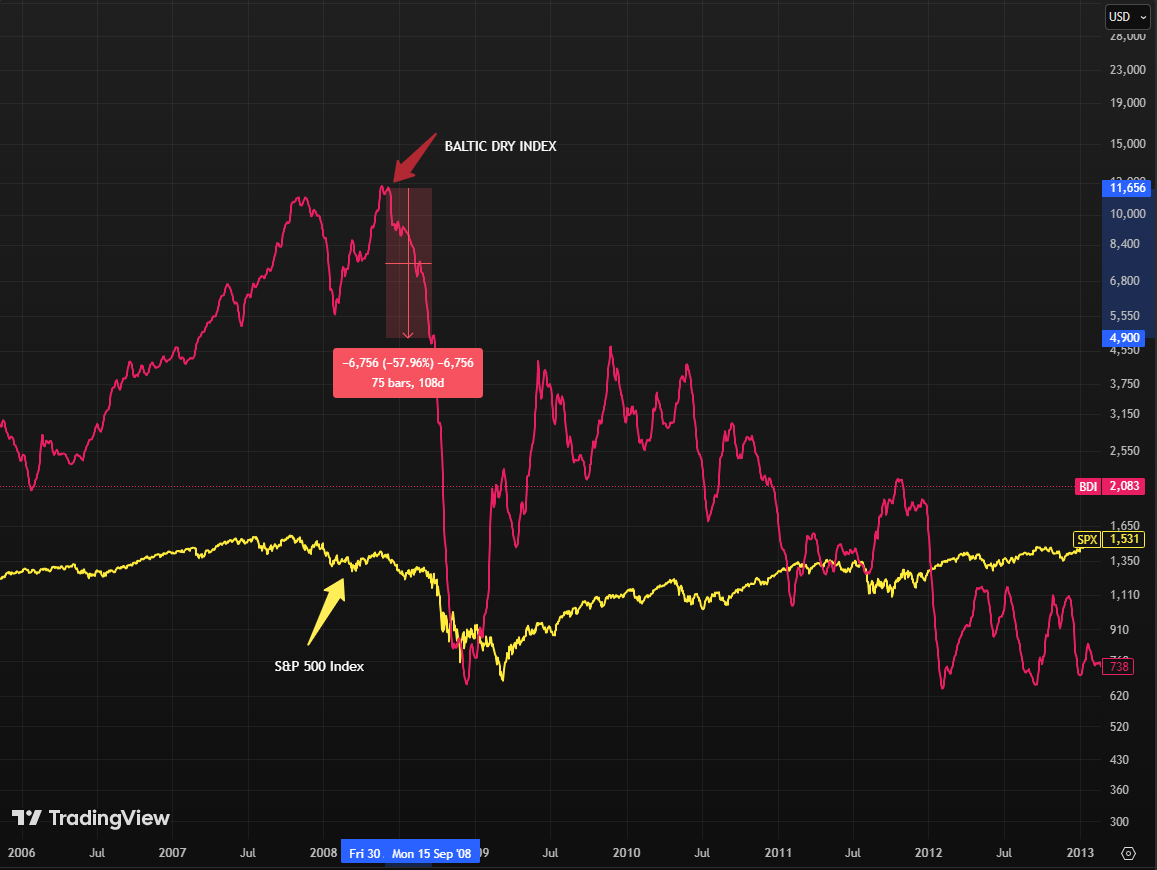
The Baltic Dry Index has shown its ability to move ahead of major economic downturns in several cycles. During the 2008 financial crisis, the crisis was widely marked from September 15, 2008, but the Baltic Dry Index had already peaked earlier on May 19, 2008. After that peak, the index declined sharply and fell about 50 to 60 percent before the September crisis date. It continued to fall further but started recovering by early December 2008, while the S&P 500 only began recovering later in early March 2009. This gap shows how shipping markets reacted months before equities reflected the slowdown.
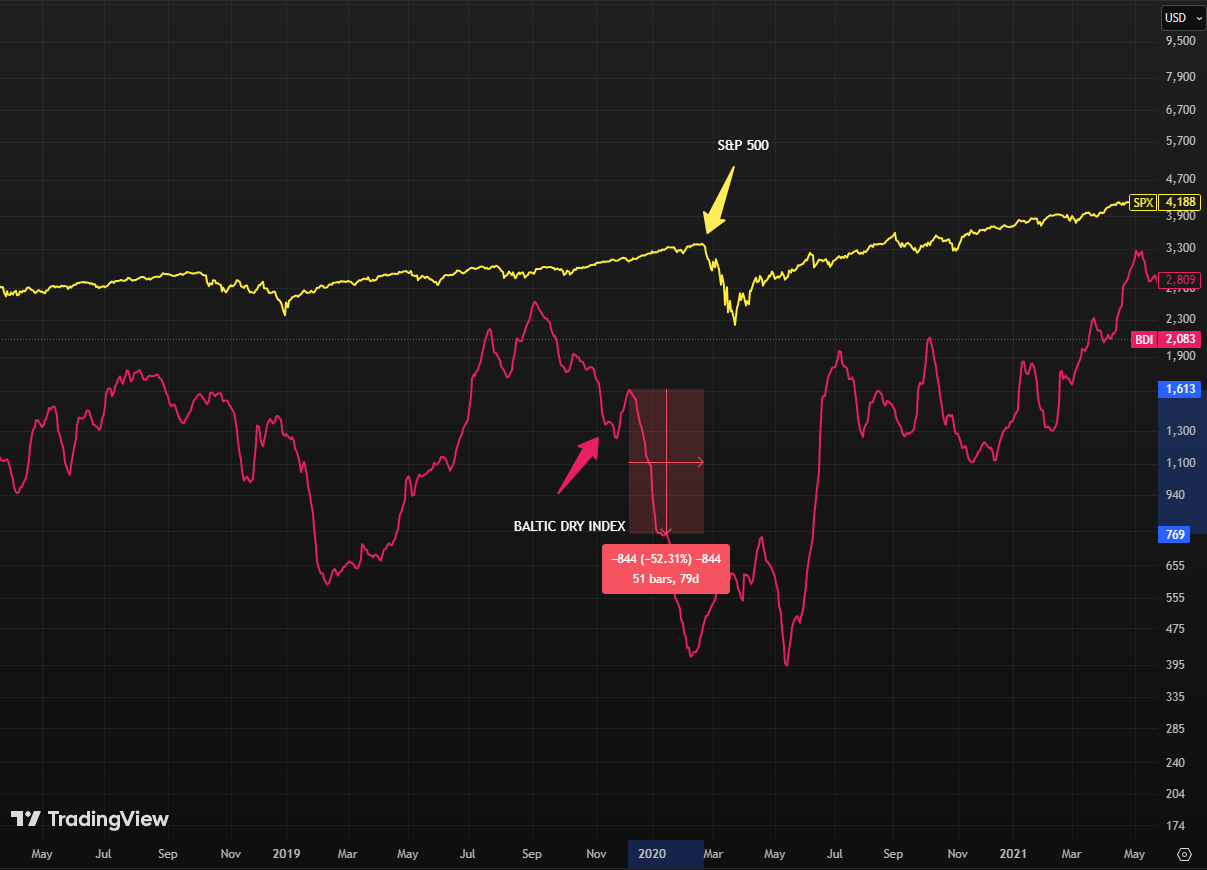
A similar pattern appeared during the Covid 19 crash. The first Covid cases were recorded as early as December 2019, and the Baltic Dry Index began declining in the early days of December. It went on to fall by around 50 percent before global markets crashed by late February due to lockdown announcements and major trade disruptions. While the stock market eventually bottomed on March 23, 2020, the Baltic Dry Index had already bottomed earlier by early February before starting to recover, again showing how freight markets moved ahead of equities.
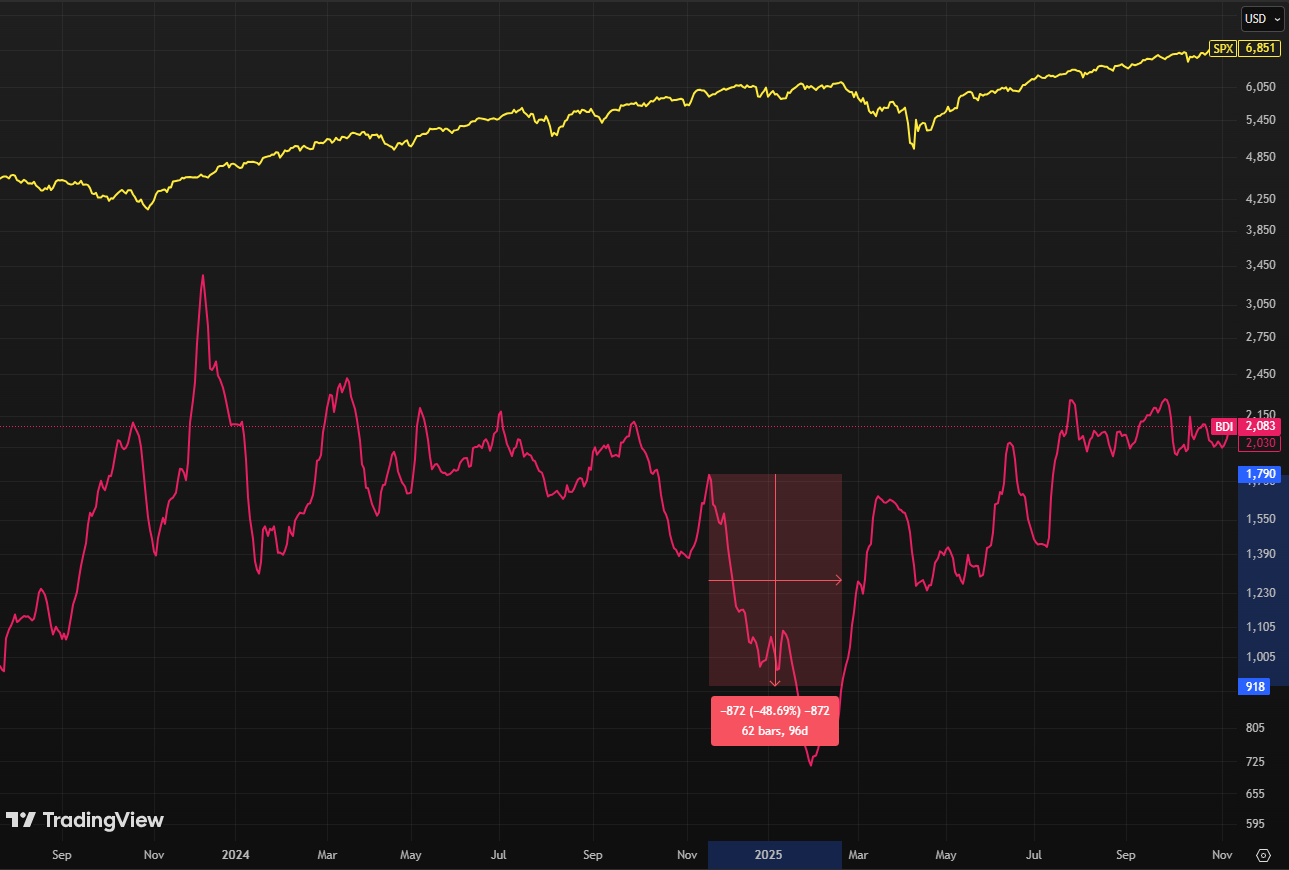
The 2025 Liberation crash also highlights how shipping markets reacted early. Commodity traders and shipping companies were among the first to see the impact of upcoming trade policies as China’s demand for iron ore fell due to a weakening property sector and front loading of exports ahead of the April 2 U.S. tariff deadline. Global markets crashed starting April 2, 2025 after U.S. President Donald Trump announced sweeping tariffs on what he called Liberation Day, triggering panic selling and marking the largest global market decline since the 2020 crash. The S&P 500 started showing cracks by mid February, but by that time the Baltic Dry Index had already declined by about 48 percent and had bottomed out by late January or early February, roughly two months before the S&P 500 reached its bottom.
However, the Baltic Dry Index does not predict every crash. During the dot com bubble, the index did not signal the downturn because the bubble was driven by financial speculation rather than a slowdown in global trade or industrial demand. Trade activity stayed relatively stable in the late 1990s, so freight demand did not collapse ahead of the crash. This shows an important limitation of the index, as it is more useful for spotting cyclical downturns than asset bubbles driven mainly by investor sentiment.
A similar limitation applies when thinking about a potential AI bubble. The Baltic Dry Index is unlikely to predict a technology driven bubble because tech cycles are shaped mostly by valuations, capital flows, and expectations rather than bulk commodity demand. The index tracks shipping costs for raw materials like iron ore, coal, and grains, so it reflects industrial activity more than financial excess. Like the dot com era, any AI bubble would likely be driven by expectations around future earnings and adoption trends rather than a fall in physical trade.
That said, the index can still show the real economic impact of the AI buildout, since large investments in data centres, power infrastructure, and construction could raise demand for steel and energy, indirectly supporting dry bulk shipping. In that case, a rising Baltic Dry Index would reflect broader industrial expansion linked to AI rather than signalling whether technology stocks are overvalued.
What Did Jeffrey Epstein Say?
In a little-noticed email sent in 2009, Jeffrey Epstein mentioned what he described as a lesser-known way people had quietly made fortunes over the previous decade: betting on shipping futures instead of being involved in the actual movement of goods. He pointed to the fast growth of freight derivatives, especially forward freight agreements, which allow shipping companies to manage risks and bet on future shipping rates on specific routes.
What made the email interesting was not just the claim, but the market it referred to. Freight derivatives were once viewed with caution by parts of the shipping industry because they were seen as complicated and not fully understood. Yet over time, this market has grown to become roughly as large as the physical shipping market itself, according to participants at the Baltic Exchange in London.
Epstein’s comments were essentially pointing to the growing role of freight derivatives as a way to profit from movements in global trade without being directly involved in shipping goods. When he referred to selling or “shorting” shipping futures, he was talking about betting that freight rates would fall, a strategy commonly used by traders and hedge funds.
The broader point is not about the individual who made the remark, but about the market itself, which offers a window into global trade trends and economic expectations. The email offered a rare look into a hidden corner of global finance that most investors rarely hear about.
When global trade slows, freight prices often fall quickly, and traders who bet correctly on this fall can make strong returns. In some cycles, profits from successful short trades have been estimated to be around 50 to 70 percent, which helps explain why experienced investors have long seen freight derivatives as a risky but potentially rewarding part of financial markets.
How Can Indian Investors Access It?
While the Baltic Dry Index itself is not directly investable, Indian investors can still gain exposure to shipping markets through freight futures based ETFs listed in global markets. In practical terms, you cannot directly short the Baltic Dry Index, but you can take a view on global trade by buying shipping ETFs if you believe freight rates and trade activity are likely to rise.
Breakwave Dry Bulk Shipping ETF (BDRY)
The Breakwave Dry Bulk Shipping ETF is designed to reflect the daily price movements of near dated dry bulk freight futures and offers unlevered exposure without needing a futures account. It is the first and only freight futures exchange traded product focused exclusively on dry bulk shipping and aims to profit from increases in freight futures beyond what is already priced into the market.
The portfolio holds freight futures with one to six months forward exposure and a weighted average expiration of about 60 to 70 days. Its allocation is roughly 50 percent Capesize 5TC, which are the largest vessels mainly transporting iron ore, 40 percent Panamax 4TC, the largest ships that can transit the Panama Canal, and 10 percent Supramax 10TC, which are medium sized ships with onboard cranes. The ETF is based on the Breakwave Dry Freight Futures Index.
The ETF has delivered about 13.87 percent returns over one month, 30.72 percent over three months, and about 80.78 percent over one year. It currently trades at around Rs. 1065.96 or USD 11.70.
The Breakwave Dry Bulk Shipping ETF (BDRY) is a fund that lets you invest in global shipping rates without directly trading futures. It mainly tracks the cost of shipping raw materials like iron ore and coal by holding short term freight futures contracts across different ship sizes. In simple terms, if global trade and shipping demand go up, this ETF tends to rise, and if shipping demand falls, it can decline. It gives investors a way to bet on the strength of global commodity trade through a single investment.
Breakwave Tanker Shipping ETF (BWET)
The Breakwave Tanker Shipping ETF focuses on crude oil tanker freight rates and is the first and only freight futures exchange traded product focused purely on tanker shipping. It provides unlevered exposure to oil tanker futures without requiring a futures account and aims to benefit from increases in oil freight futures beyond what is already priced into the market.
The portfolio holds freight futures with one to six months forward exposure and a weighted average expiration of about 60 to 90 days. Around 90 percent of the exposure is to TD3C routes using very large crude carriers, which are the largest cargo ships transporting crude from the Middle East and the Americas to Asia, while about 10 percent is allocated to TD20 routes using Suezmax vessels, which are about half the size of VLCCs and mainly operate in the Atlantic.
The ETF has delivered returns of about 56.95 percent over one month, 97.81 percent over three months, and about 319.95 percent over one year. It currently trades at around USD 47.06 or roughly Rs. 4287.54.
The Breakwave Tanker Shipping ETF (BWET) is a fund that lets you invest in oil shipping rates without trading futures directly. It tracks the cost of transporting crude oil by large tanker ships using short term freight futures contracts. In simple terms, if global oil demand and tanker shipping rates rise, this ETF tends to go up, and if oil shipping demand weakens, it can fall. It gives investors a way to take a view on the strength of global energy trade through a single investment.
Together, these ETFs provide a practical way for Indian investors to express a view on global shipping and trade cycles. While they do not allow you to directly short freight markets, they offer a way to participate on the upside if you believe global trade, commodity demand, and shipping rates are set to strengthen.
Shipping markets offer a rare window into the real economy because they reflect actual demand for moving raw materials rather than expectations or sentiment. Indicators such as the Baltic Dry Index and freight futures do not predict every downturn, but history shows they can provide early clues about shifts in global trade cycles, sometimes months before traditional economic data or stock markets react. For investors, this makes shipping an important piece of the broader macro puzzle rather than a standalone signal.
At the same time, these markets are highly volatile and influenced by factors such as fleet supply, fuel costs, geopolitics, and seasonal trade patterns. Tools like freight futures and shipping ETFs can offer exposure to these trends, but they are best viewed as tactical instruments that complement a broader investment strategy rather than replace it. Used thoughtfully, shipping data can help investors better understand where the real economy may be heading while reminding us that no single indicator can fully predict the future.
Disclaimer: The views and investment tips expressed by investment experts/broking houses/rating agencies on tradebrains.in are their own, and not that of the website or its management. Investing in equities poses a risk of financial losses. Investors must therefore exercise due caution while investing or trading in stocks. Trade Brains Technologies Private Limited or the author are not liable for any losses caused as a result of the decision based on this article. Please consult your investment advisor before investing.