

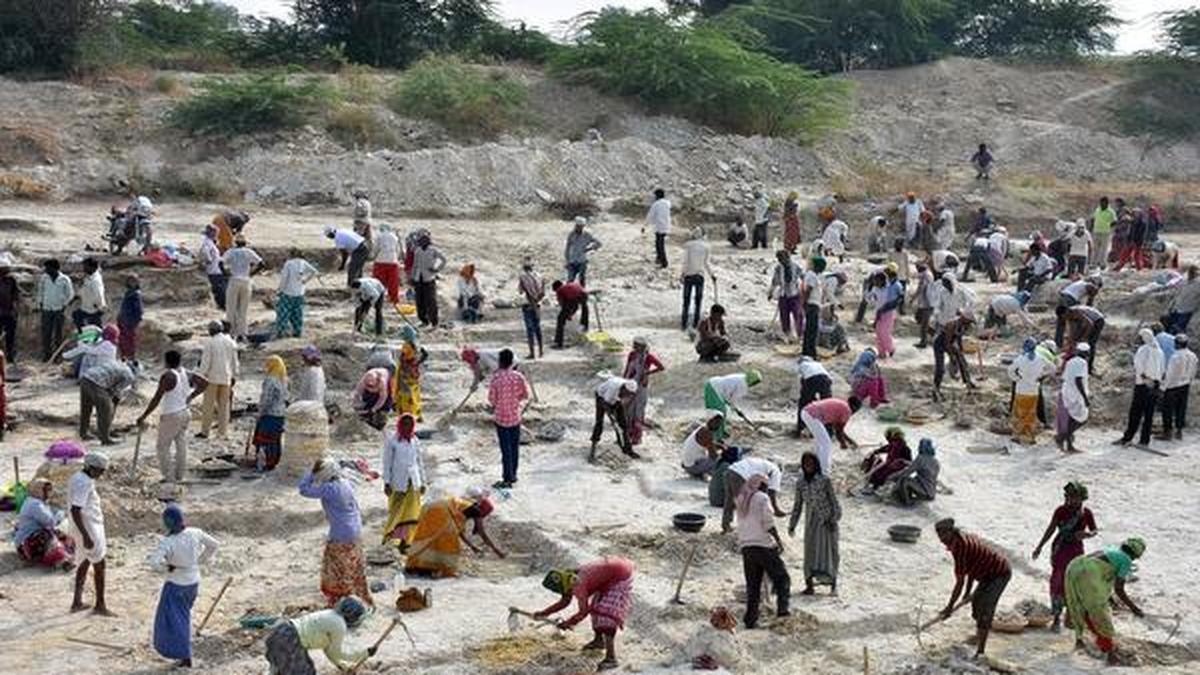
A public interest litigation petition has been filed in the Madras High Court challenging eight provisions of the Viksit Bharat- Guarantee for Rozgar and Ajeevika Mission (Gramin) Act (VB- G RAM G Act) of 2025. File.
| Photo Credit: The Hindu
A public interest litigation petition has been filed in the Madras High Court challenging eight provisions of the Viksit Bharat- Guarantee for Rozgar and Ajeevika Mission (Gramin) Act (VB- G RAM G Act) of 2025 which had replaced the Mahatma Gandhi National Rural Employment Guarantee Act (MGNREGA) of 2005.

The PIL plea is expected to be listed for hearing before the first Division Bench of Chief Justice Manindra Mohan Shrivastava and Justice G. Arul Murugan this week. Seventy-one-year-old advocate T. Sivagnanasambandan of T. Nagar in Chennnai had filed the case through his counsel on record M.L. Ravi.

In his affidavit, the litigant stated the MGNREGA had been one of the world’s largest social security initiatives which had been studied and evaluated intensively by multiple organisations. All those studies had recognised its transformative effects on the weaker sections of society, he claimed.

“The MGNREGA exempted State governments from most of the financial burden since the cost sharing ratio between the Centre and the States was 90:10. But now, as per the new Act, the cost sharing ratio is 90:10 only for north eastern and himalayan States and 60:40 for others,” he complained.
Similarly, the MGNREGA granted greater autonomy to village panchayats, in accordance with the 73rd Constitutional amendment, by making them the principal implementation authority but the VB- G RAM G Act had bid “good bye” to those constitutional guarantees given to panchayats, the petitioner lamented.
Claiming the MGNREGA and other beneficial legislations such as the National Food Security Act of 2013 had prevented hunger deaths during COVID-19, the petitioner said: “The demolition of MGNREGA now will have a catastrophic impact on crores of people across rural India.”
He contended Sections 3(1), 4(5), 5(1), 6(2), 22, 30, 34 and 37 of the VB- G RAM G Act were unjust, anti-federal and unconstitutional since they were against the rights guaranteed under Articles 14 (right to equality), 16 (right to equality of opportunity) and 21 (right to life) of the Constitution.
Section 3(1) requires the State governments to frame a scheme consistent with the provisions of VB- G RAM G Act within six months from its commencent and Section 4(5) states that the Centre shall determine the State wise normative allocation of work for each financial year, based on objective parameters.
Section 5(1) of the Act requires the State governments to provide every household, whose adult members volunteer to do unskilled manual work, not less than 125 days of guaranteed employment in a financial year but insists that the beneficiaries must be selected from rural areas notified by the Centre.
Further, Section 6(2) of VB- G RAM G Act mandates the State governments to notify in advance, a period aggregating to 60 days in a financial year covering the peak agricultural seasons of sowing and harvesting, during which works under the Act should not be undertaken to facilitatate adequate availability of agricultural labour.
Sections 22 makes it clear the fund sharing pattern between the Centre and the State governments would be 90:10 for the North Eastern and Himalayan States and 60:40 for all other States and Union territories with legislatures. The Centre would bear 100% of the expenses only in union territories without a legislature.
Section 30 of the Act gives the option to the State governments to follow their local legislations for providing employment guarantee for unskilled manual work to rural households but with a rider that the financial assistance shall be determined only by the Centre and it would not exceed what the State concerned would have been entitled to under the VB- G RAM G Act.
Section 34 empowers the State governments to frame statutory rules under the VB- G RAM G Act but insists such rules must fix the eligbility conditions, procedure for payment to the beneficiaries, maintenance of accounts and so on strictly as per the provisions of the Act.
Finally, Section 37 states the MGNREGA along with its statutory rules, notifications, schemes, orders and guidelines would stand repealed from the date when the Centre decides to do so through issuance of an official notification. The petitioner had urged the High Court to declare all these eight provisions as null and void.
Published – February 15, 2026 03:58 pm IST