

With the release of Emerald Fennell’s adaptation of Wuthering Heights, I, like many devoted readers of Emily Brontë’s novel, have found myself thinking again about the discomfort it elicits. The casting of Jacob Elordi as Heathcliff has revived a long-standing debate around the character’s racial identity.
In the novel, Heathcliff’s origins are deliberately ambiguous, yet he is consistently marked as non-white. Variously described as a ‘dark-skinned gipsy’, ‘black-eyed’, and even a ‘Lascar’—a nineteenth-century term for sailors from South Asia—these labels intensify his otherness. Heathcliff’s racialised outsider status is central to his social ostracism and alienation.
This unease is not incidental. Nineteenth-century British fiction emerged alongside imperial expansion, and novelistic worlds were implicitly shaped by imperial encounters. The Brontës were writing at a time when India occupied a powerful place in the British imagination, not only as a site of economic extraction but also as a moral and religious project. In Jane Eyre, Charlotte Brontë presents an alternative future for her heroine: marriage to her cousin St. John Rivers and a life of missionary work in India. Jane’s rejection of this fate is not an explicit critique of empire; nonetheless, it is a decisive refusal to participate in a religious mission that overrides personal autonomy.
I first read the Brontë sisters years before pursuing British women’s writing for my doctorate. Returning to them now, my engagement is more critical. Bertha Mason, Rochester’s first wife in Jane Eyre, the infamous ‘madwoman in the attic’, is of Creole descent through her mother and the daughter of a white plantation owner in Jamaica. The novel tacitly associates her madness and violence with this colonial ancestry. Jean Rhys’s Wide Sargasso Sea later reimagines Brontë’s novel from Bertha’s perspective, exposing the racial and imperial violence that underpins her effacement.
As a woman of colour, visiting Brontë country meant honouring the writers I have cherished since adolescence, albeit now with a researcher’s gaze. Among the three, Anne Brontë feels most immediately familiar to me, even when her works bear no direct connections to India. Long overshadowed by Emily and Charlotte, Anne’s first novel, Agnes Grey, offers a radical critique of class apathy and the narrow professional choices available to women. The Tenant of Wildfell Hall confronts domestic abuse, alcoholism, and institutional oppression within marriage. These thematic resonances speak persuasively to readers in South Asia and elsewhere.
Arriving at Haworth
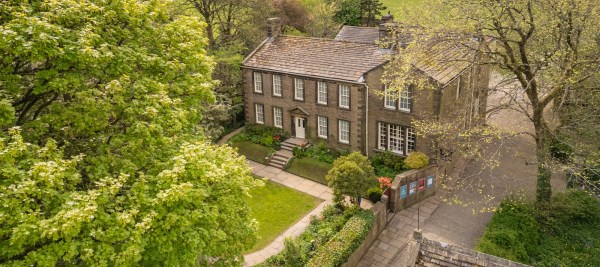 The Brontë Parsonage Museum. (Photo: bronte.org.uk)
Through travelling across England, I have learned that popular destinations become most intimate when one arrives early. I reached Haworth at eight in the morning after a long journey from Oxford, having spent the night in York. An early train from York to Leeds, followed by another to Keighley, brought me steadily closer to Brontë country. At the station, maps and signposts directed visitors to the affordable ‘Brontë Buses’, which run every twenty minutes between Keighley and Haworth. The bus ride itself was breathtaking, winding through green hills beneath low, shifting clouds, with glimpses of the steam railway line appearing from above just minutes before we arrived.
Story continues below this ad
At every turn, the sense of remoteness deepened; the gothic moors I had first encountered on the page were now vividly coming to life. Stepping off the bus, perched high amid misty hills, I was unprepared for the landscape. Cobbled streets, open green spaces, a gothic cemetery, a post box, and an old red telephone booth converted into a tiny library created the striking sensation of entering another century. The village was smaller than I had expected, but as I climbed the steep street lined with cafés and bookshops, the views grew more expansive.
With a few hours to go before the Brontë Parsonage Museum opened, I wandered through the village as a solitary traveller, guided by plaques and inscriptions that mark the family’s presence everywhere. I passed the old post office from which the sisters dispatched their manuscripts and letters, the inn frequented by their brother Branwell, and the parish church where their father, Patrick Brontë, served as a clergyman. Behind the church lies the winding cemetery where Patrick, Emily, Charlotte, and Branwell are buried. Anne Brontë rests farther away in the coastal town of Scarborough, where I would travel the following day.
Walking through Haworth, I reflected on how far their writing had travelled from this secluded place. Their London publishers, Smith, Elder & Co., had commercial roots in Bombay, where the firm’s founder made his fortune through colonial trade. That the novels of three women who lived and died in near isolation on the Yorkshire moors were enabled, in part, by wealth generated in colonial India is a reminder that Victorian literature was intimately entangled with empire, even when it appears rooted in provincial British life.
As the clock struck ten, I entered the Brontë Parsonage Museum as its first visitor that morning and discovered a treasure trove. Alongside manuscripts, first editions, and letters bearing their handwriting, the house-turned-museum displays the artefacts of their daily lives: Anne’s collection of pebbles and seashells from Scarborough, the dress Charlotte wore to a literary soirée hosted by William Makepeace Thackeray, hand-quilled boxes, sketches, paintbrushes, sewing needles, and threads. The lives of the Brontë sisters were shaped not only by writing but by a broader creativity. They were artists, diarists, and poets, devoted to teaching, housekeeping, tailoring, and craft.
Story continues below this ad
A lingering sense of loss
Beyond their artistic legacies, the rooms of the house carry a lingering sense of loss: the tragedy of lives brutally cut short. The surroundings of Haworth intensified the gloom I felt inside. With its once-bleak living conditions, the town was scarcely meant to sustain long, healthy lives. The sisters rarely left, spending their short lives here, bound by domestic duty, illness, and geographical isolation.
Repeated grief seems to eclipse literary fame—Branwell’s artistic decline and alcoholism, Emily and Anne’s deaths before the age of thirty, Charlotte’s brief marriage followed by her own early death, and the pathos of Patrick, who outlived all his children. And yet theirs is also a story of resilience in the face of mortality. Strong familial ties, especially Patrick’s determination to foster intellectual rigour in his children and the close-knit sisterhood of Emily, Charlotte, and Anne, were forged within this confined domestic world.
I stepped out of the Parsonage thoughtful and somewhat disconcerted; I had never experienced this sensation at other literary sites. Outside, the village had transformed. The skies were clearer, and tourists now crowded the streets, taking photographs and buying confectionery from the famous Beighton’s Sweet Shop. Others drifted in and out of the Cabinet of Curiosities as the aroma of candles and perfumes wafted through the air. Cold and hungry, I made my way to the Apothecary Tea Rooms and took a seat by the window overlooking the hills. Posters of Brontë adaptations lined the walls, and over a hot chocolate and warm buttered toast I struck up a long conversation with the owner. A year on, Haworth remains in my memory as one of the strangest and most beautiful days I have spent in England.
(The writer is a DPhil candidate in English at the University of Oxford.)
Story continues below this ad
As I See It is a space for bookish reflection, part personal essay and part love letter to the written word.