

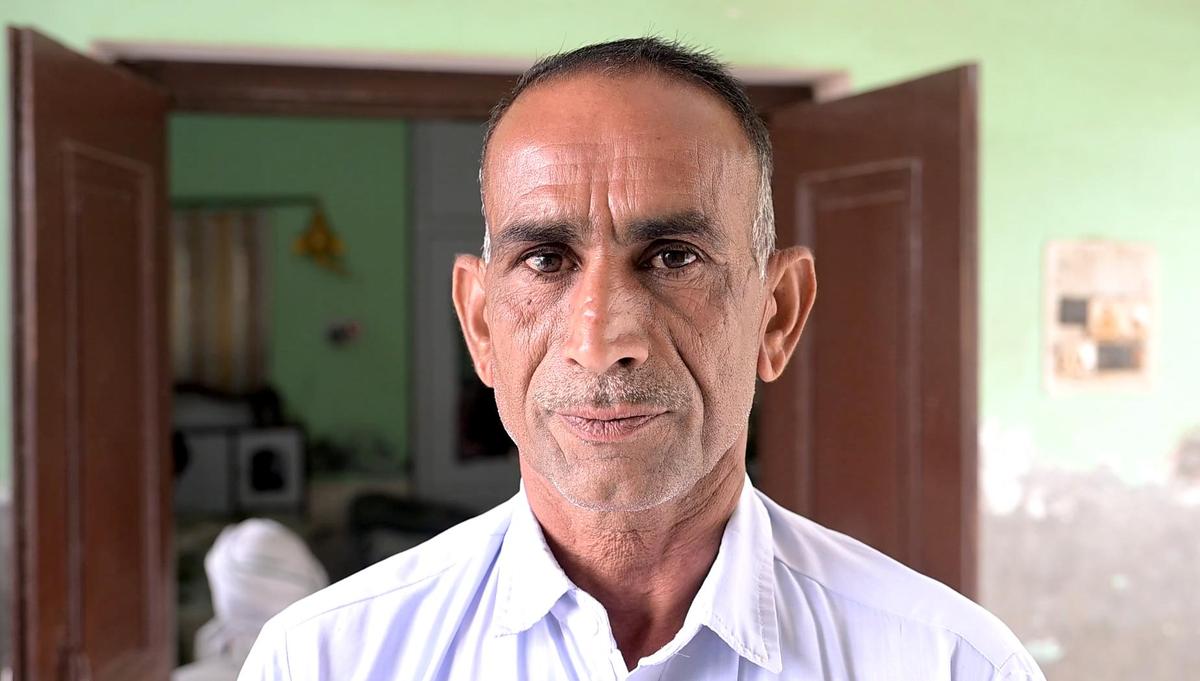
Satyavan ,a cotton farmer at Kirtan Village in Hisar District.
| Photo Credit:
Shashi Shekhar Kashyap
In Haryana’s dusty heartland of Hisar, around 180 kilometres west of Delhi, Satyavan, a weathered farmer in his late 50s, recounts the dwindling fortunes of cotton farming. A tall figure with a rugged demeanour and grey close-cropped hair, he sits amid fellow farmers in Kirtan village, his sharp features etched with concern.
For 25 years, Satyavan has tilled the land, growing cotton as a Kharif crop, but the returns have been dismal for the past decade. Last year, he sowed 5 acres, only to incur a loss of ₹15,000. The culprit, he says, is the relentless pink bollworm, which has ravaged his crops since 2014. “When you factor in the costs of seeds, fertilizers, diesel, and harvesting, the loss is stark,” he says.
Sitting adjacent to him, Dayanand Dhaka, 53, his light grey stubble glistening in the sunlight, speaks of cotton farming as a Sisyphean task. “Three to four quintals per acre, that is all I got last year,” he says, his voice tinged with defeat. “The costs have outstripped my meagre returns. It has me ₹40,000 in the red.”
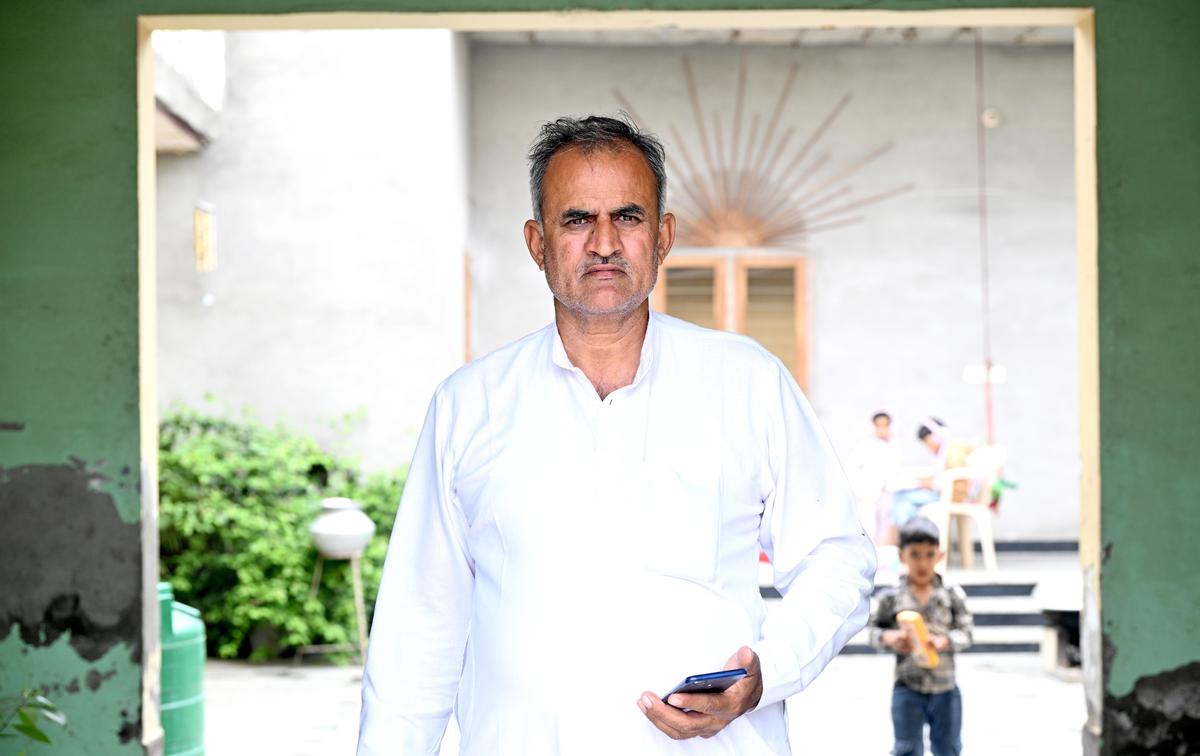
Three to four quintals per acre, that is all I got last year. The costs have outstripped my meagre returns. It has me ₹40,000 in the red Dayanand Dhaka, farmer, Kirtan village, Hisar, Haryana
| Photo Credit:
Shashi Shekhar Kashyap
It is a story that has repeated itself over 5-6 years: the pink bollworm’s relentless assault, the government’s elusive Minimum Support Price (MSP), and the crushing reality of survival. “Government agencies said my cotton wasn’t up to the mark, so I sold it to private buyers at ₹6,200 a quintal, ₹1,600 less than the MSP,” Dhaka recounts, resignation in his tone. Dhaka says he got his crop insured every year, but never got the insurance money.
A Ministry of Agriculture and Farmers Welfare 2025 report records that the total area under cotton cultivation for Haryana has declined from 0.72 million hectares in 2019-20 to 0.40 million hectares in 2024-25, bringing down the State’s share from 5.36% to 3.47% in the total area under the crop nationally.
The Department of Agricultural Economics at Chaudhary Charan Singh Haryana Agricultural University (CCSHAU), in its latest report, estimated that cotton farmers suffered a loss of ₹15,143 per acre in the last Kharif season. The cotton best stretches across Haryana’s western and south-western districts of Sirsa, Fatehabad, Jhajjar, Charkhi Dadri, Bhiwani, and Jind.
What the study found
Titled ‘Economics of Important Kharif Crops in Haryana-2025’, the 34-page report calculates the cost of cultivation and production and net returns in 18 of Haryana’s 23 districts for seven crops: paddy, cotton, bajra, mung bean, cluster bean (known locally as guar), maize, and jowar.
As per the report, the average variable cost of growing cotton per acre for the State was ₹22,821 and the total cost, including the transportation, rental value of land and management charges, settled at ₹40,024. The gross returns per acre were ₹24,882, which also included income from the by-products. The average production was four quintals per acre.

Hisar, Fatehabad, and Charkhi Dadri recorded a net loss of ₹17,515, ₹17, 315, and ₹15,276 per acre, higher than the State average. The per-acre loss of ₹9,548 for Rewari was less than the State average.
For the study, each district was classified into different crop zones on the basis of existing crop patterns. About 40 farmers were randomly selected from four villages representing different crop zones, and information was collected. Though the report cautions that the sample size for data collection was not large, it says that the results are broad indicators for different issues involved in the decision-making process for the cultivation of various Kharif crops in Haryana.
Vinay Mehla, assistant scientist at CCSHAU’s Department of Agricultural Economics, sheds light on the cotton crisis. He says historically, cotton faced threats from pests like spotted bollworm, American bollworm, and pink bollworm. The introduction of genetically modified Bt cotton seeds in the early 2000s, infused with Bacillus thuringiensis genes, initially mitigated the pink bollworm menace. However, the pest developed significant resistance by the early 2010s, leading to devastating yield losses. “Pre-pink bollworm, yields ranged from 10-12 quintals per acre; now, they are less than half of that. Last year’s floods exacerbated the situation,” Mehla says.

Vinay Mehla, Assistant scientist working at Chaudhary Charan Singh Haryana Agriculture University (CCSHAU) Hisar at Kirtan Village in Hisar District, Haryana.
| Photo Credit:
Shashi Shekhar Kashyap
He advocates comprehensive reforms, emphasising local variety development and dedicated funding. He urges an emergency government meeting to address the crisis, warning that cotton cultivation, already on the downtrend, can be a thing of the past within a couple of years, if unchecked.
Last year, yields averaged four quintals per acre, fetching ₹5,000-₹6,000 per quintal, leaving farmers at a loss. As cotton cultivation shrinks, farmers, industry, and the economy face dire consequences, including increased imports and revenue losses. “Those still growing cotton are holding on by a thread, mostly for its by-products,” Mehla notes.
Depleted gold
Haryana’s cotton, once thriving in the region’s arid climate and sandy loam soil, is now struggling. Dying yields have left farmers like Dayanand and Satyavan with few options. Alternative Kharif crops like guar and mung bean are susceptible to fungus. The highly saline groundwater in the region does not suit paddy, and bajra’s low returns make this labour-intensive crop economically unviable.

Satyavan’s experiment with KR-64 cotton, a desi, hybrid variety, flopped last year, yielding just two quintals per acre. Farmers are stuck between poor yields and unviable alternatives, with their economic stability hanging in the balance. Shifting to new crops depends on a variety of factors, including the climatic conditions, availability of labour, market demand and, above all, the right price.
Farmers in Hisar’s cotton belt are struggling, relying on wheat and mustard to stay afloat, says Sandeep, a farmer who owns 6 acres of land. “Farming is becoming a loss-making deal,” he adds. Even with the MSP, rising input costs leave farmers with meagre profits. “In 2005, one quintal of foodgrains bought 10 grams of gold; now it is a fraction of that,” says Sandeep.
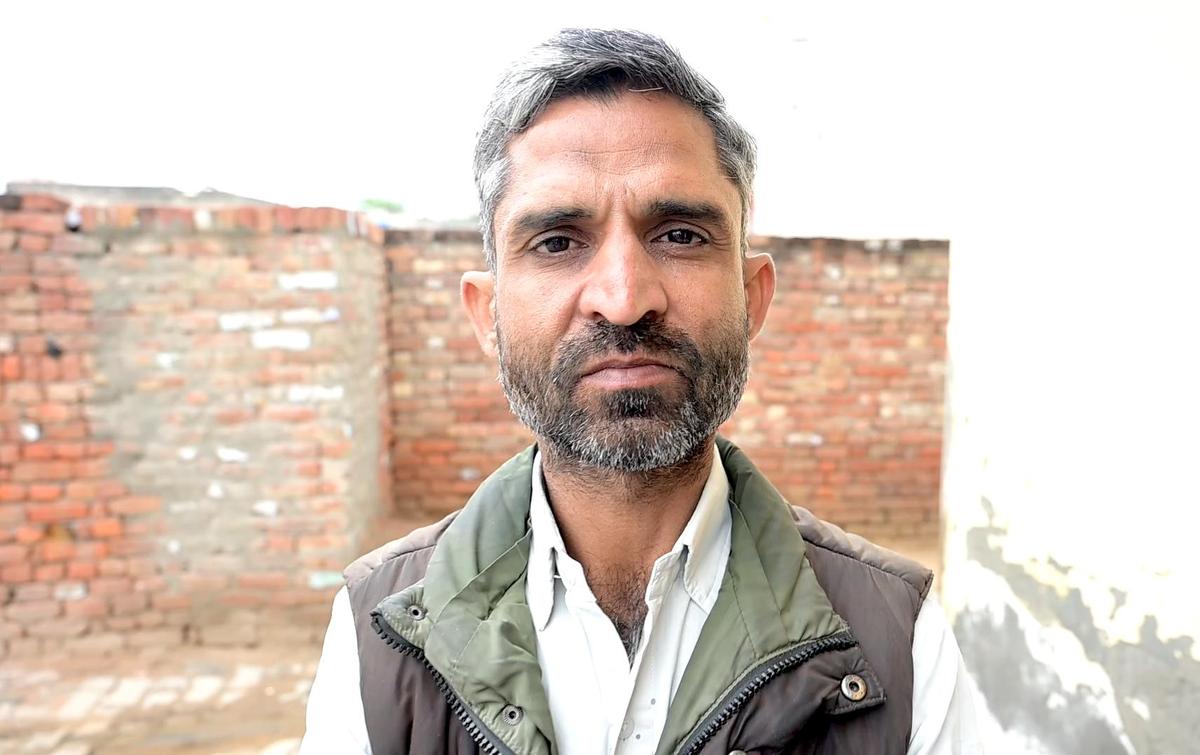
Sandeep, a cotton farmer at Kirtan Village in Hisar District, Haryana.
| Photo Credit:
Shashi Shekhar Kashyap
Diesel prices tell a similar story. One quintal of foodgrain used to buy a barrel of diesel. Now, farmers need three quintals for a barrel. “The government needs to address this price-input cost imbalance. Farmers are now shifting to paddy, despite water woes, or exploring alternatives like poultry farming, or even selling land, says Ramandeep, a journalist-farmer.
Turning to rice
In Sirsa, the top cotton-producing district in Haryana, the area under cotton cultivation has shown a gradual decrease for five years, registering a decline of 34.62% since 2020, as per district agriculture department figures. Farmers are also quitting cotton because the yield per hectare has gone down. From 714 kg per hectare in 2019, the average cotton yield in Sirsa dropped to 264 kg per hectare in 2022; rebounded to 583 kg per hectare in 2023, to fall to 534 kg per hectare the following year.
Despite the dry climate of Sirsa being historically and agro-climatically more suitable for the crop, farmers are shifting to rice, a water-intensive crop. The district agriculture department figures show the area under rice (paddy) cultivation has shot up from 1,00,300 hectares in 2020 to 1,55,650 hectares in 2024, a jump of 55.18%.

Cotton is a crop prone to pests such as pink bollworm, white fly and also impacted by sudden changes in weather conditions, forcing farmers to shift to alternative crops, despite various government schemes to incentivise water-efficient crops, says Deputy Director of Agriculture, Sirsa, Sukhdev Singh Kamboj.
Under the ‘Mera Pani-Meri Virasat (my water, my legacy)’ scheme, the Haryana government provides an incentive of ₹8,000 per acre to farmers who grow water-wise crops such as maize, pulses, and cotton, instead of paddy, to conserve depleting groundwater levels. Besides causing economic distress to the farmers, the decline in cotton production has also dealt a blow to the efforts of the Haryana government to arrest the fast-depleting groundwater level in the State.
“The Haryana government also offers ₹3,000 per acre incentive to farmers growing desi cotton as it requires significantly less water and is resilient to climate challenges. But it has failed to find many takers because the local varieties fetch lower prices compared to Bt cotton and have inconsistent market demand, though the average yield per hectare remains at par,” says Kamboj. Desi varieties are also comparatively more labour-intensive compared with higher-density hybrids that can be mechanically picked.
Read:How cotton colonised the world
Many farmers, however, maintain that local varieties are not easily available, making it difficult for them to avail themselves of the government scheme. The government also offers ₹2,000 per acre (maximum ₹4,000 per farmer) incentive for cotton growers under its Integrated Nutrient Management (INM) and Integrated Pest Management (IPM) programme, but all these efforts have, so far, failed to draw farmers back to cotton, Kamboj adds.
Farm labour struggles
The decline in cotton production has also hit the farm labourers. Playing cards under a tree in Jhajjar’s Kherka Gujjar village, surrounded by his friends, Ishwar, from the Scheduled Caste community who are often involved in farm labour work, says the local landlords’ shifting to paddy from cotton in this region has hit farm labourers like him “really hard”.
“Cotton picking needs more hands compared to paddy harvesting. Also, the landlords prefer migrant labourers from Bihar and Uttar Pradesh for paddy sowing and harvesting due to their expertise and lower wages. Locals are preferred for cotton picking,” says the 48-year-old. He adds that he, like many others in the village, now travels to the city to work as a construction worker.

Birmati, another farm labourer, says that she would make ₹10,000-15,000 during the Kharif harvesting season every year from cotton picking earlier. “The decline in the production of cotton has reduced the demand for seasonal labour over the years, particularly for the women, who drive much of the picking process,” she says. It may eventually drive workers towards the urban areas, straining the city infrastructure.
Traditionally a sugarcane belt, Jhajjar saw a sudden surge in cotton cultivation after the advent of the Bt cotton due to high production and market value. “The cotton cultivation in Jhajjar peaked in 2021 with 32,437 acres under cotton cultivation.
The government scheme to incentivise water-efficient crops also contributed to the farmers’ inclination towards the crop,” says Sub Divisional Officer (Agriculture), Jhajjar, Jagjit Sangwan. But the impact of the pink bollworm and poor prices hit farmers.
“My grandfather had purchased 2.5 acres of agricultural land using the earnings from just four acres of cotton cultivation. But today, farmers are incurring losses in cotton farming,” Mehla says, adding that soon there may be no cotton farms in Haryana.
The area under cotton cultivation across India has also decreased by 14.84% between 2019-20 and 2024-25, with production down from 36.07 million bales (170 kg in each bale) to 29.72 million bales.
ashok.kumar@thehindu.co.in
Edited by Sunalini Mathew