A student is midway through a presentation when veteran theatre actor and director M K Raina leans forward — not to interrupt, but to engage.
“Why this image? What does it do on stage?” he asks the student, referring to a picture on the screen of an old-styled hut, and goes on to explain how huts were built in the period the work is set in.
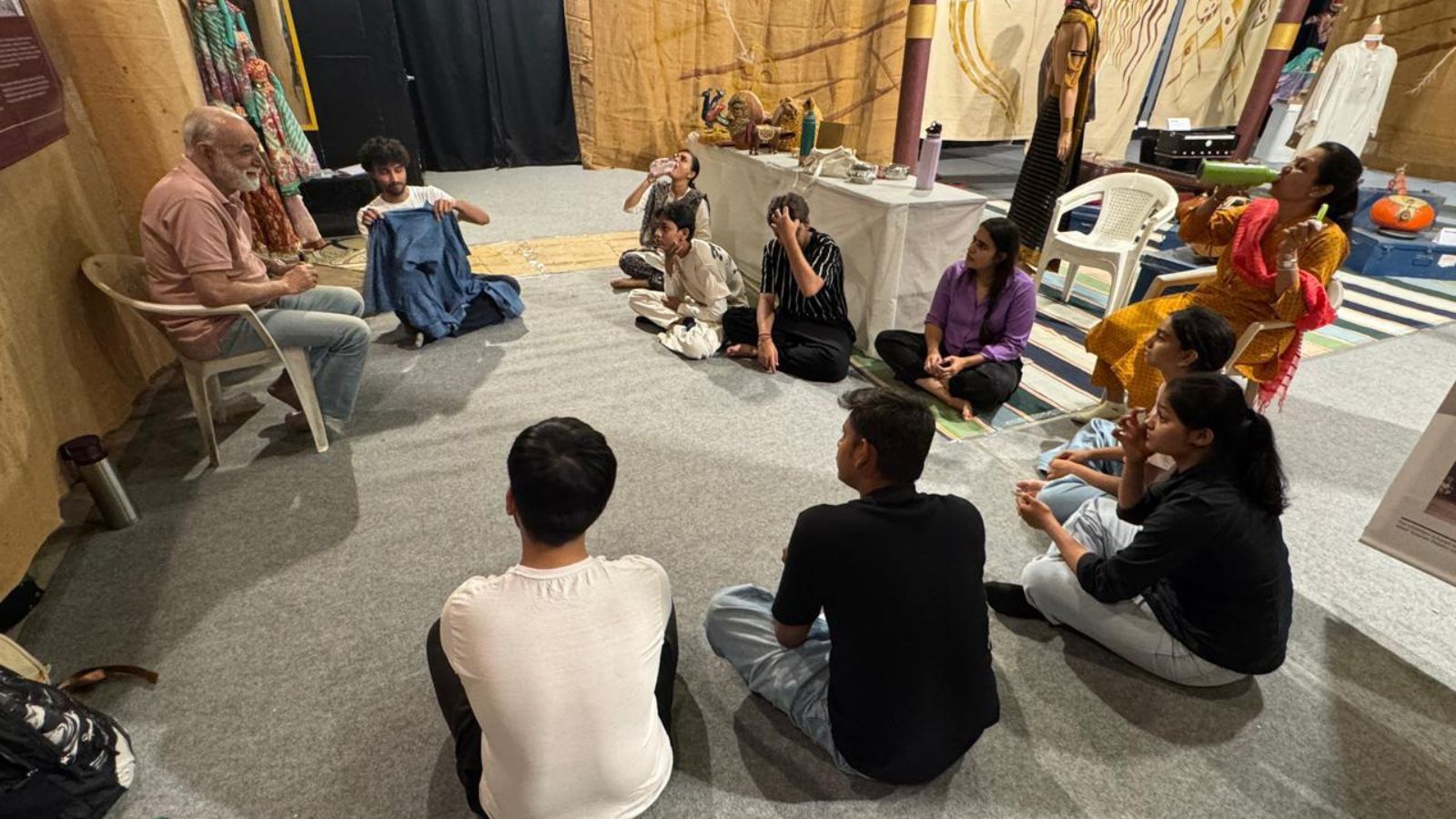
When another participant mentions working through sketches instead of slides, Raina gets up, walks across and sits on the floor with them. The students follow. The room rearranges itself into a circle—drawings spread out, references exchanged and ideas tested aloud. The distance between the performer and the master narrows.
The session is part of a masterclass at the Theatre and Media Centre (TMC) in Ahmedabad, held within an exhibition on playwright and theatre thinker the late Hasmukh Baradi who founded the centre.
Around them are masks, instruments, costume elements and architectural models—markers of performance traditions that extend beyond the conventional stage.
Raina, 77, who gripped audiences in the 80s with his performance in ‘Ek Ruka Hua Faisla’ and later in ‘Taare Zameen Par’ is here to work on a play by Baradi: ‘Eklun Akash’ (The Lonely Sky), his first experiment with Gujarati.
Story continues below this ad
At one point, Raina pauses and asks, almost casually: “Havey shu?” (what next? in Gujarati).
The question frames the larger inquiry behind ‘Beyond the Proscenium’, the theme for the nine-day ‘All About Natak Theatre Fest-2026 at TMC ending Sunday which is an attempt to rethink not just theatre, but the conditions in which it is made.
That inquiry extends into his own work in Gujarat.
“I could have done a Hindi play,” Raina tells The Indian Express. “But that wasn’t the point.”
Instead, he chose to direct Eklun Akash, a play by Hasmukh Baradi—his first in Gujarati.
Story continues below this ad
A kaleidoscopic exploration of the Nav Nirman movement, the 1970s student-led agitation in Gujarat against corruption, Eklun Akash “captures the internal dejection and the vast ‘lonely sky’ of a generation that feels profoundly lost…even though he wrote it in the 80s I saw the presence of today in this script. It is a play for the millions of youth today — where there is one job opening and five lakh people apply…Perhaps there is the echo of the anguish of the young man in this,” he says.
The production, staged over two days during the festival, becomes both a tribute and a continuation of Baradi’s work.
‘Havey shu?’
At its centre is a question—What next? (“Havey shu?”)—one that continues to resonate across generations navigating uncertainty and limited opportunities.
To stage it, Raina moves away from conventional form.
“I broke the grammar of the proscenium,” he says. “The play itself is not linear—it is kaleidoscopic.” That shift, he suggests, is not merely stylistic.
Story continues below this ad
“In Gujarati theatre, I noticed it is mostly proscenium,” he says. “That is a colonial model handed down by the British. We have not liberated ourselves from it.”
Within that structure, roles remain fixed. “This proscenium theatre is very status quoist,” he says. “It tells you—‘we are the truth, you better listen quietly,” he says, pointing to performance traditions where that separation does not hold. “In our country, drama used to happen in the open air,” he says. “People move, they respond, they participate.”
He refers to village performances of Bhavai, where audiences do not remain seated, where they move, speak, and engage without breaking the performance.“It breaks that seductiveness that the proscenium imposes, you become an active participant,” he tells the paper. But questions of control extend beyond form. “Even today, the ghost of this colonial law haunts us,” Raina says.
“You still have to submit your script to the police or a board three days before a performance to acquire permission,” he says.
Story continues below this ad
Manvita, architect and director of TMC and daughter of Hasmukh Baradi, says, “In a proscenium setup, you are already ‘imprisoned’, and then you have to satisfy these authorities before you can even step on stage.”
Across cities, the challenges are similar—limited funding, restricted spaces and uneven access. He says that theatre persons should use the spaces “available” to them. He also sees theatre as an “ensemble” which has been impacted by film actors crossing over.
He recalls encounters with actors unwilling to engage with scripts or the demands of a live performance. “This is not a ‘shot’,” he says. “You have to stand for two hours. An actor here is not just an actor,” he says. “They are a dancer, a singer, a musician”.
He recalls his years in drama school—days structured around physical training, rehearsals, and collective work, and support at the time. He also spoke on how his theatre group once built a relationship with a small dhaba owner they called “Papaji” who became a “patron” by spreading the word about their performances.
Story continues below this ad
What kind of spaces are being imagined? What kind of work is being supported? What kind of culture is being built? Back in the workshop, the session continues without a formal end. “Have shu?”—stays in the room.
(Nishant Bal is an intern at The Indian Express, Ahmedabad)