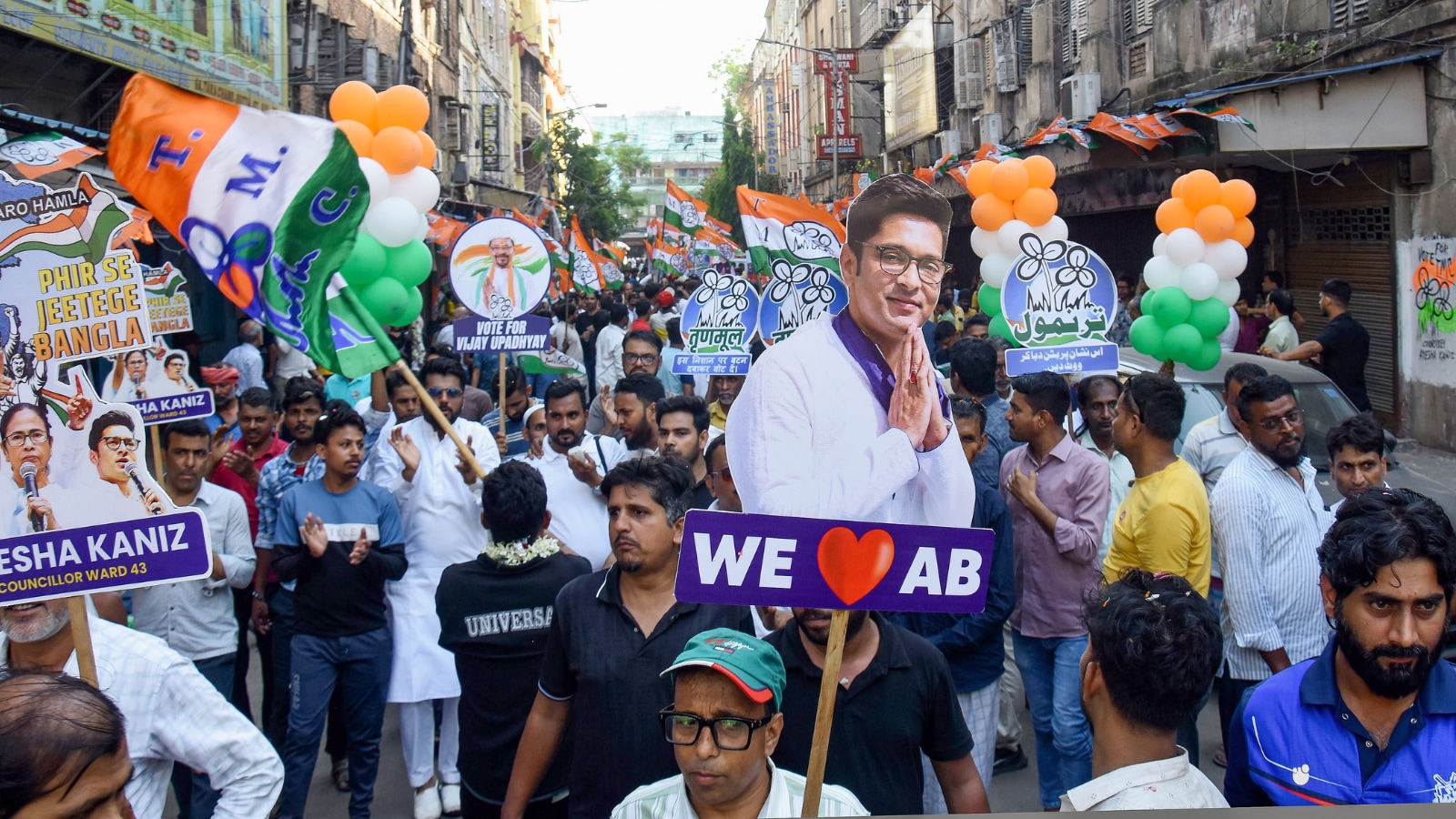
With just over a week to go for the first phase of the two-phased West Bengal Assembly polls, the ruling Trinamool Congress (TMC), which is seeking a fourth straight term, has decided not just to defend its 215 seats but has set its sights on around 250 of the state’s 294 constituencies.
Even as Chief Minister Mamata Banerjee has set a target of winning 226 seats, sources said party national general secretary Abhishek Banerjee had an even more ambitious objective: winning 250 constituencies. “It is based on a recalibration of the 2021 results. The focus is on 30-35 seats spread across 29 Lok Sabha constituencies that the TMC won in the 2024 polls. Also, over 100 Assembly seats that were decided by up to 15,000 votes in 2021 are also being monitored,” a source said.

An analysis of the 2021 Assembly results shows closely contested battles in at least 34 seats where victory margins were under 5,000 votes — with the BJP winning 21 and the TMC 13 of these seats. Margins ranged from 273 votes in Balarampur in Purulia district to just over 4,300 in Cooch Behar Dakshin in Cooch Behar district.
Similar trends were seen in the 2024 Lok Sabha elections in Balurghat in Dakshin Dinajpur (won by the BJP by 9,673 votes) and Arambagh in Hooghly district and Bishnupur in Bankura district (won by the TMC by 6,308 and 6,172 votes, respectively).
SIR effect
The Special Intensive Revision (SIR) of electoral rolls has made the party redouble its efforts on gettng voter arithmetic right. A total of 44 Assembly constituencies have recorded voter deletions exceeding 2021 victory margins. Of these, the TMC had won 24 seats and BJP 20. For instance, Samserganj in Murshidabad, where the TMC won by 26,111 votes, has seen 74,775 names deleted from electoral rolls. In Balarampur, where the BJP won by just 273 votes, 1,037 voters have been removed.
In Gaighata, a Matua-dominated seat in North 24 Parganas district that the BJP won by 9,603 votes, 19,638 names have been deleted. Similarly, in Bagdah, another BJP-held seat with a 2021 margin of 9,907 votes, over 10,000 voters have been struck off the rolls.
Among constituencies with victory margins between 5,000 and 10,000 votes, the TMC won 24 out of around 33 seats, while the BJP secured nine. Several of these — including Patashpur (Purba Medinipur district), Panskura Purba (Purba Medinipur), Sabang (Paschim Medinipur), Saptagram (Hooghly), Krishnanagar Dakshin (Nadia) and Barrackpore (North 24 Parganas) — have also seen significant voter deletions.
TMC sources said the party’s campaign strategy combines data-driven analysis with cultural messaging. The outreach includes case studies of voters affected by the SIR process and beneficiaries of welfare schemes, framed within a broader narrative of Bengali “asmita (pride)”. The party has also used the traditional, oral storytelling format of “panchali” to present its report card.
Campaign with a difference
In contrast to previous elections, TMC insiders said the campaign was less reliant on “leadership charisma” and more focused on booth-level mobilisation.
Alongside large rallies led by Mamata Banerjee and Abhishek, the party has intensified its booth-level outreach through “chhoto sabhas (local meetings)”. War rooms have been set up in all 294 Assembly constituencies, each staffed by around 20 members, including coordinators and data-entry operators.
Since the announcement of the election on March 15, Mamata and Abhishek have been holding three to four rallies daily across different regions of the state. These are supplemented by sustained grassroots engagement, with two to three micro meetings per booth each week, drawing 250–300 local residents.
The campaign also includes over one lakh “shadow agents” tasked with tracking Booth Level Officers (BLOs) and monitoring electoral roll changes. “Every aspect, from rallies to door-to-door outreach and SIR-related grievances, is tracked in near real time,” a source said. Party workers are also engaging voters through daily interactions at tea stalls, residential complexes and local clusters.
Targeted outreach programmes are being carried out for farmers, women, elderly voters, and SC/ST communities, with dedicated teams assigned to each group.
The campaign has also incorporated visual tools, including a snakes-and-ladders-style game board depicting the TMC’s “10 pratigyas, or vows” as ladders of development, with the Opposition portrayed as obstacles.