

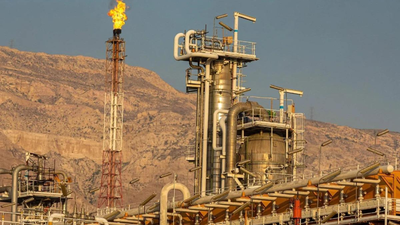
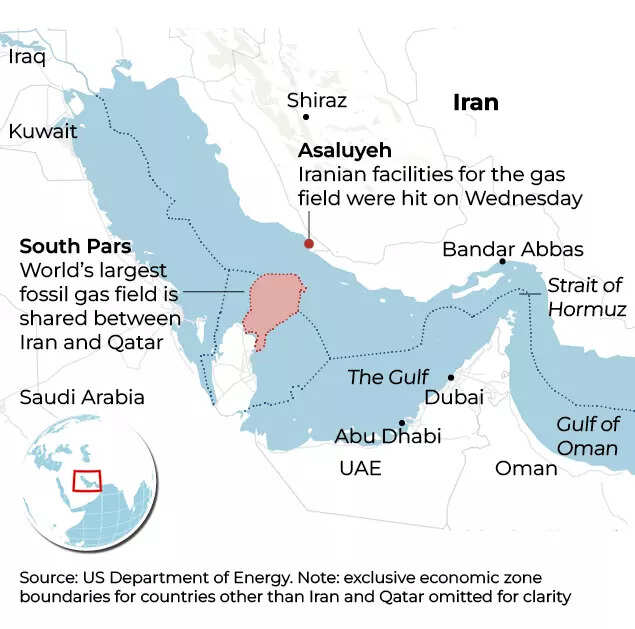
The already tense situation in the Middle East escalated sharply on Wednesday after Israel struck an Iranian production facility at the South Pars gas field, which Iran shares with Qatar across the Gulf. The attack comes amid a widening regional crisis triggered by a joint US-Israel military operation at the end of February that killed Iran’s long-serving leader Ayatollah Ali Khamenei.South Pars, the world’s largest gas field, is a key source of domestic energy for Iran, which already struggles with frequent gas and electricity shortages.
US President Donald Trump expressed surprise over the strike, saying, “The United States knew nothing about this,” and denied any involvement. However, according to AP reports, Washington had been informed in advance of Israel’s plans to target the offshore gas facility but did not take part in the operation.
“The United States knew nothing about this particular attack, and the country of Qatar was in no way, shape, or form, involved with it, nor did it have any idea that it was going to happen,” Trump wrote on Truth Social.
Poll
Should the international community intervene in the conflict between Israel and Iran?
Since the launch of the large-scale military campaign on February 28, Iran has expanded its retaliation beyond military targets to include oil and gas infrastructure across the region, raising global concerns given the Gulf’s importance in energy supply.Watch: Iran missile hits Qatar’s Ras Laffan, world’s largest LNG hubThe strike on South Pars marks the first time in the conflict that a major fossil fuel production facility has been directly targeted.
What has been targeted in recent days?
On Tuesday, an Iranian drone attack forced the suspension of operations at the Shah gas field in Abu Dhabi. The site produces around 1.28 billion standard cubic feet of gas per day and supplies about 20 percent of the UAE’s gas and 5 percent of the world’s granulated sulphur used in fertilisers.On Wednesday, Israel struck Iran’s South Pars gas field. The field is the largest in the world and a backbone of Iran’s energy system.
Why the South Pars strike matters
The South Pars gas field, the largest known in the world, spans around 9,700 square kilometres in the Persian Gulf.The damage to South Pars could worsen Iran’s already severe energy shortages. The field accounts for up to 70 percent of Iran’s gas production. Initial reports suggest that sections contributing nearly 12 percent of total output may have been affected.The strike has also raised fears of a wider escalation, with both sides now targeting critical energy infrastructure. Experts warn that such attacks could have long-term consequences for global energy markets.Oil prices have already risen after the strike, driven by concerns of supply disruptions. Analysts say that if production facilities suffer major damage, recovery could take years.It is estimated to hold about 51 trillion cubic metres of gas, according to the Guinness World Records.Oil prices have already surged following news of the strike, with Brent crude rising more than 5 percent to over $110 per barrel.The field is shared by Iran and Qatar, with the Qatari side discovered first in 1971.The strike also marks the first reported attack on Iran’s core energy infrastructure.
How the region is reacting
Iran has warned of further retaliation and listed major oil and gas sites in Saudi Arabia, the UAE and Qatar as potential targets. Explosions were later reported in Riyadh.Qatar blamed Israel for the attack, calling it a “dangerous and irresponsible” escalation that threatens global energy security. The UAE also warned that the strike poses risks to both regional stability and global energy supplies.
Why repairs may not be quick
Once the damage is done, repair is never straightforward and the aftermath can be long and devastating. Despite its scale and significance, the key question remains: can the South Pars gas field be repaired quickly?
Past experience suggests recovery may take far longer than expected. After the 2003 invasion of Iraq that toppled Saddam Hussein, rebuilding damaged energy infrastructure proved to be a slow and complex process.The Bush administration had pledged that reconstruction would be funded through oil revenues. However, even with access to facilities and nearly $2 billion spent on oil projects, it took more than two years for production to return to pre-war levels.More recently, efforts to repair Ukraine’s power infrastructure following Russian strikes have also faced major delays, with equipment shortages and logistical bottlenecks slowing progress.These examples highlight that restoring large-scale energy systems after conflict is a difficult and time-consuming task, raising concerns about how quickly South Pars can recover.
Bigger impact beyond energy
Energy production in the Gulf is not just about economics—it plays a key role in political stability and regional relations. Countries depend on energy revenues to support their economies and maintain social balance.The South Pars field has also acted as a bridge between Iran and Qatar in the past. The latest attack has raised concerns about how deeper conflict could disrupt not just energy supplies, but also fragile regional ties.With both sides continuing strikes and counterattacks, the situation risks spiralling further, putting critical global energy infrastructure under increasing threat.