

Take a look at the essential events, concepts, terms, quotes, or phenomena every day and brush up your knowledge. Here’s your UPSC Current Affairs knowledge nugget for today on Mahatma Gandhi’s Dandi March.
(Relevance: The Dandi March is one of the most important events of the Indian National Movement. The UPSC has also asked questions on these themes. In 2020, a question was asked about the Gandhi-Irwin Pact. Even though these are common themes, aspirants often mark incorrect answers in the Prelims. Therefore, it becomes essential to thoroughly prepare these topics.)
March 12 marks the 96th anniversary of the historic salt march or Dandi March led by Mahatma Gandhi from Sabarmati Ashram to Dandi in Gujarat. In this context, let’s know about the Dandi March and its significance.
Key Takeaways:
1. The 24-day march from March 12 to April 5, 1930 was a tax resistance campaign against the British salt monopoly. Based on Gandhi’s principle of non-violence or Satyagraha, the march marked the inauguration of the civil disobedience movement.
2. The Dandi march was easily the most significant organised movement against the British Raj after the non-cooperation movement of the early 1920s. In all the attention that it drove from the national and international media and world leaders, it was truly a turning point in the Indian Independence movement.
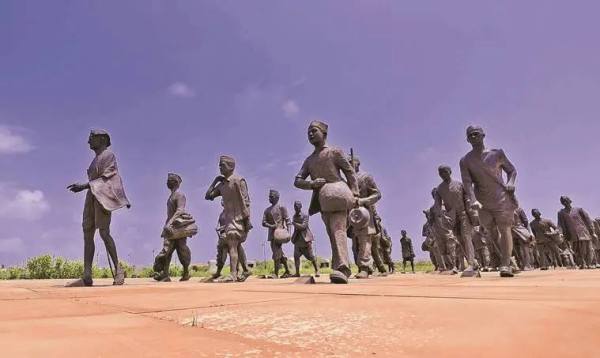 Dandi Salt Satyagraha Memorial in Dandi, Gujarat. (Photo: Nirmal Harindran)
Why did Gandhi choose ‘salt’?
The 1882 Salt Act gave the British a monopoly in the manufacture and sale of salt. Even though salt was freely available on the coasts of India, Indians were forced to buy it from the colonisers. Gandhi decided that if there was any one product through which civil disobedience could be inaugurated, then it was salt. Addressing a massive gathering in Ahmedabad on March 8, Gandhi declared his decision to break the salt laws.
From Salt Satyagraha to a Nationwide Civil Disobedience Movement
1. Notably, on 6 April 1930, Gandhi along with his followers defiantly broke the salt law by manufacturing salt from the sea. Gandhi told a representative of the Free Press, “With this, I am shaking the foundations of the British Empire.”
Story continues below this ad
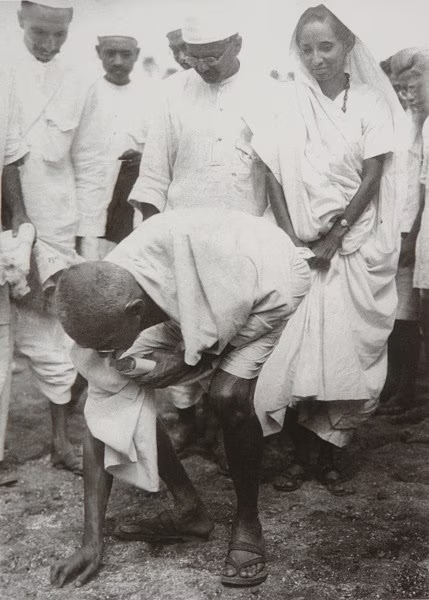 Gandhi during salt satyagraha. (Wikimedia Commons)
2. With this, the movement spread throughout the countryside. It is estimated that around 60,000 people were arrested by the British. According to the website of gandhismriti, Jawaharlal, Mahadev Desai, and Gandhi’s son Devdas were the first to be sent to jail. The British government declared the Indian National Congress as illegal. Gandhi informed the Viceroy that he was going to raid the government salt works at Dharasana. Before he could proceed, he was arrested and sent to Yeravda Central Jail.
3. After Gandhi’s arrest, Mr. Abbas Tyabji, took over the march to Dharsana but he was also arrested. Sarojini Naidu succeeded Abbas Tyabji who led the march but was met with police brutality.
4. Similar acts of civil disobedience took place in other parts of India. Several Colonial laws were broken along with a boycott of foreign cloth and liquor. What started as salt satyagraha soon grew into mass satyagraha. In Bengal, for instance, volunteers led by Satish Chandra Dasgupta walked from Sodepur Ashram to the village of Mahisbathan to make salt. K.F Nariman in Bombay led another group of marchers to Haji Ali Point where they prepared salt at a nearby park.
5. The anti-chowkidari (village police) tax along with non-payment of rent was followed in the raiyatwadi areas. There were many violent confrontations with the police and massive tribal invasions of forests in Central Provinces, Maharashtra, and Karnataka.
Story continues below this ad
6. In the North-West Frontier Province (NWFP), Khan Abdul Ghaffar Khan, popularly known as the Frontier Gandhi, raised a band of non-violent volunteers known as the Khudai Khidmatgars (Red Shirts), who played an active role in the movement. The volunteers were able to capture the town. However, the British were able to reoccupy it soon and unleashed brutality on the Red Shirts which was resisted by non-violence alone.
7. C. Rajagopalachari led the Civil Disobedience movement in Tamil Nadu. He organised a march from Trichinopoly to Vedaranniyam on the Tanjore coast to break the salt law in April 1930. This was followed by picketing of foreign cloth shops and an anti-liquor campaign.
8. In Malabar, Nair Congress leader, Kelappan, organised the salt march. Similarly, in Orissa, the Civil Disobedience movement was carried out under the leadership of Gopabandhu Chaudhary. In Bihar, leaders like Ram Briksha Benipuri, Prof Abdul Bari and Acharya Kripalani led the movement.
9. In Chittagong, a group of revolutionaries headed by Surjaya Sen launched a campaign against the British. They seized the local armoury and an Independence Proclamation was made in the name of the ‘Independent Republican Army’ and fought a pitched battle on the Jalalabad hill leading to the death of several revolutionaries.
Story continues below this ad
What was the Gandhi-Irwin pact?
1. Gandhi sent an 11-point ultimatum to Irwin on 31st January 1930. These were the 11 demands: Total prohibition, Reduction of the exchange ratio, Reduction of land revenue by 50%, Abolition of the salt tax, Reduction of military expenditure, Reduction of salaries of the highest-grade services, Protective tariff on foreign cloth, Passage of the Coastal Traffic Reservation Bill, Discharge of all political prisoners except those condemned for murder, Abolition of the C.I.D and Issue of licenses to use firearms, for self-defense.
2. When Irwin showed no inclination to meet the demands, Gandhi began his historic Salt March, the Dandi. On January 25, 1931, Viceroy Irwin announced the unconditional release of Gandhi and other Congress leaders to facilitate negotiations.
3. On 5th March 1931, the Gandhi-Irwin Pact was signed. It also came to be known as the Delhi Pact. This led to the release of all political prisoners who were not convicted of violence, remission of fines, and return of confiscated lands. Government employees who had resigned from service were treated leniently. The Congress agreed to end the Civil Disobedience Movement and take part in the Second Round Table Conference later that year.
BEYOND THE NUGGET: What is Gandhian Philosophy?
Generations to come, will scarce believe, that such a man as this one, ever in flesh and blood walked upon this earth. — Albert Einstein
This statement by Albert Einstein effectively captures the impact of Mahatma Gandhi and his philosophy. Einstein was deeply inspired by Gandhi’s teachings to the extent that he called him the most enlightened of all the politicians of his time. In this context, let’s delve into understanding the Gandhian Philosophy.
Story continues below this ad
1. Non-violence (Ahimsa): Mahatma Gandhi is known around the world as the apostle of non-violence. “Non-violence,” according to Gandhi, “is mightier than the mightiest weapon of destruction devised by the ingenuity of man”. The United Nations defines the term as a rejection of the “use of physical violence to achieve social or political change.”
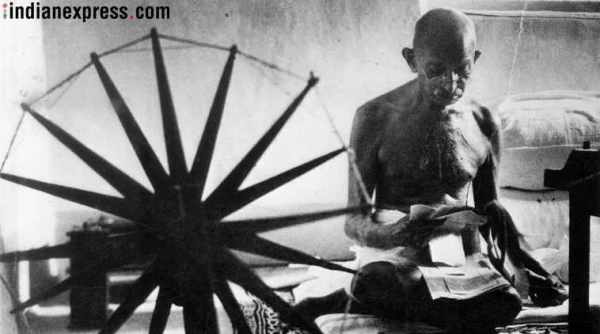 Mahatma Gandhi. (Express archive photo)
2. Satyagraha: Gandhi’s philosophy of Satyagraha, or truth-force, has inspired millions across India and the world. Satyagraha means holding on to the truth by non-violent resistance to evil, by refusing to submit to the wrong. The idea of Satyagraha draws its organic and spiritual energy from truth and non-violence.
3. Self-reliance (Swadeshi): Self-reliance was a key principle of Gandhian philosophy. Mahatma Gandhi wanted India to become self-reliant and prevent Indian money from being diverted to Britain.
4. Sarvodaya: The concept of Sarvodaya is another significant part of Gandhian philosophy. Sarvodaya is a Sanskrit term comprised of two words: “sarva” (all) and “udaya” (uplift), meaning ‘the uplift of all’, ‘the welfare of all’, or ‘progress of all’. The term was first coined by Gandhi as the title of his 1908 translation of John Ruskin’s tract on political economy, “Unto This Last”.
Story continues below this ad
5. Swaraj (self-rule) and Gram Swaraj: ‘To be able to live fearlessly’ is how Mahatma Gandhi defined swaraj in Hind Swaraj.”Gram Swaraj” is another concept of rural reconstruction proposed by Mahatma Gandhi before India’s independence. It focuses on the holistic development of society, placing individuals at the center of the economic system.
Post Read Question
The Gandhi-Irwin Pact included which of the following? (UPSC CSE 2020)
1. Invitation to Congress to participate in the Round Table Conference
2. Withdrawal of Ordinances promulgated in connection with the Civil Disobedience Movement
Story continues below this ad
3. Acceptance of Gandhiji’s suggestion for enquiry into police excesses
4. Release of only those prisoners who were not charged with violence
Select the correct answer using the code given below:
(a) 1 only
(b) 1, 2 and 4 only
(c) 3 only
(d) 2, 3 and 4 only
(Sources: What was the significance of Mahatma Gandhi’s Dandi March, UPSC Issue at a Glance | Gandhi’s Philosophy in Constitution and Government Policies.)
Subscribe to our UPSC newsletter. Stay updated with the latest UPSC articles by joining our Telegram channel – Indian Express UPSC Hub, and follow us on Instagram and X.
Story continues below this ad
🚨 Click Here to read the UPSC Essentials magazine for February 2026. Share your views and suggestions in the comment box or at manas.srivastava@indianexpress.com🚨